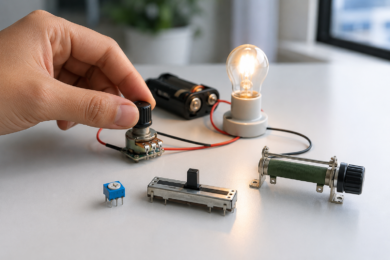
A Variable Resistor is one of those small electronic components that quietly does a lot of important work. You may not notice it, but it can control volume, adjust brightness, tune a circuit, change motor speed, and help sensors respond to movement or position.
In simple words, it is a resistor whose resistance value can be changed. A fixed resistor has one set resistance value, while a Variable Resistor lets you increase or decrease resistance as needed. That simple adjustment gives circuit designers much more control.
You will find it in radios, audio equipment, lighting controls, lab circuits, robotics projects, test equipment, power supplies, and many everyday electronic devices.
What Is a Variable Resistor?
A Variable Resistor is an electrical component used to change resistance in a circuit. Resistance affects how much current flows through a circuit. When resistance increases, current usually decreases. When resistance decreases, current usually increases.
This makes the component useful when a circuit needs adjustment instead of one fixed setting.
For example, think about a volume knob on an old radio. When you turn the knob, you are not just moving plastic. Inside, a resistive track and a moving contact change the electrical signal level. That change makes the sound louder or softer.
A Variable Resistor usually works through a moving contact called a wiper. The wiper slides or rotates across a resistive material. As the contact position changes, the effective resistance changes too. Electronics references commonly describe this part as an adjustable resistor used to vary resistance or control current in a circuit.
Why Variable Resistors Matter in Electronics
Modern electronics often need flexible control. A circuit may work fine on paper, but real parts have tolerances, temperature changes, and different load conditions. A Variable Resistor helps adjust the circuit after assembly.
It can be used for:
- Setting the sensitivity of a sensor
- Adjusting audio volume
- Dimming lights
- Controlling motor speed
- Calibrating measuring equipment
- Tuning signal levels
- Creating adjustable voltage outputs
This is why these components are common in both beginner electronics and professional circuit design.
A fixed resistor is useful when the circuit needs one stable value. A Variable Resistor is better when the circuit needs adjustment, tuning, or user control.
How a Variable Resistor Works
The basic working idea is simple.
Inside the part, there is a resistive element. This element may be made from carbon, wire, cermet, conductive plastic, or another resistive material. A moving contact touches the resistive path.
When the contact moves, the current has to pass through more or less resistive material. That changes the resistance value.
In many designs, the component has three terminals:
- One terminal connects to one end of the resistive track
- Another terminal connects to the other end
- The middle terminal connects to the moving wiper
When all three terminals are used, the part often works as a voltage divider. When only two terminals are used, it can work as a rheostat to vary resistance in series with a load.
Main Types of Variable Resistor
There are several types, and each one is made for a slightly different job. The most common types are potentiometers, rheostats, presets, trimmers, and digital potentiometers.
1. Potentiometer
A potentiometer is probably the most familiar type of Variable Resistor. It normally has three terminals and is often used to divide voltage.
You see potentiometers in:
- Volume controls
- Tone controls
- Joystick position sensing
- User adjustment knobs
- Analog input controls
- Sensor calibration circuits
A potentiometer can be rotary or linear. A rotary potentiometer turns like a knob. A linear potentiometer slides back and forth.
In a circuit, the output voltage from the wiper changes as the knob or slider moves. That makes it very useful for controlling signal levels. Electronics learning resources describe a potentiometer as a three-wire resistive device that can produce a continuously variable voltage output from the wiper position.
2. Rheostat
A rheostat is used mainly to control current. It usually works with two terminals, even if the physical component has three.
A rheostat is commonly used where higher current control is needed. Traditional examples include lamp dimming, heater control, motor speed adjustment, and generator testing.
The big difference is purpose. A potentiometer is often used for voltage division and signal adjustment. A rheostat is usually used in series with a load to control current.
Britannica describes a rheostat as an adjustable resistor used when current or resistance must be varied in an electrical circuit.
3. Preset Variable Resistor
A preset is a small adjustable resistor used for one-time or occasional circuit tuning. It is usually adjusted with a screwdriver rather than a hand knob.
You may find presets inside:
- Power supplies
- Sensor modules
- Audio boards
- Measuring instruments
- Small control circuits
A preset is not meant for daily user control. It is more like a hidden setting for technicians or manufacturers.
For example, a sensor board may have a preset to adjust its trigger level. Once the correct level is set, the user may never touch it again.
4. Trimmer Potentiometer
A trimmer potentiometer is similar to a preset, but it is often used where fine adjustment is needed. It may be very small and mounted directly on a printed circuit board.
Trimmers are common in:
- Oscillator circuits
- Calibration circuits
- Radio-frequency tuning
- Precision measuring devices
- Small analog control systems
They are helpful when a circuit needs exact adjustment during testing or repair.
5. Digital Potentiometer
A digital potentiometer performs a similar job to a regular potentiometer, but it is controlled electronically rather than manually.
Instead of turning a knob, a microcontroller or digital system changes the resistance setting.
Digital potentiometers are used in:
- Smart audio systems
- Automated calibration
- Programmable gain circuits
- Consumer electronics
- Embedded systems
- Remote-controlled devices
They are useful when settings need to be saved, changed by software, or adjusted automatically.
Potentiometer vs Rheostat: What Is the Difference?
Many people confuse potentiometers and rheostats because both are adjustable resistive components. The difference is mostly in how they are wired and used.
| Feature | Potentiometer | Rheostat |
|---|---|---|
| Common terminals used | Three | Two |
| Main function | Voltage division | Current control |
| Common use | Signal level adjustment | Load current adjustment |
| Example | Volume knob | Lamp dimmer or motor control |
| Load handling | Usually lower power | Often higher power |
A potentiometer can sometimes be wired as a rheostat by using the wiper and one end terminal. But in normal use, a potentiometer is more about creating an adjustable voltage, while a rheostat is more about changing current flow.
Common Uses of Variable Resistor in Real Life
A Variable Resistor is not just a classroom component. It is used in real products and practical circuits.
Audio Volume Control
One of the easiest examples is audio volume control. In older radios, speakers, amplifiers, and mixers, a potentiometer adjusts the signal level before amplification.
Turn the knob one way, and the signal becomes stronger. Turn it the other way, and the signal becomes weaker.
This is a simple but powerful use. It gives the user direct control without changing the whole circuit.
Light Dimming
A rheostat or electronic dimming circuit can control the brightness of a lamp. In older systems, resistance was adjusted to reduce current and dim the light.
Modern dimmers often use more efficient electronic methods, but the basic idea of control through changing electrical behavior is still important.
Motor Speed Control
A Variable Resistor can help control the speed of small DC motors by adjusting current or control voltage.
For example, a small hobby motor controller may use a potentiometer as an input. The actual power control may be handled by a transistor or motor driver, but the knob tells the circuit how fast the motor should run.
This is common in robotics, fans, small machines, and laboratory test setups.
Sensor Calibration
Many sensors do not work perfectly with one fixed setting. A light sensor, temperature sensor, or proximity sensor may need adjustment depending on the environment.
A small trimmer lets the user or technician set the correct threshold.
For example, a light-sensitive circuit may turn on an LED when the room gets dark. A trimmer can set how dark the room must be before the LED turns on.
Power Supply Adjustment
Adjustable power supplies often use potentiometers to set output voltage or current limit.
When you turn the knob on a bench power supply, you are changing the reference or feedback level inside the circuit. The power supply then adjusts its output.
This gives engineers and technicians safe control while testing different devices.
Position Sensing
A potentiometer can also work as a position sensor. When attached to a moving part, the wiper position changes as the part moves.
This method is used in:
- Joysticks
- Pedals
- Servo feedback
- Control levers
- Mechanical angle sensing
It is simple, low-cost, and easy to read with analog electronics or a microcontroller.
Practical Example: Using a Variable Resistor with an LED
Imagine a simple LED circuit with a battery, resistor, and LED. If the resistor value is fixed, the LED brightness stays mostly the same.
Now replace the fixed resistor with a Variable Resistor in series. As resistance increases, less current flows through the LED, and the LED becomes dimmer. As resistance decreases, more current flows, and the LED becomes brighter.
However, there is one important safety point. You should not reduce resistance too far, because too much current can damage the LED.
A good practice is to place a fixed resistor in series with the Variable Resistor. The fixed resistor acts as a safety limit.
For example:
- Battery: 9V
- LED: standard red LED
- Fixed resistor: 330 ohms
- Variable Resistor: 1k ohm
The fixed resistor protects the LED, while the adjustable part controls brightness within a safer range.
Practical Example: Volume Control in an Audio Circuit
In a basic audio circuit, a potentiometer can be connected as a voltage divider.
The input audio signal goes across the two outside terminals. The output is taken from the wiper. As the knob turns, the wiper receives a larger or smaller portion of the input signal.
This changes the audio level before it reaches the amplifier.
That is why potentiometers are so common in audio equipment. They are simple, cheap, and effective.
For smooth volume control, audio circuits often use logarithmic potentiometers rather than linear ones. Human hearing does not respond to sound changes in a perfectly linear way, so a logarithmic taper usually feels more natural when turning the knob.
Practical Example: Adjusting Sensor Sensitivity
Suppose you are building a light-activated night lamp. The lamp should turn on when the room becomes dark.
The circuit uses a light-dependent resistor and a comparator. But different rooms have different lighting conditions. A fixed threshold may not work well everywhere.
A trimmer Variable Resistor can set the trigger point.
In a bedroom, you may want the light to turn on only when it is almost dark. In a hallway, you may want it to turn on earlier. The adjustable resistor makes this possible without redesigning the circuit.
Variable Resistor Values and Ratings
When choosing a Variable Resistor, value matters. Common values include:
- 1k ohm
- 5k ohm
- 10k ohm
- 50k ohm
- 100k ohm
- 1M ohm
The right value depends on the circuit.
A low-value resistor may allow more current. A high-value resistor allows less current and is often used in signal circuits.
Power rating also matters. A small potentiometer may only handle a small amount of power. A rheostat used for motor or lamp control may need a much higher power rating.
If the part overheats, smells burnt, or changes value unexpectedly, it may be under-rated for the job.
Linear Taper vs Logarithmic Taper
Not all Variable Resistor parts change value in the same way.
A linear taper changes resistance evenly as the knob turns. If the knob is turned halfway, the resistance is roughly halfway too.
A logarithmic taper changes resistance in a curved way. This is useful for audio volume because human hearing responds better to logarithmic changes.
Here is a simple comparison:
| Taper Type | How It Changes | Best Use |
|---|---|---|
| Linear | Even change across rotation | Sensors, general control, test circuits |
| Logarithmic | Slow then faster change, or similar curve | Audio volume controls |
| Reverse log | Opposite of log taper | Special audio or control circuits |
Choosing the wrong taper can make the control feel strange. For example, a linear pot used for audio volume may feel like most of the useful control happens in one small part of the knob movement.
Key Specifications to Check Before Buying
Before choosing a Variable Resistor, check these details:
- Resistance value
- Power rating
- Tolerance
- Taper type
- Number of turns
- Mounting style
- Shaft size
- Physical size
- Terminal layout
- Expected lifespan
- Environmental rating
For basic hobby projects, a 10k linear potentiometer is often a safe starting point for signal control. For power circuits, you need to calculate current and power carefully.
A simple rule is this: never choose a part only because it fits physically. Make sure it fits electrically too.
Common Mistakes Beginners Make
A Variable Resistor is easy to use, but a few mistakes happen often.
Using It Without a Current-Limiting Resistor
Beginners sometimes connect an LED directly with an adjustable resistor. If the knob is turned too far, resistance can become very low, and the LED may burn out.
Always use a safe fixed resistor where needed.
Confusing the Middle Pin
On a potentiometer, the middle pin is usually the wiper. If the pins are wired incorrectly, the circuit may work backward or not work at all.
A multimeter can help identify which terminal is which.
Using a Low-Power Part in a High-Power Circuit
Small trimmers and potentiometers are not made to handle heavy current. Using them in motor or lamp circuits can overheat the part.
For higher current, use a proper rheostat or use the potentiometer only as a control input for a transistor, MOSFET, or driver circuit.
Choosing the Wrong Resistance Value
If the resistance value is too low, the circuit may draw too much current. If it is too high, the circuit may not respond properly.
Always match the component value to the circuit design.
How to Test a Variable Resistor with a Multimeter
Testing is simple.
Set the multimeter to resistance mode. Connect the probes to the two outside terminals first. You should see the total resistance value, such as 10k ohms.
Then connect one probe to the middle terminal and the other probe to one outside terminal. Turn the knob slowly.
The resistance should change smoothly.
If the value jumps, cuts out, or behaves randomly, the part may be dirty or damaged.
For older audio equipment, crackling sounds when turning a volume knob often come from dust or wear inside the potentiometer.
When Should You Use a Variable Resistor?
Use it when a circuit needs adjustment.
Good reasons include:
- The user needs manual control
- The circuit needs calibration
- A sensor threshold must be adjustable
- A signal level needs tuning
- A prototype needs testing flexibility
- A device needs position feedback
- The ideal resistance value is not known yet
Avoid using it as a cheap shortcut in high-power circuits unless the part is rated for that job. In many modern designs, a small potentiometer controls a separate power-handling device instead of carrying the full load itself.
Variable Resistor in Modern Electronics
Even though digital electronics are everywhere, the Variable Resistor is still useful. In fact, it often connects the physical world to electronic control.
A knob feels natural. A slider is easy to understand. A trim adjustment gives engineers flexibility. A digital potentiometer lets software adjust analog behavior.
This balance is why variable resistance still matters in electronics.
It is not just an old-fashioned component. It is a practical bridge between user input, analog signals, sensors, and control circuits.
Is a Variable Resistor the Same as a Potentiometer?
Not always.
A potentiometer is a type of Variable Resistor, but not every adjustable resistor is used as a potentiometer.
Think of it this way:
A Variable Resistor is the broad category. A potentiometer is one common type. A rheostat is another common use or configuration.
When all three terminals are used for voltage division, people usually call it a potentiometer. When two terminals are used to control current, people often call it a rheostat.
Final Thoughts
A Variable Resistor may look like a small and simple part, but it gives electronic circuits something very valuable: control. It lets users adjust settings, helps technicians fine-tune circuits, and allows designers to build flexible systems instead of fixed ones.
From volume knobs and dimmer controls to sensor tuning and motor speed adjustment, this component appears in many practical places. Once you understand how resistance affects current and voltage, it becomes much easier to see why this part is so useful.
For readers learning electronics, the best way to understand it is to test one with a multimeter, add it to a simple LED circuit, and watch how the behavior changes. That hands-on experience makes the theory feel real. It also gives you a better understanding of Ohm’s law, which connects voltage, current, and resistance in a circuit.
In the end, a Variable Resistor is not just a component you memorize for exams. It is a real-world control tool used in everyday electronics, repair work, prototyping, and circuit design.
FAQs
What is the main purpose of a Variable Resistor?
The main purpose of a Variable Resistor is to adjust resistance in a circuit. This allows control over current, voltage, signal level, sensitivity, or calibration depending on the circuit design.
What are the common types of Variable Resistor?
The common types include potentiometers, rheostats, presets, trimmer potentiometers, and digital potentiometers. Potentiometers are often used for voltage control, while rheostats are more commonly used for current control.
Can a Variable Resistor control LED brightness?
Yes, it can control LED brightness by changing current flow. However, a fixed resistor should usually be added in series to protect the LED from too much current.
What is the difference between a potentiometer and a rheostat?
A potentiometer usually uses three terminals and works as a voltage divider. A rheostat usually uses two terminals and controls current by changing resistance in series with the load.
Where is a Variable Resistor used in daily life?
It is used in volume controls, dimmer switches, sensor modules, joystick controls, power supplies, test circuits, motor control systems, and many electronic devices.