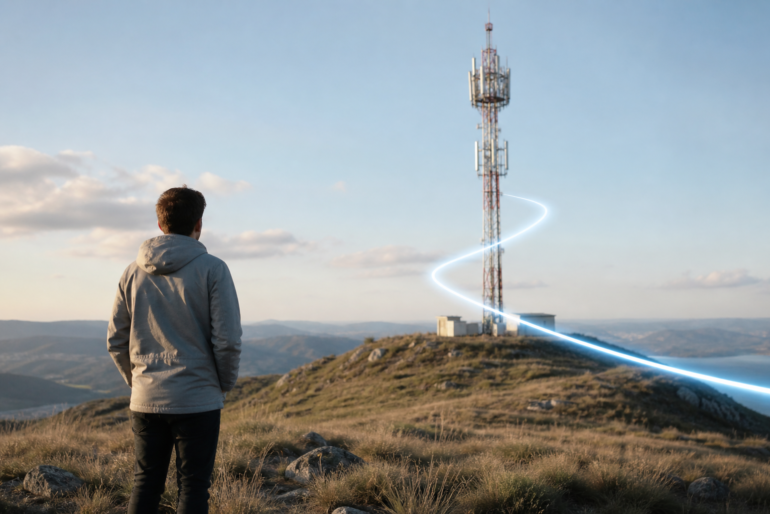
A Radio Bearer sounds like one of those telecom terms only engineers need to care about. But it actually explains something every mobile user experiences daily: how your phone keeps video calls smooth, messages quick, apps responsive, and internet data moving between your device and the mobile network.
Think of it like a dedicated path over the air between your phone and the cell tower. When you open YouTube, send a WhatsApp message, join a Zoom call, or browse a website, your data does not simply “float” through the air randomly. The network organizes that traffic using logical channels, rules, priorities, and quality settings.
That is where this concept becomes important.
In mobile networks like LTE and 5G, a Radio Bearer helps carry either control messages or user data between your device and the radio access network. In simple words, it is part of the system that makes mobile communication reliable instead of chaotic.
Modern networks are built to handle millions of devices at the same time. Phones, tablets, smartwatches, connected cars, security cameras, and industrial sensors all compete for wireless resources. Without proper traffic handling, the network would quickly become slow, unstable, and unpredictable.
A Radio Bearer helps the network decide how different types of traffic should be treated. A voice call may need low delay. A video stream may need steady bandwidth. A software update can wait a little longer. The bearer structure gives the network a smarter way to manage all of that.
What Is a Radio Bearer in Simple Terms?
A Radio Bearer is a logical connection used to carry information between user equipment, such as a smartphone, and the mobile network over the air interface.
It is not a physical wire. It is not a visible signal path. Instead, it is a managed communication route created inside the radio network.
The mobile network uses it to decide how data should move, how much priority it should receive, and what quality level should be maintained.
A simple way to understand it is this:
Your phone talks to the cell tower using radio waves. But inside those radio waves, the network separates different kinds of communication into organized paths. Each path has a purpose.
Some paths carry network control messages. Others carry your actual internet data.
That organized path is what telecom engineers call a bearer.
In LTE networks, the base station, called an eNodeB, maps core network bearer quality settings to radio bearer quality settings before sending reconfiguration instructions to the device. ETSI’s LTE specification describes this mapping between EPS bearer QoS and Radio Bearer QoS during network procedures.
In 5G, the idea becomes more flexible because the network has to support more types of services, including high-speed broadband, low-latency communication, IoT devices, and enterprise applications.
Why Mobile Networks Need Bearers
Mobile networks are busy places. Every second, countless devices are requesting access, sending data, receiving updates, switching cells, and maintaining connections.
If every packet of data were treated the same way, users would notice problems quickly.
A video call might freeze because a background app update is using resources. A gaming session might lag because the network does not know it needs lower delay. An emergency or control message might get stuck behind normal browsing traffic.
Bearers solve this by giving the network a way to classify, prioritize, and control traffic.
They help with:
- Connection setup
- Data transfer
- Network signaling
- Quality of service
- Traffic separation
- Mobility management
- Reliable communication
- Efficient use of radio resources
This is especially important in 5G because not all services have the same needs. A smart meter, a self-driving vehicle, a video streaming app, and a factory robot do not use the network in the same way.
The network must understand the difference.
Radio Bearer vs Normal Internet Connection
Many people imagine mobile internet as one simple connection from phone to tower. In reality, it is layered and controlled.
When you connect to mobile data, your phone is not just getting one open pipe to the internet. It is establishing several communication relationships with the network.
Some are used to keep the connection alive. Some are used for security. Some are used for actual app data.
A Radio Bearer sits inside this bigger system. It handles the radio-side part of communication between the device and the radio access network.
Here is a basic comparison:
| Term | Simple Meaning | Main Purpose |
|---|---|---|
| Radio Bearer | Logical radio path between device and network | Carries signaling or data over the air |
| Core Network Bearer | Network-side traffic path beyond the radio network | Carries data through the mobile core |
| QoS Flow | 5G quality-based traffic flow | Defines how traffic should be treated |
| RRC Connection | Control relationship between phone and network | Manages radio connection behavior |
This structure may sound technical, but it is what allows mobile networks to handle different apps in smarter ways.
Types of Radio Bearers
There are two main types commonly discussed in LTE and 5G systems: signaling bearers and data bearers.
Both are important, but they do different jobs.
Signaling Radio Bearer
A Signaling Radio Bearer carries control messages between the device and the network.
These messages are not your app data. They are the instructions that help your phone connect, authenticate, move between cells, update network settings, and maintain communication.
For example, when your phone attaches to a network or moves from one tower to another, it must exchange control information. That information travels through signaling bearers.
Without this layer, your phone would not know how to behave inside the network. It would not know when to change cells, how to configure radio settings, or how to maintain the connection.
In simple terms, signaling bearers are like the traffic control system of the mobile network.
They help the phone and tower stay coordinated.
Data Radio Bearer
A Data Radio Bearer carries user data.
This is where your browsing, streaming, messaging, video calls, gaming traffic, and app data move across the radio interface.
When you open a website or stream a song, the user-plane traffic needs a managed path. The data bearer provides that path.
The network can assign different handling rules depending on the type of service. For example, a voice call may need more consistent low-latency treatment than a file download.
This is why your phone can often keep a voice call stable even while other apps are using the internet in the background.
The system is not perfect, of course. Coverage, congestion, device quality, frequency band, and network load still matter. But bearers help the network make better traffic decisions.
How Radio Bearer Works in LTE
LTE, often called 4G LTE, uses a bearer-based architecture to manage traffic between the device, radio access network, and core network.
When your phone connects to LTE, the network sets up bearers based on service requirements. These bearers are connected with quality parameters such as priority, delay budget, and packet loss expectations.
The eNodeB plays a central role. It manages the radio side of the connection and maps network-level service requirements to radio-level behavior.
For example, if a certain app session requires a specific quality level, the LTE network may use bearer settings to help manage that traffic.
In LTE, bearers are closely tied to Quality of Service, often shortened to QoS. QoS is simply the network’s method of deciding which traffic needs what kind of treatment.
Not all data is equal.
A real-time voice call needs quick and stable delivery. A movie download can tolerate more delay. A chat message uses very little bandwidth but should still feel instant.
The LTE bearer system helps support these differences.
ETSI documentation on LTE radio resource control also references functions such as QoS control, radio bearer configuration, mobility, and recovery from radio link failure, showing how deeply bearers fit into radio network operation.
How Radio Bearer Works in 5G
5G keeps the same basic need, but the architecture becomes more advanced.
The radio technology used in 5G is called New Radio, or NR. 3GPP explains that NR is the radio technology for 5G and is specified in the 38-series technical specifications, including the overall NG-RAN description.
In 5G, bearers are part of a broader quality and service framework. Instead of only thinking in older LTE-style bearer terms, 5G introduces a more flexible model built around QoS flows and the 5G Core.
The network can map different QoS flows to data radio bearers. This helps 5G support very different services on the same infrastructure.
That matters because 5G is not just about faster phone internet.
It is also designed for:
- Enhanced mobile broadband
- Ultra-reliable low-latency communication
- Massive IoT connections
- Private industrial networks
- Smart city systems
- Connected vehicles
- Remote monitoring
- Cloud gaming and AR applications
A single 5G network may need to serve a person watching 4K video, a hospital device sending critical data, and thousands of sensors reporting small updates.
The bearer and QoS structure makes this more manageable.
Radio Bearer and QoS: Why Quality Matters
Quality of Service is one of the most important ideas connected to a Radio Bearer.
QoS tells the network how traffic should be handled. It can include things like priority, delay sensitivity, packet loss tolerance, and guaranteed bit rate.
Imagine a highway with different lanes.
Some lanes are for emergency vehicles. Some are for regular cars. Some are for heavy trucks. The road is shared, but traffic is organized based on need.
Mobile networks work in a similar way.
A live video call should not be treated exactly like a background photo backup. One is sensitive to delay. The other can wait.
QoS helps the network make these decisions, while bearers provide the managed path over the radio interface.
This is one reason modern mobile networks feel much more responsive than older systems. They are not only faster. They are also better at managing different traffic types.
Real-World Example: Video Call on 5G
Let’s say you are on a 5G video call while walking through a busy city.
Your phone is connected to a nearby 5G base station, known as a gNodeB. Your video call data needs to travel from your phone to the network and back with low delay.
At the same time, your phone may also be syncing email, checking app notifications, updating location, and loading background content.
The network must decide which traffic deserves faster handling.
Your video call is time-sensitive. If packets arrive too late, the call freezes or becomes choppy. Your email sync, however, can tolerate a short delay.
The network uses bearer and QoS mechanisms to separate these traffic types and manage them properly.
That is why a well-designed 5G network can support smooth real-time apps even when many users are connected in the same area.
Of course, this depends on signal strength, network capacity, backhaul quality, and operator configuration. Bearers help, but they do not magically fix poor coverage or overloaded cells.
Real-World Example: Smart Factory Network
Now imagine a factory using a private 5G network.
Inside the factory, machines, sensors, robots, tablets, and cameras are all connected. Some devices send small sensor readings. Others require low-latency control signals. Security cameras may upload video streams continuously.
Each type of traffic has different needs.
A robot control signal may need extremely low delay. A temperature sensor can send small updates every few seconds. A security camera needs steady upload capacity.
A Radio Bearer allows the radio network to organize these flows more intelligently.
This is one reason 5G is important for industries, not just smartphone users. It gives network designers more control over how different services perform.
Radio Bearer in 5G Network Slicing
Network slicing is one of the most talked-about 5G features.
It allows operators to create virtual network slices for different use cases. One slice could serve consumer broadband. Another could serve industrial automation. Another could support emergency services.
Radio bearers do not create slicing by themselves, but they help carry the traffic that belongs to different services across the radio access network.
For example, a hospital slice may have stricter reliability and delay requirements than a general browsing slice. The radio network still needs to deliver traffic according to those requirements.
That is where bearer configuration, QoS flows, scheduling, and radio resource management all work together.
Network slicing sounds abstract, but the goal is simple: give different services the network behavior they actually need.
Why Radio Bearer Matters for 5G Performance
Most users judge a mobile network by speed bars, download tests, and signal strength. Those things matter, but they do not tell the whole story.
Performance also depends on how intelligently the network handles traffic.
A Radio Bearer matters because it supports:
- Better traffic separation
- More predictable app performance
- Lower delay for sensitive services
- Stronger connection management
- More efficient radio resource use
- Improved support for voice, video, and data
- Better service handling in crowded areas
In real life, this can affect how quickly a web page loads, how stable a video call feels, or how well a gaming session performs on mobile data.
It can also affect enterprise use cases where reliability is more important than raw speed.
A factory robot does not care about winning a speed test. It cares about predictable delay and stable delivery.
Common Misunderstandings About Radio Bearer
Because this topic is technical, it is easy to misunderstand.
One common mistake is thinking a bearer is the same as a frequency band. It is not.
A frequency band is the spectrum used for radio transmission. A bearer is a logical communication path within the network architecture.
Another mistake is thinking it is the same as a physical channel. Again, not exactly. Physical channels carry signals at the radio layer, while bearers are higher-level logical structures used for organizing communication.
Some people also assume bearers only matter to telecom engineers. That is partly true, because regular users do not configure them manually. But their impact shows up in everyday mobile performance.
When a network handles voice, video, browsing, and background data smoothly, bearer management is part of the reason.
Radio Bearer vs QoS Flow in 5G
In 5G, the relationship between QoS flows and bearers is especially important.
A QoS flow defines how a specific traffic flow should be treated. The network then maps QoS flows to radio bearers so that the radio access network can carry that traffic properly.
This gives 5G more flexibility than older architectures.
For example, multiple QoS flows may be mapped in ways that help the network balance efficiency and performance. The goal is to avoid wasting radio resources while still meeting service requirements.
This matters because 5G must support many traffic types at once.
A video streaming app, a connected vehicle system, and an IoT sensor network cannot all be handled with one basic rule. The network needs a more detailed system.
That is why 5G uses a more advanced quality framework.
What Happens When Bearer Setup Fails?
When bearer setup fails, the user may notice connection problems.
The phone might show mobile signal but fail to load data. A call might drop. An app may stay stuck while trying to connect. In some cases, the device may need to reconnect to the network.
Bearer issues can happen because of several reasons:
- Poor radio signal
- Network congestion
- Authentication problems
- Core network failure
- Misconfigured network settings
- Device software bugs
- Handover problems between cells
For regular users, the fix may be as simple as toggling airplane mode, restarting the phone, or moving to a stronger signal area.
For telecom teams, troubleshooting is much deeper. Engineers may check logs, bearer setup messages, QoS mapping, RRC signaling, handover events, and radio performance counters.
This is one reason the concept remains important in network optimization.
How Engineers Use Radio Bearer Information
Network engineers do not only look at signal strength. They study how connections behave.
Bearer-related data can help engineers understand whether a network is serving traffic properly.
They may look at:
- Bearer setup success rate
- Bearer drop rate
- Data bearer throughput
- Signaling performance
- QoS handling
- Latency behavior
- Handover stability
- Congestion patterns
If many users in one area experience bearer failures, the issue may be related to capacity, interference, configuration, or coverage.
By analyzing these patterns, operators can improve network reliability.
For example, if video users are facing frequent drops in a stadium, engineers may adjust radio parameters, add small cells, increase capacity, or tune QoS policies.
This is where technical concepts become real customer experience improvements.
How Radio Bearer Affects Everyday Users
You do not need to know the term to feel its impact.
When your phone switches smoothly from one tower to another, bearer management is involved. When your video call keeps working while you move through the city, bearer handling matters. When your apps remain connected even in a busy mall, the network is managing radio resources behind the scenes.
A Radio Bearer helps support the invisible structure behind mobile data.
Users usually notice it only when something goes wrong.
If a bearer drops or is not configured correctly, the experience may feel like weak internet, even if signal bars look fine. That is because signal strength alone does not guarantee proper data service.
A phone can “see” the tower but still have trouble maintaining the right network session.
Radio Bearer and Low Latency in 5G
Low latency is one of 5G’s biggest promises.
Latency means delay. In mobile networks, it refers to how long it takes data to travel from your device to the network and back.
For normal browsing, a little delay may not matter much. For online gaming, remote driving, industrial control, or augmented reality, delay matters a lot.
Bearer configuration helps support low-latency services by allowing traffic to be handled with the right priority and quality settings.
The bearer alone is not the only factor. Latency also depends on radio conditions, network architecture, edge computing, routing, device capability, and server location.
Still, without proper bearer and QoS handling, low-latency service would be much harder to deliver reliably.
Radio Bearer and Voice Services
Voice over LTE and voice over 5G need careful handling because voice is time-sensitive.
A short delay or packet loss can affect call quality. Too much delay makes conversation feel awkward. Too much packet loss causes robotic or broken audio.
The network uses managed service handling to keep voice traffic stable.
In LTE, voice services often rely on IMS and dedicated QoS treatment. In 5G, voice may be delivered through Voice over NR or fall back to LTE depending on operator deployment.
Either way, radio-side traffic management remains important.
The user simply hears a clear call. The network is doing a lot of work behind the scenes.
Is Radio Bearer Only Used in 5G?
No. The idea existed before 5G.
LTE uses radio bearers. Earlier cellular systems also had their own forms of logical radio channels and bearer concepts. 5G builds on the idea and adapts it for a more flexible service-based architecture.
What changes in 5G is not the need for bearers, but the way traffic quality is handled across the full system.
5G has to support more device types, more service categories, and more performance expectations than older networks.
That makes bearer management more important, not less.
Why This Topic Matters for Students and Tech Readers
If you are learning telecom, networking, or 5G architecture, this is one of those concepts that connects theory with real network behavior.
Understanding Radio Bearer helps you make sense of:
- How LTE and 5G organize traffic
- Why QoS matters
- How phones communicate with towers
- Why some apps need priority
- How network engineers troubleshoot failures
- Why 5G is more than just speed
It is also useful for people working in mobile testing, network planning, telecom support, cloud gaming, IoT, or private 5G projects.
You do not need to memorize every protocol message to understand the big picture. Start with the basic idea: the network creates organized radio paths for control and data.
Once that clicks, the rest of the architecture becomes easier to follow.
Practical Tips to Understand Radio Bearer Better
A good way to learn this topic is to connect it with apps you already use.
Think about a video call. It needs low delay, steady data, and reliable delivery.
Think about a file download. It needs bandwidth, but it can tolerate more delay.
Think about a smart sensor. It may send tiny updates but needs battery efficiency and reliable access.
Now ask: should the network treat all of these the same?
The answer is clearly no.
That is the practical reason bearers exist.
If you are studying deeper telecom topics, learn these ideas together:
- RRC signaling
- Data Radio Bearer
- Signaling Radio Bearer
- QoS flow
- 5G Core
- NG-RAN
- eNodeB and gNodeB
- Packet scheduling
- Handover
- Radio resource management
These terms may seem separate at first, but they are all part of the same mobile communication story.
Frequently Asked Questions
What does Radio Bearer mean?
Radio Bearer means a logical radio connection used to carry signaling or user data between a mobile device and the radio access network. It helps the network organize how information travels over the air.
Why is Radio Bearer important in 5G?
It is important in 5G because the network must handle many service types, including video streaming, gaming, IoT, voice, industrial systems, and low-latency applications. Bearers help the network carry traffic with the right quality treatment.
What is the difference between SRB and DRB?
SRB stands for Signaling Radio Bearer. It carries control messages. DRB stands for Data Radio Bearer. It carries user data such as app traffic, browsing, calls, and streaming data.
Does Radio Bearer affect internet speed?
It can affect the overall experience, but it is not the only factor. Speed also depends on signal strength, network congestion, spectrum, device capability, backhaul, and operator configuration.
Is Radio Bearer visible to mobile users?
No, users do not see it directly. It works inside the mobile network. Users only notice the result through better or worse connection quality.
Conclusion
A Radio Bearer may sound like a small technical detail, but it plays a major role in how mobile networks actually work. It gives the radio access network a structured way to carry control messages and user data between your phone and the cell tower.
In LTE, it helps map service quality to the radio connection. In 5G, it becomes part of a more flexible system that supports faster broadband, low-latency apps, IoT, voice services, and private network use cases.
For everyday users, the benefit is simple: smoother calls, better data handling, more reliable sessions, and smarter traffic management. For telecom professionals, it is a core concept behind network performance, troubleshooting, and optimization.
As mobile networks continue to grow, the Radio Bearer remains one of the quiet but essential building blocks behind modern wireless communication. It is part of the hidden structure that keeps devices connected, apps responsive, and 5G services ready for real-world demands. For anyone learning about mobile systems, understanding this term also makes the wider world of cellular networks much easier to follow.