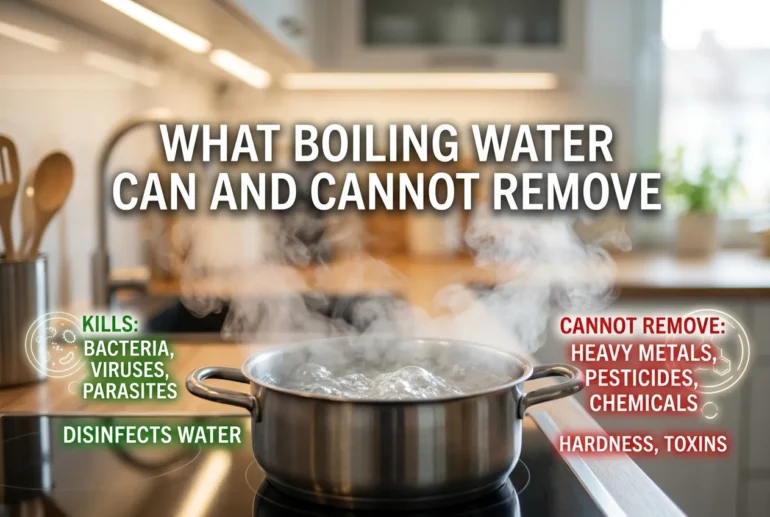
Summary/ Quick answer: Boiling water kills bacteria, viruses and protozoa. It does not remove dissolved salts, heavy metals, nitrate, pesticide residue or hardness — and can concentrate them, because the water evaporates and the contaminant does not. Boiling is disinfection; purification is a separate job.
Most Indians have the same reflex when the water tastes odd. Or, if there is a contamination scare in the neighbourhood. They resort to boiling water immediately. However, boiling water does not solve all the water-related problems. It is good at disinfecting but not purifying.
Boiling water is generally useful, and it has kept generations safe. However, it solves one category of problems: it kills bacteria and pathogens. If your water is hard or has chemical residue or high levels of TDS, boiling does not help. Sometimes boiling can concentrate what was already in the water. The gap starts from people assuming boiling is the safest method. But what it actually does is worth understanding before you get a water purifier rental or buy one.
Advantages of Boiling Water for Drinking
We all know that heat kills living things, and Protozoa, viruses, and bacteria are the cause of waterborne stomach illnesses. And these do not survive sustained boiling. After flooding, contamination is a risk – then, boiling water is widely advised. It is the correct measure to follow for the immediate response.
However, the real benefits of boiling water are narrow. It is a disinfection method, not a purification method. The advantages of drinking boiled water begin and end with biological safety.
What temperature does water boil at, and how long is enough?
Water boils at 100 degrees Celsius at sea level and lower as altitude rises. The boiling water temperature you actually reach depends on where you live. The WHO advises that reaching a rolling boil is enough to inactivate bacteria, viruses and protozoa. CDC puts a practical number on it — a rolling boil held for one minute, extended to three minutes above 2,000 metres. Either way, getting to a rolling boil matters more than how long the water is boiling. As steam leaves, whatever is dissolved stays behind in a small volume.
Why Boiling Water has its Limitations
Many people assume that only bacteria and viruses live in the water. But it is nuanced — your tap water also contains dissolved metals, fluoride, nitrate or pesticide residues that you cannot see. Boiling water has no strong effect on any of the following:
1. Dissolved salts and hardness: The calcium and magnesium are responsible for the white residue on the bottles, pans, and dishes. It comes with a faint chalky aftertaste. Boiling can settle some of it, but the hardness level does not go away.
2. Heavy metals: Lead from older plumbing and arsenic in groundwater belts may be found. When boiling, these do not evaporate – the concentration increases.
3. Nitrates: It is common in borewell water, especially if there is farmland or a leaky sewage line. Nitrate levels do not change with temperature.
4. Pesticide and industrial residue: Water from agricultural lands can blend with groundwater, and heat cannot purify the chemical traces.
5. Taste and odour: The smell of chlorine or the metallic taste may come from a treatment plant or old pipes; boiling does not get rid of foul smell or taste. Also, taste is never a reliable sign that your water is safe to drink.
When Boiling Water for Drinking Becomes a Chore
In a busy month, the habit of boiling water for drinking barely survives. It burns gas or electricity every day and needs hours of cooling before anyone will drink it. For a student or someone working full time, the habit slips, and the fallback is drinking straight from the tap.
In shared flats where roommates change every few months, nobody wants to be the one who bought the appliance and has to move it. A monthly water purifier subscription sidesteps that, though the purifying technology you need still depends on the water quality in your building.
Drinking Boiled and Filtered Water: What Actually Handles Dissolved Metals
Filtration runs on a different principle.
1. RO pushes water through a membrane fine enough to hold back dissolved solids and metals — exactly what boiling water cannot handle.
2. A UV filter kills the microbes heat would have killed.
3. Together, an RO+UV system covers both sides, which is the practical case for drinking boiled and filtered water rather than treating the two as alternatives.
| What’s in the water | Boiling | UV | UF | RO |
| Bacteria, viruses, protozoa | Yes | Yes | Yes | Yes |
| Dissolved salts, hardness | No – settles carbonate hardness, concentrates the rest | No | No | Yes |
| Heavy metals (lead, arsenic) | No – concentrates | No | No | Yes |
| Nitrate, fluoride | No | No | No | Yes |
| Pesticide residue | No | No | Partly | No |
| Taste and odour | No | No | Partly | Yes |
Which system suits your household depends on the local water. Where hardness or high dissolved solids is the issue, RO is usually the right fit. Where TDS is already low, UV may be enough on its own, since the risk is arriving through the pipes rather than sitting in the minerals.
How long you are staying decides rent or buy
The other consideration is how long you plan to stay in a city, because people avoid buying a purifier and put their health at risk in the meantime. For anyone moving between cities for work or study, hauling a purifier along is its own problem, which is part of why renting one has become common. Rental plans generally cover installation, filter changes and servicing.
Conclusion
Boiling water is a good habit to keep when the situation calls for it, but it is not the complete answer people assume it is. Heat deals with living organisms in your water; it does nothing about what is dissolved in it. Find out which of the two problems you actually have — if it is the second, no amount of time on the stove will fix it.