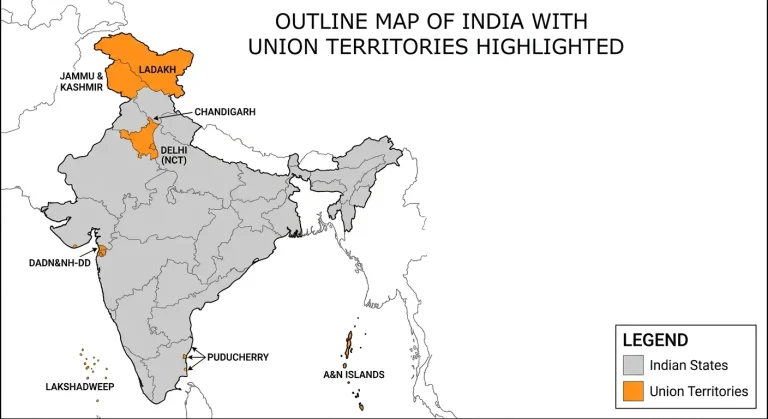
Say a paper gives you four Indian place names and asks which of the following is not a union territory. The answer is whichever one isn’t on a list of eight. India has 28 states and 8 union territories, and the eight are Delhi, Puducherry, Jammu and Kashmir, Ladakh, Chandigarh, Dadra and Nagar Haveli and Daman and Diu, Lakshadweep, and the Andaman and Nicobar Islands. Everything else, from Goa to Sikkim to Telangana, is a state.
The catch is that questions often lean on recent changes or on notes that are a few years out of date. This guide covers the list, how union territories differ from states, and the names that trip up UPSC, SSC, banking and state-exam candidates.
Which of the Following Is Not a Union Territory? The Fast Answer
Check every option against the eight names above. If one isn’t there, that’s your answer. These are the names question-setters reach for most often:
| Name | Status | Why it causes confusion |
|---|---|---|
| Goa | State | It was governed together with Daman and Diu until 1987 |
| Sikkim | State | It’s small and remote, and joined India only in 1975 |
| Telangana | State | It’s the newest state, so people doubt its status |
| Delhi | Union territory | It’s the capital, yet it isn’t a state |
| Jammu and Kashmir | Union territory | It was a full state until October 2019 |
| Ladakh | Union territory | It was carved out of the old Jammu and Kashmir state |
| Chandigarh | Union territory | It’s the capital of Punjab and Haryana but belongs to neither |
Goa deserves a closer look. Goa was part of a single union territory with Daman and Diu until it attained statehood on 30 May 1987, and that shared past is why the names still get linked. Telangana, on the other hand, was formed on 2 June 2014 and remains India’s newest state.
One habit saves marks: check the print date of your study material. Anything published before late 2019 shows Jammu and Kashmir as a state, and anything from before 2020 lists Dadra and Nagar Haveli and Daman and Diu as two separate territories.
The Complete List of Union Territories in India
| Union territory | Capital | Own legislature? |
|---|---|---|
| Andaman and Nicobar Islands | Sri Vijaya Puram | No |
| Chandigarh | Chandigarh | No |
| Dadra and Nagar Haveli and Daman and Diu | Daman | No |
| Delhi (National Capital Territory) | New Delhi | Yes |
| Jammu and Kashmir | Srinagar and Jammu (seasonal) | Yes |
| Ladakh | Leh | No |
| Lakshadweep | Kavaratti | No |
| Puducherry | Puducherry | Yes |
Only three union territories have their own legislatures: Delhi, through the 69th Amendment of 1991, Puducherry, under the Union Territories Act of 1963, and Jammu and Kashmir, under the 2019 reorganisation law. The other five are run more directly by the Centre.
If an older paper mentions Port Blair, it means the same city. A gazette notification of 14 September 2024 made Sri Vijaya Puram its official name.
Union Territories vs States: What Actually Differs
| Feature | States | Union territories |
|---|---|---|
| Executive head | Governor appointed by the President, with an elected Chief Minister | Lieutenant Governor or Administrator appointed by the President |
| Elected government | Always | Only in Delhi, Puducherry and Jammu and Kashmir |
| Law-making | State legislature handles the State List and shares the Concurrent List | Parliament can legislate, and assemblies have limited powers where they exist |
| Constitutional basis | Named in the First Schedule as part of the Union of States | Administered by the Union under Article 239 |
| Autonomy | Substantial | Limited, and it varies from one territory to another |
States draw their law-making powers from the State and Concurrent Lists, while union territories are administered by the Centre under Article 239.
Delhi: The Case That Confuses Most Readers
Delhi has an elected Chief Minister and an Assembly, so it looks like a state. It isn’t one. The Assembly has no say over police, public order or land, which is why disputes with the Lieutenant Governor keep making headlines. Article 239AA holds the special rules for Delhi.
Puducherry: A Territory in Four Pieces
Puducherry isn’t one continuous patch of land. It’s made up of four small enclaves, Puducherry, Karaikal, Mahe and Yanam, scattered along the coasts of Tamil Nadu, Kerala and Andhra Pradesh. That geography is a legacy of French rule. Older books also spell the name Pondicherry, so watch for both.
Why Some Regions Become Union Territories
There’s no single rule. Each case has its own reason:
- Strategic position: The Andaman and Nicobar Islands and Lakshadweep are remote island groups. The Andaman and Nicobar Islands fall under the direct administrative control of the Union Ministry of Home Affairs.
- Small size: Some regions are too small to run as full states.
- The national capital: Delhi houses the central government, so the Union keeps a firm hand on its administration.
- A shared capital: Chandigarh serves two states, and union territory status keeps it neutral.
- Colonial history: Puducherry was French, while Goa, Daman and Diu and Dadra and Nagar Haveli were Portuguese.
- Political reorganisation: Jammu and Kashmir and Ladakh were turned into union territories by Parliament in 2019.
How the Map Changed, and Why Old Notes Mislead
- 1956: The States Reorganisation Act created 14 states and 6 union territories.
- 1975: Sikkim merged with India through the 36th Constitutional Amendment.
- 30 May 1987: Goa became the 25th state, and Daman and Diu stayed on as a separate union territory.
- 2 June 2014: Telangana was formed.
- 31 October 2019: The former state of Jammu and Kashmir was split into the union territories of Jammu and Kashmir and Ladakh
- 26 January 2020: Dadra and Nagar Haveli merged with Daman and Diu.
- September 2024: Port Blair was renamed Sri Vijaya Puram, a name change with no change in status.
The count has stayed at 28 states and 8 union territories since early 2020, though demands for new states keep circulating. Before you quote the numbers in print, confirm them with the Ministry of Home Affairs or the national portal.
A Four-Step Method for Any “Not a UT” Question
- Recall the eight by region. Two island groups (Andaman and Nicobar, Lakshadweep), four in the north (Delhi, Chandigarh, Jammu and Kashmir, Ladakh), one in the west (Dadra and Nagar Haveli and Daman and Diu) and one in the south (Puducherry).
- Strike out the obvious states. Anything you can place inside a state’s familiar boundaries is likely a state.
- Watch for old names. Pondicherry, Port Blair, and a separate Daman and Diu may all appear in dated questions.
- Read the wording twice. “Which is a union territory” and “which is not” need opposite answers, and the second form is the easier one to misread under time pressure.
Practice Questions
- Which of the following is not a union territory: Chandigarh, Puducherry, Goa, Lakshadweep?
Answer: Goa. - Which of these is a union territory: Sikkim, Ladakh, Tripura, Manipur?
Answer: Ladakh. - Which one is not a union territory: Delhi, Telangana, Chandigarh, Andaman and Nicobar Islands?
Answer: Telangana. - How many union territories have their own legislature?
Answer: Three: Delhi, Puducherry, and Jammu and Kashmir.
Final Takeaway
The next time a paper asks which of the following is not a union territory, run each option against the eight names and pick the one that’s missing. Learn the list by region, keep the 2019 and 2020 changes in mind, and distrust any note that predates them. If the question is about legislatures or powers, remember that only three territories have assemblies, and even those answer to the Centre on key subjects.
FAQ
How many union territories are there in India?
There are eight, alongside 28 states.
Is Delhi a state or a union territory?
It’s a union territory, officially the National Capital Territory of Delhi. It has an elected Assembly, though police, public order and land sit outside its powers.
Is Goa a union territory?
No. Goa has been a state since 30 May 1987. The confusion comes from Daman and Diu, which is part of a union territory.
Is Jammu and Kashmir still a state?
No. It became a union territory in October 2019, and Ladakh became a separate one.
Which union territories have their own assembly?
Delhi, Puducherry, and Jammu and Kashmir.