
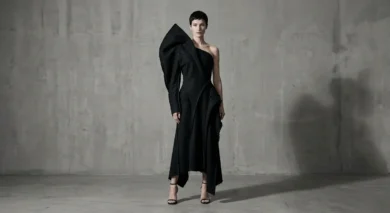
Avant garde fashion is clothing designed to challenge what clothing is supposed to be. Instead of flattering the body or following the season’s trends, it experiments with shape, material, and meaning — a jacket with three sleeves, a dress made of folded paper, a silhouette that deliberately distorts the human form. The term comes from French military language, where avant-garde meant the advance guard, the soldiers who went out first. Applied to art and then to fashion, it describes the people working ahead of what the mainstream has accepted.
That’s the definition. The more useful question for a beginner is how to tell genuine avant-garde work from something that’s simply strange, and whether any of it connects to what regular people actually wear. Both get answered below, along with the designers worth knowing and a realistic look at wearing experimental pieces in daily life.
Where the Term Came From (And Why It Matters)
The phrase predates fashion by a long stretch. Military strategists used it literally. Nineteenth-century French writers borrowed it for artists and thinkers working ahead of public taste, and by the early twentieth century it described the wave of movements — Futurism, Dada, Constructivism, Surrealism — that tore up the rules of painting, poetry, and theater.
Fashion absorbed the idea from that art world, not separately from it. Early-twentieth-century radical dress experiments were tangled up with the same concerns driving modern art: industry, speed, revolution, and new ways of living. Russian Constructivists like Lyubov Popova and Varvara Stepanova took the turn most literally, moving from abstract painting into practical industrial work at a Moscow textile factory, designing clothes meant for a reorganized society rather than for a market.
Two things follow from that origin, and both matter for understanding the style today.
First, avant-garde work is defined by its relationship to the norm, not by any fixed look. Something is avant-garde because it’s ahead of or against what’s accepted — which means the goalposts move. Shoulder pads and androgynous tailoring were confrontational in one decade and standard in the next.
Second, the point was never decoration. These designers were arguing with something. A piece that looks odd but makes no argument is just an odd piece.
What Actually Makes a Garment Avant-Garde?
Here’s a practical test. Look for at least two or three of these qualities, not just one:
- It questions the body’s expected shape. Padding in the “wrong” places, volume where tailoring usually subtracts it, asymmetry that refuses to balance out.
- It uses materials outside the fashion vocabulary. Paper, molded plastic, industrial felt, metal mesh, repurposed waste, synthetic fibers developed for other industries.
- It carries a concept. The collection is about something — mortality, technology, labor, cultural memory — and the clothes articulate it.
- It treats construction as the subject. Raw edges, exposed seams, unfinished hems, garments turned inside out, deliberately drawing attention to how a thing is made.
- It’s indifferent to flattering you. Not hostile, just uninterested. Conventional attractiveness isn’t the goal it’s optimizing for.
- It borrows from other disciplines. Architecture, sculpture, engineering, and performance all show up constantly in this work.
What doesn’t qualify: a normal dress in a loud print, a celebrity red-carpet stunt with no idea behind it, or anything whose only distinguishing feature is being expensive. Shock on its own isn’t a concept. The useful distinction is between strangeness for its own sake and the presence of a serious proposition.
Avant-Garde vs. Haute Couture vs. Costume
Beginners mix these up constantly, and the confusion is reasonable — they overlap on the runway. The differences are real, though.
| What defines it | Primary goal | Example scenario | |
|---|---|---|---|
| Avant-garde | Breaks with convention; concept-driven | Propose a new idea about dress | A coat constructed so the wearer’s silhouette reads as architecture, not anatomy |
| Haute couture | A legally protected French designation with strict criteria around ateliers and hand-work | Peak craftsmanship, made for one client | A hand-beaded gown requiring hundreds of hours of embroidery |
| Costume | Designed to represent a character or role | Communicate identity within a fiction or performance | A gown built for a stage production or film |
The overlaps are where it gets interesting. Plenty of avant-garde work is produced at couture-level craftsmanship — the two categories aren’t opposites. And the boundary with costume is genuinely blurry: a Hussein Chalayan piece that transforms mechanically on the runway is doing something closer to performance than to retail.
The cleanest way to separate them: couture asks “how beautifully can this be made?”, costume asks “who is this person supposed to be?”, and avant garde fashion asks “why do clothes have to work this way at all?”
The Designers Worth Knowing First
You don’t need a reading list of forty names. Six or seven cover most of what defines the field, and recognizing their work makes everything else easier to place.
The Japanese Wave: Rei Kawakubo and Yohji Yamamoto
If there’s a single turning point in the modern story, it’s the Paris debut of Rei Kawakubo’s Comme des Garçons and Yohji Yamamoto in the early 1980s. Their collections were black, oversized, frayed, and asymmetric at a moment when Paris fashion meant bright color and body-conscious glamour. The press reaction was openly hostile — the collections were widely described in dismissive terms at the time — and within a few years the same ideas had reshaped how a generation thought about clothing.
Kawakubo’s later work kept pushing. Her 1997 collection, often called “lumps and bumps,” padded the body in places that made no anatomical sense, forcing a question about where the body ends and the garment begins. Decades on, major museums treat the work as significant enough for retrospective exhibitions, which is a reasonable marker of how far the ideas traveled.
Issey Miyake
Miyake approached the problem through technology and process. His pleating methods — garments cut oversized, then heat-pressed into permanent pleats — produced clothes that are genuinely experimental in construction and genuinely wearable, which is a rarer combination than it sounds. His work is a useful counter-example for anyone assuming avant-garde means unwearable.
Alexander McQueen
McQueen combined technical tailoring ability with theatrical, often dark storytelling — collections exploring mortality, nature, violence, and history. His shows functioned as performances rather than product presentations. He’s the entry point most Americans already have, usually through the Met’s 2011 retrospective or through the red-carpet afterlife of his silhouettes.
Vivienne Westwood
Westwood’s route in was punk. She built a visual language out of deliberate destruction — tears, safety pins, slogans — and later turned toward historical British tailoring reassembled on her own terms. Her career illustrates how avant-garde positions get absorbed: ripped clothing moved from genuine provocation to a standard mall product within about fifteen years.
Martin Margiela and the Antwerp Six
The Belgian designers who emerged in the 1980s brought deconstruction into focus — exposed linings, visible seams, garments taken apart and rebuilt. Margiela in particular removed his own name and face from the brand’s presentation, which was itself a statement about designer celebrity.
Hussein Chalayan
Chalayan is the clearest example of technology as a creative tool rather than a gimmick. His work has included remote-controlled garments and pieces that mechanically transform in front of an audience, expanding the question of what a garment can do, not just how it looks.
Current Names
Rick Owens is the most visible contemporary figure, with a draped, monochrome, quietly gothic aesthetic that’s influenced an enormous amount of mainstream menswear. Beyond him, the field changes fast enough that any list goes stale — a worthwhile habit is checking recent coverage from established fashion publications or museum programming rather than relying on a guide written a year ago.
Why Clothes Nobody Wears Still Matter
A fair question: if most of this never reaches a store, why does it get so much attention?
It functions as research and development. Techniques developed in experimental collections filter down over years. Deconstruction gave mass retail raw hems and exposed seams. The oversized silhouettes that dominated the 2010s trace back through decades of Japanese design. Ideas introduced by experimental designers frequently influence broader fashion for years afterward.
It’s cultural commentary. Avant-garde work often operates as a visual argument about social norms — gender expectations, consumption, body standards, labor. The 1980s Japanese collections questioned a specific Western idea of how a woman’s body should be presented, and they did it through cut rather than through text.
It expands what’s possible. Material experiments done without commercial pressure — biofabricated leather alternatives, 3D-printed structures, garments integrating electronics — often start in this space precisely because there’s no sales target to protect.
It’s honest about being a proposal, not a product. A runway piece isn’t failing when nobody buys it. It was never trying to be a product in the first place.
One caveat worth stating plainly: radical form has never been automatically progressive. Experimental design movements have at times served ideologies that aged very badly, and treating “boundary-pushing” as automatically good is lazy history. Judge the proposition, not just the novelty.
Can You Actually Wear Avant-Garde Fashion?
Yes, with a realistic framing. Almost nobody wears head-to-toe runway pieces. What people do is borrow the principles.
Start With One Element
The most common beginner mistake is wearing five experimental things at once, which reads as costume rather than style. One unusual element against otherwise simple clothing is more effective and far more wearable:
- An exaggerated, architectural shoulder on an otherwise plain coat
- Asymmetry — one sleeve, one hemline, one closure that doesn’t match
- Unexpected proportion: very wide trousers with a fitted top, or the reverse
- A single unconventional material — molded, coated, or technical fabric
- Deliberate layering that obscures rather than defines the waistline
Build Around Neutrals
A lot of this aesthetic lives in black, charcoal, bone, and gray, and there’s a practical reason beyond mood: when color isn’t doing the work, shape becomes visible. A complicated silhouette in a loud print fights itself.
Learn the Difference Between Interesting and Ill-Fitting
Oversized and badly fitting look identical in photos and nothing alike in person. Intentional volume has structure — a defined shoulder line, a deliberate drape point, a clear relationship to the body underneath. Clothes that are simply too big just hang. If you’re buying secondhand to experiment cheaply, this is the thing to check in a mirror before committing.
Price Realistically
Genuine designer pieces run into thousands. More accessible routes:
- Secondhand and vintage platforms, where older experimental pieces circulate at a fraction of original prices
- Diffusion and lower-priced lines from experimental houses
- Independent and emerging designers selling directly, often at a fraction of established-house pricing
- Alteration — a tailor restructuring something you own is the cheapest experiment available
Know Your Setting
Most American workplaces have a narrower tolerance than fashion coverage suggests. Sculptural outerwear and unusual proportion read as considered in most creative or urban settings; a deconstructed piece with raw edges reads differently in a conservative office. That’s not a reason to avoid it, just a reason to choose deliberately rather than discovering it in a meeting.
How to Learn More Without Getting Lost
Three habits make this field much easier to understand:
Look at museum collections. Institutions with serious costume holdings — the Metropolitan Museum of Art, whose Costume Institute mounts major fashion exhibitions, and the Victoria and Albert Museum in London — publish exhibition material and collection records that explain context rather than just showing images. For the art-movement roots, the Museum of Modern Art documents the early-twentieth-century avant-garde that fashion grew out of.
Watch full runway shows, not photo sets. A collection’s argument usually lives in the sequence, the staging, and the movement. Still images flatten it.
Read the collection notes. Designers routinely publish a statement explaining what a collection is about. It’s the fastest way to tell whether there’s a proposition underneath the surface.
The Takeaway
Avant-garde fashion isn’t a style you can buy into with a shopping list — it’s a stance toward clothing that treats a garment as an idea rather than a product. The designers who matter in it weren’t trying to make you look good; they were asking what clothing could be if it stopped obeying the rules about bodies, seasons, and salability. That’s why the field feels impenetrable at first and then suddenly makes sense: once you start looking for the argument instead of the aesthetic, the strange shapes become legible.
If you want to start somewhere concrete this week, pick one designer from the list above, find a full runway show from their archive, and watch it with the collection notes open. One hour of that teaches more than a dozen definition articles.
FAQ
Is avant-garde fashion the same as haute couture?
No. Haute couture is a protected French designation with formal requirements about ateliers and hand-construction, focused on craftsmanship for individual clients. Avant-garde describes an experimental attitude toward design. A garment can be one, both, or neither.
Who started avant-garde fashion?
There’s no single founder, and anyone claiming one is oversimplifying. The attitude moved into clothing from early-twentieth-century art movements, with figures like Elsa Schiaparelli bringing Surrealist ideas into dress in the 1930s. The modern form is most associated with the Japanese designers who showed in Paris in the early 1980s.
Why is so much avant-garde clothing black?
Removing color makes structure, volume, and construction more visible, so shape carries the idea. It also became a signature of the Japanese and Belgian designers who shaped the modern aesthetic, and the association stuck.
Is avant-garde fashion expensive?
Designer pieces generally are. The aesthetic itself isn’t — secondhand platforms, independent designers, and good tailoring make experimental proportion and silhouette reachable at ordinary budgets.
What’s the difference between avant-garde and just dressing weird?
Intention and coherence. Avant-garde work proposes something about how clothing should function or what it should mean. Without that underlying idea, unusual clothing is just unusual.