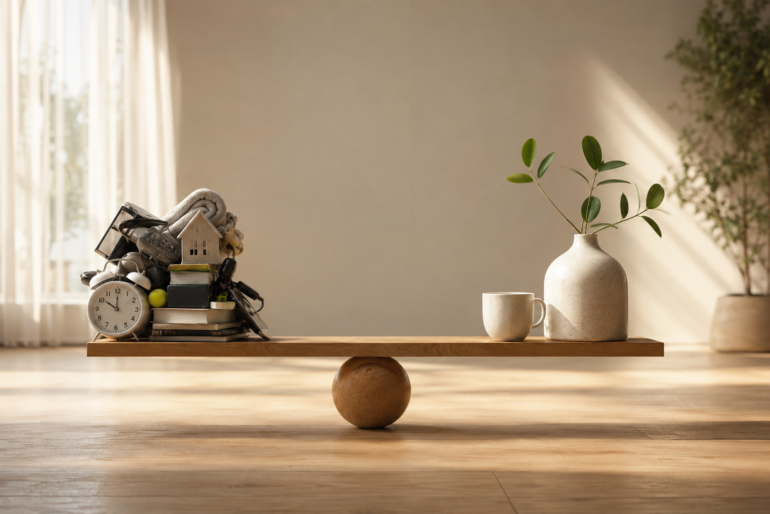
There comes a point when “more” starts feeling heavy.
More clothes in the closet. More apps on the phone. More tabs open in your mind. More plans, more payments, more pressure to keep up with a life that looks good from the outside but feels crowded on the inside.
That is where Less With Less becomes more than a catchy phrase. It is a simple living mindset built around one honest question: what if life felt fuller not because we added more, but because we stopped carrying what no longer served us?
Simple living does not mean giving away everything, living in an empty room, or pretending money does not matter. It means choosing carefully. It means creating space for what is useful, meaningful, peaceful, and real.
For many people, the idea of Less With Less is not about sacrifice. It is about relief.
What Does Less With Less Mean?
Less With Less means living with fewer unnecessary things, fewer draining habits, fewer impulse decisions, and fewer distractions so you can enjoy more clarity, time, and emotional breathing room.
It is not the same as being cheap. It is not about forcing yourself to live uncomfortably. It is about understanding that a fuller life does not always come from owning more, buying more, or doing more.
Think of it this way.
A kitchen with only the tools you actually use can feel better than a kitchen packed with gadgets you forgot you owned. A weekend with one meaningful plan can feel better than a schedule full of obligations. A wardrobe with clothes you love can feel easier than a closet full of “maybe someday” outfits.
This is the heart of simple living. You remove the noise so the important things can finally be heard.
Why Simple Living Feels So Appealing Today
Modern life is convenient, but it is also noisy.
People are surrounded by choices, ads, subscriptions, shopping apps, notifications, and social pressure. Even a normal day can feel like a long list of decisions. What to buy, what to wear, what to post, what to answer, what to watch, what to upgrade next.
That constant pressure can make life feel busy without feeling meaningful.
Research also supports the idea that clutter and distraction can affect how people feel and function. Princeton researchers have found that visual clutter competes for attention and can make it harder for the brain to focus. In simple terms, too much stuff in your field of view can make your mind work harder than it needs to.
That is one reason Less With Less connects with people who are tired of feeling mentally overloaded. It gives them permission to stop chasing everything.
The Emotional Weight of Too Much Stuff
Clutter is not just about messy shelves. It can become emotional background noise.
A chair covered in clothes can remind you that laundry is unfinished. A drawer full of old bills can create a tiny wave of stress every time you open it. A closet packed with unused items can quietly make you feel guilty about money spent, choices delayed, or plans never started.
UCLA’s Center on Everyday Lives of Families studied 32 Los Angeles families and found that many homes contained a large number of possessions, with household spaces serving many overlapping activities. The research highlighted how everyday family life can become shaped by the amount of stuff inside the home.
Another UCLA-linked study found that women who described their homes as cluttered or unfinished had patterns of cortisol associated with higher stress. The study does not mean every messy home causes stress for every person, but it does show that the way we experience our home environment can affect our body and mood.
That is why simple living often feels emotional. You are not only clearing space. You are removing reminders that keep pulling at your attention.
Less With Less and Money: A Practical Connection
Simple living is also closely tied to money.
Most people do not feel stressed because they bought one unnecessary item. They feel stressed because small spending habits slowly become normal. A few unused subscriptions. A few impulse orders. A few upgrades that looked harmless at the time. Then suddenly the budget feels tight.
The U.S. Bureau of Labor Statistics reported that housing and transportation accounted for about half of household spending in 2024. That matters because many lifestyle choices are connected to the biggest expenses people carry, not just small purchases like coffee or decor.
This is where Less With Less becomes practical. It encourages people to ask better questions before spending.
Do I need this, or do I just want a quick mood boost?
Will this make daily life easier, or will it become one more thing to store, clean, maintain, or pay for?
Am I buying this because it fits my life, or because it fits someone else’s image of success?
Those questions are simple, but they can change a budget over time.
Simple Living Does Not Mean Living Poorly
One common misunderstanding is that simple living means lowering your standard of life.
It does not.
In fact, many people who choose a simpler lifestyle feel more satisfied because they stop spending energy on things they do not truly value. They may still buy quality products. They may still enjoy travel, food, technology, fashion, or home design. The difference is that they become more intentional.
A simple life can still be beautiful.
It can include a cozy home, good meals, useful tools, meaningful hobbies, and comfortable routines. The goal is not to own nothing. The goal is to stop letting random things own your time, space, and attention.
That is why Less With Less works best when it is personal. Your version of simple living may look different from someone else’s. A parent with children will not live the same way as a single professional in a studio apartment. A small business owner will not have the same needs as a retiree.
The point is not to copy a minimalist photo online. The point is to build a life that feels lighter to you.
Signs You Might Need a Simpler Lifestyle
Sometimes people do not notice how crowded life has become until they feel constantly tired.
Here are some signs that simple living may help:
You often feel overwhelmed at home, even when nothing serious is wrong.
You keep buying storage items instead of reducing what you own.
You lose things often because every drawer or surface is full.
You feel busy all week but cannot clearly say what mattered most.
You spend money to feel better, then feel guilty later.
You avoid certain rooms, closets, emails, or tasks because they feel too messy.
You own many things “just in case,” but rarely use them.
You feel like your life looks fine from the outside but feels too heavy inside.
These signs do not mean you are failing. They simply mean your environment or routine may be asking for a reset.
A Real-World Example: The Overstuffed Home Office
Imagine someone named Daniel.
He works from home three days a week. His desk has old receipts, two unused notebooks, tangled chargers, coffee mugs, mail, random cables, and a printer that barely works. Every morning, he sits down already annoyed. Before work even begins, his space reminds him of unfinished tasks.
Daniel does not need a dramatic life change. He needs a simple one.
He removes everything from the desk. He keeps one notebook, one pen, his laptop, one charger, and a small tray for daily papers. He throws away old packaging, recycles papers he does not need, and moves rarely used items to one labeled box.
Nothing magical happens. But the next morning, work feels easier.
That is Less With Less in real life. It is not about perfection. It is about reducing friction.
How Less With Less Can Make Life Feel Fuller
At first, it sounds strange. How can less make life feel fuller?
The answer is space.
When you own fewer unnecessary items, you create physical space. When you reduce commitments, you create time space. When you limit distractions, you create mental space. When you spend more intentionally, you create financial space.
And space is powerful.
It allows you to notice what you already have. It helps you enjoy ordinary moments. It gives you room to think before reacting. It makes your home feel calmer and your schedule feel more human.
Pew Research Center has reported that when people discuss meaning in life, areas like family, occupation, material well-being, friends, and health often come up across countries. A simpler lifestyle can support these areas by making more room for relationships, well-being, and work that feels purposeful.
Fullness is not always about quantity. Sometimes it is about attention.
Simple Living at Home
Home is usually the best place to start.
Not because your home needs to look perfect, but because it shapes your daily mood. You wake up there. You return there. You rest there. If your home constantly feels crowded, your mind may struggle to settle.
Start with visible surfaces.
A clear dining table can make meals feel calmer. A cleaner bedroom corner can make sleep feel easier. A simplified entryway can make mornings less chaotic.
You do not need to declutter the whole house in one day. In fact, that often leads to frustration. Choose one small area and finish it.
Try this approach:
Pick one drawer, shelf, bag, or corner.
Remove everything from that space.
Put back only what you use, need, or truly value.
Create a home for each item you keep.
Donate, recycle, or discard what no longer belongs.
Then stop. Let one finished space teach you how good less can feel.
Simple Living With Clothes
Clothes are emotional for many people.
We keep items from old versions of ourselves. Clothes that do not fit. Clothes bought for imaginary events. Clothes that were expensive but uncomfortable. Clothes that make us feel guilty every time we see them.
A Less With Less wardrobe is not about wearing the same outfit every day. It is about making daily choices easier.
Keep clothes that fit your actual life. Work clothes you wear. Casual pieces that feel good. Shoes that do not hurt. Colors and styles that match your real routine.
A smaller wardrobe can make mornings faster because you are not fighting through items that no longer serve you.
One useful question is: would I choose this today?
If the answer is no, and you have not worn it in a long time, it may be taking up more space than it deserves.
Simple Living With Technology
Digital clutter can be just as tiring as physical clutter.
Unread emails, unused apps, endless photos, old downloads, group chats, browser tabs, saved posts, and notifications can create a quiet sense of pressure.
Simple living in the digital world does not mean deleting everything. It means making your devices support your life instead of interrupting it.
Start with notifications. Turn off anything that does not need immediate attention. Remove apps you open out of habit but rarely enjoy. Unsubscribe from emails that only tempt you to buy things. Organize important files into simple folders.
You can also create screen-free pockets in your day.
For example, no phone during breakfast. No social media for the first 30 minutes after waking. No scrolling in bed. These small limits can make your day feel less reactive.
Simple Living With Your Schedule
A full calendar can look productive, but it can also hide exhaustion.
Many people say yes automatically. Yes to extra plans. Yes to favors. Yes to meetings. Yes to events they do not want to attend. Then they wonder why their week feels like it belongs to everyone else.
Less With Less asks you to protect your time with more honesty.
Before saying yes, pause.
Do I have the energy for this?
Does this match my priorities right now?
Will I resent this later?
Is this truly necessary, or am I afraid of disappointing someone?
A simpler schedule does not mean avoiding responsibility. It means choosing responsibility wisely.
Simple Living and Family Life
Simple living can be tricky in a family because everyone has different needs.
Children may love toys. Partners may have different comfort levels with clutter. Older relatives may attach memories to objects. That is normal.
The goal is not to force everyone into one strict system. The goal is to build shared habits that reduce stress.
Families can start with practical rules.
One basket for daily toys. One shelf for school papers. One donation box near the closet. One weekly reset where everyone returns items to their place.
It also helps to connect simple living with benefits everyone can feel. Less time cleaning. Easier mornings. More room to play. Fewer lost items. A calmer home.
When people feel the benefit, they are more likely to join in.
The Difference Between Decluttering and Simple Living
Decluttering is an action. Simple living is a mindset.
Decluttering says, “Let me remove what I do not need.”
Simple living says, “Let me stop bringing unnecessary pressure back into my life.”
That difference matters.
You can declutter every month and still feel overwhelmed if your habits stay the same. If you keep buying things to fix emotions, keep overbooking your schedule, keep comparing your life online, or keep ignoring your budget, the clutter will return in another form.
Less With Less is stronger when it changes the way you decide.
Before adding something new, ask what it will cost beyond money. Will it cost time? Space? Maintenance? Attention? Emotional energy?
That question can save you from repeating the same cycle.
What to Keep When You Choose Less
Simple living is not only about what you remove. It is also about what you protect.
Keep what supports your health.
Keep what helps you work well.
Keep what brings real joy.
Keep what carries meaningful memories without burying your home.
Keep tools you use regularly.
Keep relationships that feel honest, kind, and mutual.
Keep routines that make you feel steady.
The goal is not an empty life. The goal is a clearer life.
Mistakes People Make When Trying to Live Simply
Many people get excited about simple living and try to change everything at once. That can backfire.
The first mistake is going too extreme. Throwing away too much too fast can lead to regret, especially with sentimental items or practical tools.
The second mistake is buying “minimalist” products to become simpler. Matching containers, new furniture, and aesthetic storage can be useful, but they can also become another shopping trap.
The third mistake is copying someone else’s lifestyle. A person living alone in a city apartment may not need the same things as a family of five in a rural home.
The fourth mistake is thinking simple living must look plain. Your home can still have color, personality, books, art, plants, and warmth.
The best version of Less With Less is not cold or empty. It feels calm, useful, and human.
A Simple 7-Day Less With Less Reset
If you want a practical starting point, try a one-week reset.
Day 1: Clear one surface you see every day.
Day 2: Remove five items from your closet that you never wear.
Day 3: Cancel or review one unused subscription.
Day 4: Turn off nonessential phone notifications.
Day 5: Clean one drawer or cabinet.
Day 6: Say no to one unnecessary commitment or delay it honestly.
Day 7: Spend 20 minutes enjoying your space without buying anything new.
This reset is small, but that is the point. Simple living works better when it feels doable.
How to Buy Less Without Feeling Deprived
Buying less can feel uncomfortable at first because shopping often fills emotional gaps.
People buy when they are bored, stressed, sad, excited, or trying to become a new version of themselves. That does not make them bad. It makes them human.
The goal is not to shame yourself. The goal is to slow the moment down.
Try a 48-hour pause before nonessential purchases. Put the item in your cart, then wait. If you still want it after two days and it fits your budget, you can buy it with more confidence.
Create a “real need” list. These are items you already know would improve your daily life. When you shop, check that list first instead of reacting to ads.
Also ask whether you can borrow, repair, reuse, or repurpose something before buying new.
This is how Less With Less becomes a practical money habit instead of a strict rule.
Simple Living Is Not About Being Perfect
No one lives simply all the time.
There will be messy weeks. There will be impulse purchases. There will be busy seasons where your home, inbox, or schedule gets out of control again.
That is normal.
Simple living should not become another standard you use to judge yourself. It should feel like a tool you return to when life gets too crowded.
The question is not, “Am I doing this perfectly?”
The better question is, “What can I make lighter today?”
Maybe you delete 200 old emails. Maybe you donate three shirts. Maybe you cook a simple dinner instead of ordering out. Maybe you spend the evening with your family instead of scrolling.
Small choices count.
Frequently Asked Questions About Less With Less
Is Less With Less the same as minimalism?
Not exactly. Minimalism often focuses on owning fewer things, while Less With Less is broader. It can include fewer distractions, fewer unnecessary expenses, fewer commitments, and fewer emotional burdens. It is more about fullness through simplicity than strict minimal rules.
Can simple living help reduce stress?
It can help many people, especially when clutter, overspending, or overcommitment are part of their stress. Research has linked cluttered home descriptions with stress-related cortisol patterns, and attention research shows that visual clutter can compete with focus.
Do I have to get rid of sentimental items?
No. Sentimental items can have real emotional value. The key is to keep the ones that truly matter instead of keeping everything from guilt. A small memory box can feel more meaningful than several crowded storage bins.
Is simple living good for families?
Yes, but it should be flexible. Families need more items than individuals, especially with children. The goal is not to remove everything, but to create routines and spaces that make daily life easier.
Can I live simply and still enjoy nice things?
Absolutely. Simple living is not against beauty, comfort, or quality. It encourages you to choose nice things carefully, use them fully, and avoid filling your life with items that do not matter to you.
Conclusion: Less With Less Can Make Life Feel Fuller
Less With Less is not about living small. It is about living with more attention.
It reminds us that a full life is not always built by adding more things, more plans, more purchases, or more pressure. Sometimes it grows when we remove what distracts us from what already matters.
A calmer home. A lighter schedule. A healthier budget. A clearer mind. A better relationship with your own time. These are not small rewards.
Simple living gives you a chance to look at your life honestly and ask, “What is actually helping me live well?”
The answer will be different for everyone. But the direction is often the same. Less noise. Less clutter. Less pressure. More space for what feels real.
In that sense, simple living is not a trend. It is a return to something deeply human: choosing enough over endless more. Even the idea of a balanced lifestyle has roots in how people think about daily habits, values, and ways of living, which makes the phrase modern lifestyle meaningful in the final stretch of this conversation.
When you practice Less With Less, you are not giving up life’s fullness. You are making room to feel it again.