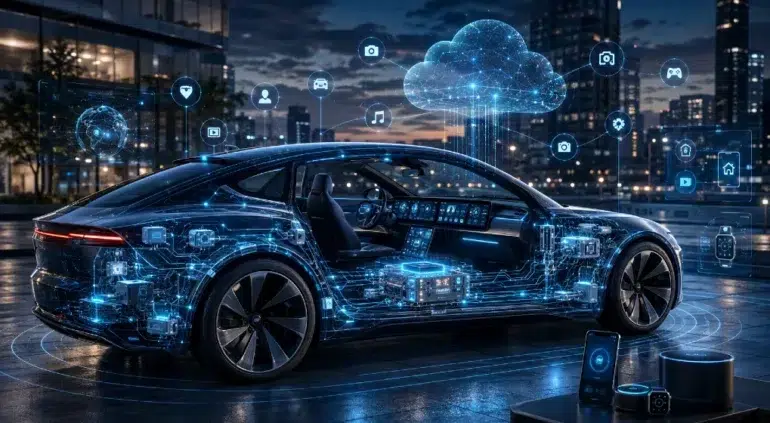
For most of automotive history, progress was measured in mechanical terms. Engines became more efficient, gearboxes smoother, chassis lighter, and safety systems more advanced. Cars were defined by what could be engineered, bolted together, and refined over time in physical form.
That model is now being fundamentally rewritten.
Today’s vehicles are increasingly defined not only by hardware, but by software. What once functioned as a mechanical product is evolving into a continuously updated digital platform—one that behaves less like a traditional car and more like a connected smart device.
This shift is quietly reshaping how vehicles are built, how they are improved, and how drivers experience them on a daily basis.
From Static Machines to Evolving Systems
Traditionally, a car left the factory in a fixed state. Its capabilities were largely locked in at the point of manufacture, with improvements only possible through physical modifications or replacement parts.
That assumption no longer holds.
Modern vehicles are now capable of receiving over-the-air updates that can refine performance, fix software bugs, improve efficiency, and even introduce new features long after purchase. In some cases, the vehicle that leaves the showroom is only the starting point for what it will eventually become.
This transforms the car from a static machine into an evolving system.
Much like smartphones, laptops, or smart home devices, the automotive experience is increasingly defined by its ability to improve over time rather than remain unchanged.
The Car as a Digital Ecosystem
One of the most significant changes in the industry is the shift from isolated vehicle functions to integrated digital ecosystems.
Rather than separate systems controlling navigation, entertainment, climate, and safety independently, modern cars increasingly rely on unified software platforms that coordinate everything in real time.
These platforms connect the vehicle not only internally, but externally as well. Cloud services, smartphone integration, traffic data, charging networks, and remote diagnostics all feed into a constantly updated digital environment.
For drivers, this means the car is no longer just a means of transport. It is a node within a larger network of connected services.
Continuous Improvement Through Updates
One of the defining characteristics of software-defined vehicles is the ability to improve continuously.
Manufacturers can now deploy updates that enhance functionality without requiring a visit to a service centre. These updates may improve navigation accuracy, refine driver-assistance behaviour, optimise battery usage, or introduce entirely new interface designs.
This approach changes the ownership experience significantly. Instead of gradually degrading or remaining static over time, vehicles can become better, smarter, and more capable as they age.
It also shifts expectations. Drivers are increasingly beginning to see software improvements as part of standard ownership rather than optional extras.
App Integration and the Expansion of In-Car Experience
The modern vehicle is also becoming a platform for third-party applications and services.
Infotainment systems are no longer limited to radio, navigation, or basic media playback. Instead, they increasingly support app ecosystems that mirror those found on mobile devices.
Streaming services, productivity tools, travel applications, and vehicle-specific apps are all becoming part of the in-car experience.
This expansion reflects a broader trend: the car is no longer separate from digital life. It is becoming an extension of it.
Whether commuting, travelling long distances, or simply running daily errands, drivers are now interacting with the same digital ecosystems they use elsewhere—just within a mobile environment.
Artificial Intelligence as the Invisible Layer
Behind many of these developments is artificial intelligence.
AI systems are increasingly responsible for interpreting data from sensors, predicting driver behaviour, managing energy consumption, and improving safety systems. Unlike traditional programming, these systems can adapt based on real-world usage patterns.
For example, navigation systems can learn preferred routes. Climate systems can adjust based on habitual preferences. Driver-assistance features can refine responses based on driving style.
While much of this happens invisibly, it significantly shapes the experience behind the wheel.
The result is a vehicle that feels more responsive, more intuitive, and increasingly tailored to the individual driver.
Hardware Still Matters, But Software Leads
Despite the rise of digital systems, physical engineering remains essential. Safety, performance, comfort, and design still rely heavily on mechanical innovation.
However, software is now the layer that determines how effectively those systems work together.
Two vehicles with similar hardware can deliver very different experiences depending on their software architecture. This is why many manufacturers are now investing as heavily in software development as they are in traditional engineering.
The competitive advantage is shifting from purely mechanical excellence to digital capability.
Personalisation in a Software-Driven World
One of the most noticeable outcomes of this transformation is the rise of deep personalisation.
Modern vehicles can store driver profiles that include seating positions, climate preferences, entertainment settings, and driving modes. In some ecosystems, these preferences follow the user across multiple vehicles or devices.
This creates a more seamless and personalised ownership experience.
Physical identity and personalisation still play a role as well. Many drivers continue to seek ways to express individuality through their vehicles in both subtle and visible ways. Within this wider culture of automotive identity, companies such as Plates Express reflect the ongoing importance of personal connection between driver and machine, even as much of that experience becomes increasingly digital.
The combination of software-based and physical personalisation is redefining what ownership means in modern motoring.
The Challenges of a Software-Defined Future
As vehicles become more connected and software-dependent, new challenges emerge.
Cybersecurity is now a critical concern, as vehicles are effectively connected computers on wheels. Protecting systems from malicious interference is as important as traditional mechanical reliability.
Data privacy is another growing issue. Connected vehicles generate vast amounts of information about driving behaviour, location, and usage patterns. Managing this data responsibly will be essential to maintaining trust.
There is also the challenge of complexity. As systems become more advanced, ensuring reliability, simplicity, and usability becomes increasingly important for manufacturers.
Conclusion
The automotive industry is undergoing a fundamental transformation. Cars are no longer just mechanical products enhanced with digital features—they are becoming software-defined platforms that evolve continuously over time.
This shift is changing how vehicles are designed, how they are experienced, and how they are valued. Software now plays a central role in shaping performance, functionality, and personalisation, often in ways that are invisible to the driver.
While the physical car remains essential, the future of motoring is increasingly being written in code. And as vehicles continue to evolve into connected digital ecosystems, they are becoming one of the most significant technology platforms of the modern era.