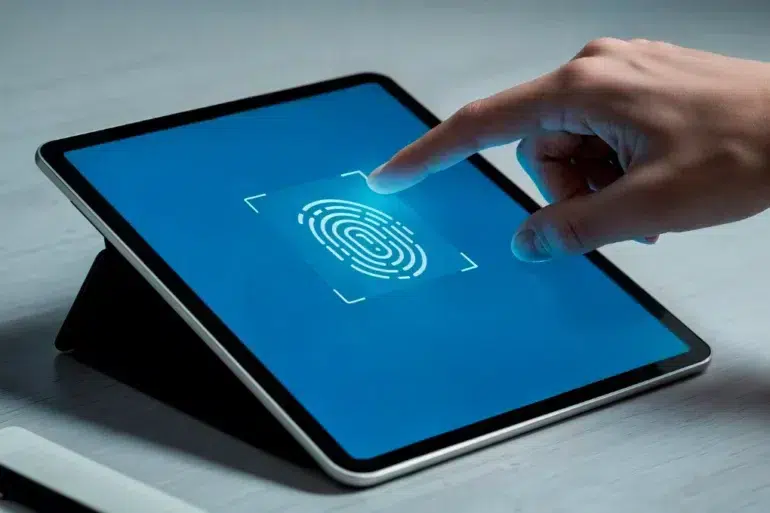
Biometric verification is one of the most important aspects that are needed in the latest security systems for faster and more reliable user identification than a password or a PIN alone can provide.
Defining the broad category of biometric authentication includes fingerprints and facial recognition. Both require a unique human characteristic to operate in a way that the other simply cannot. The way in which each operates in the whole of the biometric identification process, as well as usability across specific industries and personal use, cannot be understated.
How Fingerprint Biometrics Work
Fingerprint biometrics work by scanning the unique pattern of ridges and valleys on a person’s fingertip. The fingerprint sensor analyzes the details, such as ridge endings and bifurcations, then it creates a digital template based on the image. This digital representation is encrypted, saved, and used for further matching. When someone is verifying their identity, the fingerprint sensor captures the fingerprint information, and the software compares it with the saved fingerprint template. The method of recognizing with fingerprints is very accurate and reliable. This can be credited to the fact that they’re unique to every person, and they don’t change over time. For more details, visit here.
How Face Biometrics Work
On face biometrics, it generally uses facial recognition to identify people, based on analysis of facial characteristics. The spacing of eyes, shape of the nose, jawline, and general facial structure. The system records these points, called landmarks, and converts them into a mathematical representation, called a faceprint. Face biometric solutions can then authenticate an image or video feed when the template matches the biometric data stored in a system. Many solutions also include spoofing detection, sometimes called liveness detection, to ensure the image or video feed is a living person and not a photo or recording.
Key Differences in Recognition
The most essential difference between fingerprint and face biometrics involves the methodology relied upon by each to extract an individual’s personal identification information. Physically, fingerprint biometrics rely on skin-to-skin contact with a sensor to draw attention to the tiny skin creases that form a unique pattern for a fingerprint. In contrast, face biometrics do not require participants to actually make physical contact with the system itself, instead relying on the system’s ability to read and record the general contours of a person’s physical appearance. Face recognition, therefore, has a speed advantage in high-throughput areas, and fingerprint biometrics tend to work more accurately and precisely for low-throughput applications.
Use Cases Across Industries
Fingerprint biometrics are often used in banking, worker attendance, police work, and high-security clearance. Face biometrics are widely used, too, such as with mobile iris scanning, at airports, surveillance systems, and retail personalization. Many organizations use fingerprint and face biometrics, paired together when beneficial, to enhance their accuracy and security systems.
Conclusion
Fingerprint and face biometrics are both good at identifying one’s rightful identity, but are used in different scenarios. Fingerprint is used for accuracy with a focus on limiting access. Face biometrics are used for speed and convenience. As long as they work together in tandem, they are really a match made in heaven.