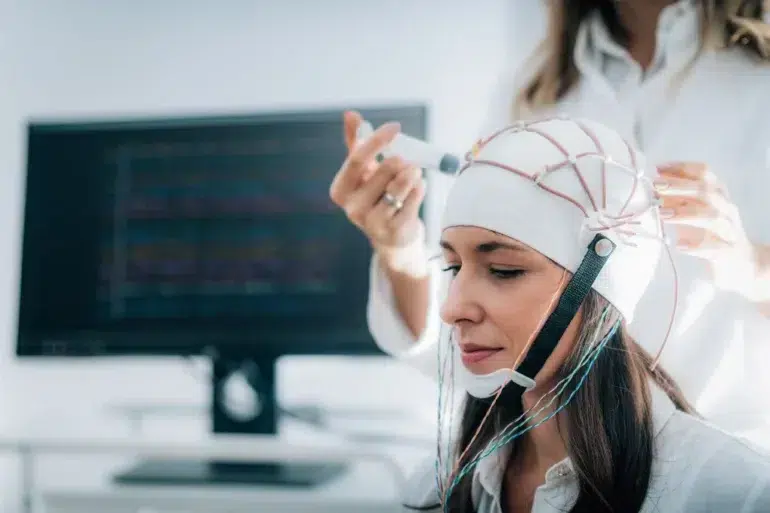
There have been many exciting discoveries in recent years about how we think, remember, feel, and how neurological diseases arise, but it has long been difficult to observe the brain in action. Thanks to brain-computer interfacing (BCI) technologies and electroencephalography (EEG), this is now easier than ever. Gathering reliable data can help speed up the pace of scientific discovery. Companies like BrainAccess.ai are now helping this process, developing new products to make it easier for researchers, ordinary people, and doctors to monitor brain functions.
How BCI and EEG Technology Work
BCI systems provide a direct bridge between the human brain and external systems. Although the majority of non-invasive BCI applications are reliant on EEG systems, which monitor the brain’s electrical activity via sensors on the scalp, these sensors essentially record the small voltage changes that signal firing neurons. The recordings can then be translated into a digital signal for further analysis by researchers.
In addition to providing a wealth of information about what occurs within the brain under varied conditions, when processing tasks, or when changing across time, the data also allows researchers to identity profiles indicating when a participant is attentive, learning, asleep, under stress, or evidencing a particular brain related disorder; all without the necessity for the surgical procedures required to implant invasive sensors inside the brain! With advancements in sensor technology and the development of improved signal processing techniques, the EEG-based BCI systems have been further refined in terms of reliability and the quality of information that can be accurately detected and analyzed.
Expanding Research Capabilities Through Software
Software tools have been instrumental in shaping the field of brain-computer interfaces. Development software, like a BCI SDK, makes it possible for researchers to create their own experiments with ease, identify patterns in EEG data, and create integrations with other software tools. This freedom to develop software to meet a specific need opens doors for new types of research and study designs.
Real-World Applications in Brain Research
The range of applications for such cutting-edge BCI technologies continues to grow. In neuroscience, EEG systems are helping scientists piece together interactions that take place within the brain as the basis of decision-making or memory formation. Meanwhile, in the field of medicine, researchers are using them for studies related to epilepsy, Parkinson’s disease, or ADD and ADHD, all the way through to the effect of BCIs in assisting the recovery processes of rehabilitation treatment for patients attempting to regain lost communication or motor functions due to a variety of injuries or diseases.
Looking Ahead
As technology gets more personal and programs get more powerful, new possibilities for brain science open up. By streamlining the process of collecting, processing, and interpreting brain data, the latest EEG and BCI technologies are making it easier to advance our knowledge of the brain and develop new avenues for improving human health.