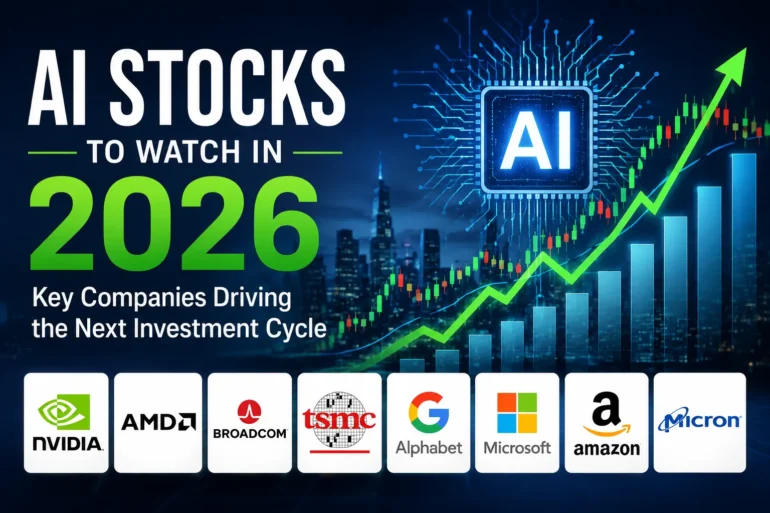
Artificial intelligence is emerging as one of the central themes shaping technology investing in 2026. It began with early excitement around AI applications and large language models, but then grew into a broader investment narrative spanning semiconductors, cloud computing, networking, memory, data centers, and enterprise technology.
This will open up areas of opportunity for investors in different areas of the tech supply chain. But investors will need to look beyond companies that get the most attention if they are to spot the winners, and will need insight into how the dollars for AI are distributed through the wider ecosystem and which companies are set to gain from continued investment.
AI Investment Extends Beyond Software
Artificial intelligence is reliant on a large technology infrastructure. Powerful processors enable AI calculation, while memory, networking equipment, cloud platforms and data centers enable the systems for training and running AI applications. This means the investment opportunity in AI is far broader than just companies developing AI applications. Design and manufacture of semiconductors, infrastructure providers, cloud companies and enterprise software companies can all benefit from the demand growth in AI.
Nvidia is still arguably the most visible example of this infrastructure push, with its graphics processing units being adopted into many high performance AI compute systems, combined with a broad ecosystem encompassing networking, software and platform players catering to AI application developers.
Another key player is AMD, through its data center business and accelerator products, which provide a way to gain exposure to the rising need for AI compute resources. In these companies, pricing, market share, product adoption and customer decisions all compete.
The Importance of Custom Chips and Networking
With the development of more sophisticated AI systems, the movement of large quantities of data between computational systems has become crucial. AI data centers need networking technology that is capable of throughput.
Broadcom represents one company positioned in this part of the ecosystem. In addition to its semiconductor portfolio, the company provides technologies associated with networking and custom silicon.
Custom-designed chips could become increasingly important as large technology companies develop infrastructure tailored to their specific computing requirements. This creates another potential area of opportunity for semiconductor and networking companies.
Semiconductor Manufacturing Remains Critical
The AI boom also depends on companies that manufacture advanced semiconductors.
Taiwan Semiconductor Manufacturing Company plays a major role in semiconductor production and provides manufacturing capacity for companies designing advanced processors. As computing requirements increase, advanced manufacturing remains an important part of the technology supply chain.
For investors, therefore, exposure to the sector carries a higher risk. Factors such as industry cycles, level of capital expenditure, customer concentration, global affairs and demand trends will all impact on the results of semiconductor players.
Thus, investors should consider macroeconomic and industry factors rather than blanket assumptions that higher AI demand will benefit all players.
Cloud Computing Creates Another AI Opportunity
AI applications require substantial computing resources, which makes cloud infrastructure another important part of the investment landscape.
Alphabet, Microsoft, and Amazon all have significant exposure to cloud computing and enterprise technology. Their cloud businesses can provide computing infrastructure and AI services to organizations that want to use artificial intelligence without building every part of the required infrastructure themselves.
Microsoft has exposure through Azure, enterprise software, and AI products. Its existing relationships with business customers could provide a significant distribution channel for new AI capabilities.
Alphabet’s exposure consists of Google Search, Google Cloud, and its overall tech ecosystem. Those investing in the company need to consider how effectively it is able to monetize AI while also growing its cloud business.
Amazon’s AI opportunity is closely connected to Amazon Web Services. AWS provides computing and cloud infrastructure for businesses developing and deploying AI applications, while Amazon can also apply AI across areas such as e-commerce, advertising, and logistics.
Memory Is Becoming an Important Part of the AI Story
AI computing does not depend solely on processors. Modern computing systems also require high-performance memory, making memory manufacturers an important part of the broader AI ecosystem.
Micron is one company investors can watch in this area.
A heightened need for memory associated with data, center and AI applications has the potential to sustain the business on a matured semiconductor landscape. However, memory cycles exist, with prices, inventories, supply increases and capital budgets all having a strong influence on business results. Investors would need to identify whether such trends were temporary industry drivers or a sign of a long term boost to AI driven memory demand.
What Investors Should Examine
An additional point. While stocks operating in a Strong AI environment have a potentially huge upside. It does not mean that they are necessarily a good buy. There are other fundamentals to consider when investing.
Revenue growth Another important consideration is: to sustain growth, what companies rewarded by the benefits of AI require is to show that their growth results in significant business outcomes.
Earnings and margins are also relevant. The dramatic increase of sales revenue might not necessarily be considered appreciated if it cannot gradually transform into constant profit achievement.
Valuation is also worthy of some reflection. A company that would appear to be robust can turn out to be a very risky investment if everyone already has very high expectations for the future growth.
Capital expenditure is the other significant issue. Investment in AI infrastructure is high, and while this heavy expenditure can result in future growth, it also strains cashflow.
Competitive position cannot be ignored. Market dynamics in the technology field are often very fast and firms have to keep investing in product lines and/or infrastructure as competitors launch new technologies.
Customer concentration can also create risk. Some semiconductor and infrastructure companies depend heavily on a limited number of major customers, making changes in customer spending particularly important.
Why Investors Need a Broader View of AI Stocks
The AI investment cycle has moved far beyond just a handful of headline tech stocks. It is now a connected ecosystem of semiconductor designers, chip manufacturers, networking equipment providers, memory companies, cloud platforms and enterprise software businesses.
Investors researching this theme can also follow AI stock market analysis to monitor developments across individual companies and the wider market.
But investments related to AI are not immune to fluctuations. Technology stocks are susceptible to the announcement of earnings, product releases, customer expenditure, interest rates, capital expenditure budgets, demand for semiconductors as well as macro events.
The Bottom Line
AI is transforming the landscape of technology investment by driving demand for the various levels of the ecosystem of digital infrastructure.
NVIDIA and AMD expose you to AI computing, Broadcom enables networking and custom silicon, TSMC provides the manufacturing of semiconductors, Alphabet, Microsoft and Amazon expose you to the cloud and enterprise technology, and Micron to the memories needed for the current AI systems.
The best investment strategy would not be…to discover companies connected to AI. Instead, investors will need to dive deep on revenue development, profitability, valuation, CAPEX, competitive edge, customer clusters, and how sustainable the demand for AI is.
Opportunities may arise in various areas of the supply chain as artificial intelligence advances. A systematic approach to research could enable investors to tell the difference between companies with sustained technological demand on the one hand and stocks which are merely expectations games on the other.
7 FAQs
1. What are AI stocks?
AI stocks: Stocks of companies that create, develop, market or derive significant value from AI solutions, these may be hardware or software companies, data, center companies, networking companies or cloud services companies.
2. Which AI stocks should investors watch in 2026?
Other large publicly traded firms heavily involved in the AI ecosystem are NVIDIA, AMD, Broadcom, TSMC, Alphabet, Microsoft, Amazon and Micron.
3. Are AI stocks risky?
Yes, AI stocks and AI related stocks can move significantly due to a number of reasons, including competition, advances in technology, valuation expectations, and macro economic factors.
4. Why are semiconductor companies important to AI?
Using AI means lots of processing. Semiconductors offer the computing, memory and networking building blocks that run AI systems.
5. Is NVIDIA the only important AI stock?
No. There are semiconductor vendors, software and applications vendors, cloud providers, networking companies, and data center operators in the AI architecture ecosystem.
6. How can investors research AI stocks?
They can look at earnings, growth of revenue, margins, valuation, cash flow, product development, position in competition and any more stock, specific indicator reflecting AI demand.
7. Should investors buy AI stocks immediately?
Nothing is clear cut. Before choosing to invest, investors should evaluate valuation, fundamentals, risk, time horizon of the investment & his existing overall portfolio.