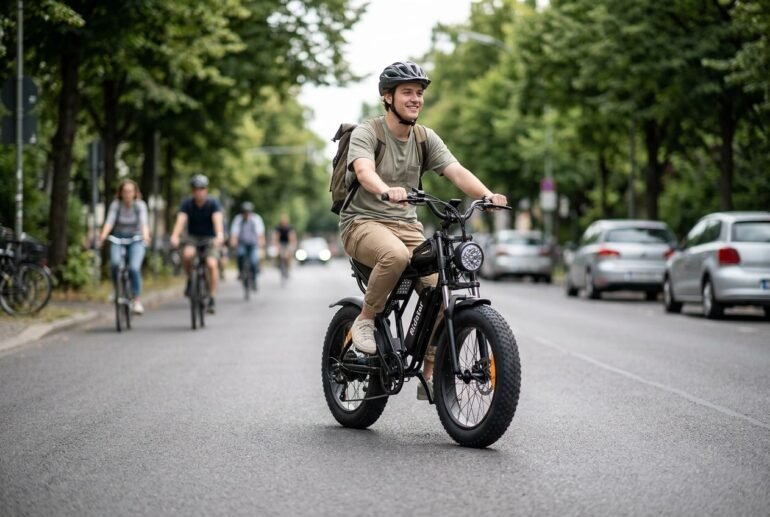
The Ridstar Q20 is one of those fat tire electric bikes that instantly grabs attention. It has a bold, moto-inspired frame, chunky 20-inch tires, a large removable battery, and enough power on paper to make daily commuting and weekend riding feel more exciting than a regular city bike.
But looks and spec sheets do not always tell the full story.
A good e-bike should feel stable, comfortable, practical, and safe for the kind of riding you actually do. So in this review, we will look at the bike from a real buyer’s point of view: performance, range, comfort, features, value, downsides, and who should seriously consider it.
Ridstar Q20 at a Glance
The Ridstar Q20 is sold as a fat tire electric bike built for mixed use. That means it is not just aimed at smooth city roads. It is also designed for gravel paths, rough pavement, park trails, beach-style surfaces, and uneven streets where skinny tires can feel shaky.
According to Ridstar’s official product listing, the bike features a 1500W motor, a 48V 20Ah removable battery, 20 by 4-inch fat tires, dual hydraulic brakes, 7-speed Shimano mechanical shifting, and front and rear suspension. Ridstar also lists a tested top speed of around 30 to 33 mph and a range of up to 50 miles in pure electric mode or up to 75 miles with pedal assist, depending on conditions.
Here is the quick breakdown:
| Feature | Details |
|---|---|
| Bike type | Fat tire electric bike |
| Motor | 1500W brushless motor |
| Battery | 48V 20Ah removable battery |
| Tires | 20 x 4-inch fat tires |
| Claimed range | Up to 50 miles electric, up to 75 miles pedal assist |
| Claimed top speed | Around 30 to 33 mph tested |
| Brakes | Dual hydraulic brakes |
| Gearing | Shimano 7-speed |
| Suspension | Front and rear suspension |
| Rider height | Around 5’4″ to 6’2″ or 6’4″, depending on listing |
| Best for | Commuting, casual off-road riding, mixed-surface use |
On paper, this is a strong setup for the price range. The bigger question is whether those specs make sense for your daily riding life.
First Impression: A Bike That Wants to Feel Bigger Than It Is
The first thing most people notice about this bike is the design. It does not look like a traditional commuter bicycle. It has more of a mini electric motorcycle feel, especially because of the frame shape, fat tires, and long saddle.
That style can be a positive or negative depending on what you want.
If you like a bold, sporty e-bike that stands out, the design works well. It feels more adventurous than a basic step-through commuter bike. The fat tires give it a planted look, and the larger frame makes it seem tougher than many compact e-bikes.
But if you want something subtle, lightweight, and easy to carry upstairs, this is probably not that kind of ride. Fat tire e-bikes usually trade portability for stability, grip, and road presence.
The Ridstar Q20 seems best for riders who want a fun, powerful e-bike rather than a quiet-looking city bicycle.
Motor Performance: Strong Enough for Most Riders
The motor is one of the main reasons people search for this model. A 1500W motor gives the bike plenty of pull for quick starts, hills, and heavier riders. Ridstar’s own listings promote the Q20 as a powerful fat tire e-bike, with the official store showing 1500W power and a tested top speed range of about 30 to 33 mph.
In everyday use, that kind of power matters most in three situations.
First, it helps when you are starting from a stop. If you ride in traffic, near intersections, or through neighborhoods with frequent stop signs, stronger acceleration makes the bike feel less sluggish.
Second, it helps on hills. A lower-powered e-bike can feel fine on flat ground but struggle when the road starts rising. The extra motor strength gives the bike better climbing confidence, especially when paired with pedal assist.
Third, it helps with heavier loads. If you carry a backpack, groceries, delivery items, or ride with accessories, a stronger motor gives you more breathing room.
Still, riders should be realistic. A powerful motor does not turn an e-bike into a motorcycle, and local laws may limit where and how fast you can ride. PeopleForBikes notes that many U.S. e-bike regulations use a three-class system, and electric bicycles are often treated differently based on motor output, throttle use, and speed limits.
That point matters because this bike’s advertised speed and power may go beyond normal Class 1, Class 2, or Class 3 e-bike limits in some places. Before riding at full speed on public roads, bike lanes, or trails, check your local rules.
Battery and Range: Good Numbers, But Conditions Matter
The Ridstar Q20 uses a 48V 20Ah removable battery. That is a respectable battery size for a fat tire e-bike in this price range. A removable battery is also a real advantage because you can charge it indoors, keep it away from extreme weather, and replace it more easily if needed.
Ridstar lists up to 50 miles in pure electric mode and up to 75 miles in pedal assist mode on its Q20 product page. The official U.S. listing also shows the same 50-mile electric and 75-mile assist range claim.
Those numbers are useful, but they should not be read like a guarantee.
Real-world range depends on:
- Rider weight
- Tire pressure
- Wind
- Hills
- Road surface
- Speed
- Throttle use
- Pedal assist level
- Temperature
- Battery age
For example, a lighter rider cruising on flat roads at a moderate speed may get close to the higher range claims with pedal assist. A heavier rider using throttle heavily on hills will likely get much less.
That is true for almost every e-bike, not just this one.
A practical way to think about it is this: the battery should be strong enough for daily commuting, short errands, and recreational rides without constant charging. But if you plan long, high-speed rides using throttle most of the time, expect the battery to drain faster.
Ride Comfort: Fat Tires Make a Big Difference
Comfort is where fat tire e-bikes often shine. The 20 by 4-inch tires give the bike more contact with the ground, which helps absorb bumps and improve grip. They are especially useful on cracked pavement, gravel, dirt paths, and uneven roads.
The Ridstar Q20 also includes front and rear suspension, according to the official listings. That combination of fat tires and suspension gives the bike a more cushioned feel than a rigid commuter bike with narrow tires.
This matters if your local roads are rough. Many riders do not realize how tiring small bumps can become over a 30-minute commute. Fat tires smooth out the ride and make the bike feel more forgiving.
The long saddle is another important part of the design. It fits the moto-inspired look and gives riders more seating space. However, it may not suit everyone. Traditional bicycle saddles allow more leg movement for active pedaling, while long bench-style seats can feel better for casual cruising.
If you are buying mainly for pedal-heavy fitness riding, this design may not feel as natural as a regular hybrid e-bike. If you are buying for relaxed commuting, throttle-assisted cruising, and mixed terrain, it makes more sense.
Brakes and Safety: Hydraulic Brakes Are a Smart Choice
A heavier, faster e-bike needs strong brakes. That is not optional.
The official Q20 product page lists dual hydraulic brakes, while Ridstar’s store describes front and rear oil disc brakes. Hydraulic brakes generally offer smoother stopping power and better modulation than basic mechanical disc brakes, especially on heavier e-bikes.
That is a major plus.
When an e-bike can reach higher speeds, braking becomes just as important as acceleration. You need to slow down confidently on hills, in traffic, near pedestrians, and when the road surface changes suddenly.
The National Highway Traffic Safety Administration reminds cyclists that riders are vulnerable road users, and that predictable riding, visibility, defensive behavior, and helmet use all play a role in reducing crash risk.
For a bike like this, safety habits matter even more:
- Wear a certified helmet.
- Do not ride faster than conditions allow.
- Use lights in low visibility.
- Brake early on wet roads.
- Keep both tires properly inflated.
- Check brake performance often.
- Learn how the bike reacts before riding in traffic.
The bike may have strong hardware, but the rider still makes the biggest safety difference.
Tires and Terrain: Built for Mixed Surfaces
The fat tires are one of the biggest selling points. A 20 by 4-inch tire gives the bike a wide footprint, which helps on loose or uneven surfaces. This makes the bike more flexible than a narrow-tire commuter model.
It can handle:
- City streets
- Broken pavement
- Gravel roads
- Light trails
- Park paths
- Hard-packed dirt
- Sandy or loose surfaces with care
That does not mean it is a full mountain bike for aggressive trail riding. Fat tires help with grip and comfort, but frame geometry, suspension quality, rider skill, and trail difficulty still matter.
Think of it as a bike for mixed-surface adventure, not extreme downhill riding.
For many buyers, that is exactly the sweet spot. You can ride to work during the week and take it onto rougher paths on the weekend without feeling limited to smooth pavement.
Design and Practicality: Stylish, But Not for Everyone
The design is one of the reasons people like the Ridstar Q20, but it also creates a few practical trade-offs.
The bike looks cool. It has a strong visual identity. It does not look like a plain commuter e-bike. For many riders, that is part of the appeal.
But the same features that make it look tough also make it less compact. Fat tires, a larger battery, suspension parts, and a strong frame usually add weight. Ridstar’s 1000W Q20 listing on another official Ridstar store page shows an item weight of 66 pounds, which gives a reasonable idea of the kind of weight class buyers should expect from this style of bike.
That means you should think about storage before buying.
Do you have a garage? A ground-floor apartment? A secure bike room? A place to charge the battery indoors?
If you need to carry your bike up stairs every day, this may feel like a chore. If you have easy storage and want stability, the weight becomes less of an issue.
Commuting With the Ridstar Q20
For commuting, this bike has several strengths.
The motor helps you maintain speed without exhausting yourself. The battery gives enough capacity for most daily routes. The fat tires make rough roads easier to handle. The upright, relaxed riding style can feel comfortable for casual riders.
It is especially useful if your commute includes:
- Uneven city roads
- Mild hills
- Longer distances
- Mixed pavement and gravel
- Areas where a stronger light and road presence help
- Short errands before or after work
However, it may not be the best commuter for everyone.
If your route is full of narrow bike lanes, crowded sidewalks, tight indoor storage spaces, or strict e-bike speed rules, the size and power may feel like too much. A lighter commuter e-bike could be easier in those cases.
The Ridstar Q20 works best for riders who want their commute to feel fun, not just practical.
Off-Road and Weekend Riding
This bike has the right personality for casual weekend rides. The fat tires and suspension make it more enjoyable on imperfect surfaces. You can ride through parks, open paths, gravel sections, and mild dirt trails without feeling like the bike is out of place.
The wide tires also help beginners feel more stable. That confidence can make a big difference if you are new to e-bikes or nervous on rougher surfaces.
Still, there are limits.
This is not a professional trail bike. Do not treat it like a downhill mountain bike. The weight, long saddle, and e-bike frame style are better suited to cruising and light adventure than technical trail riding.
For casual outdoor riders, though, it has a lot of appeal.
Who Should Buy This Bike?
The Ridstar Q20 makes the most sense for riders who want a powerful, stylish, fat tire e-bike for everyday riding and fun weekend use.
It is a good match for:
- Adults who want a bold-looking electric bike
- Riders who prefer comfort over lightweight design
- Commuters dealing with rough roads
- People who want throttle and pedal assist flexibility
- Riders who enjoy gravel paths and light trails
- Buyers who want strong specs for the price
- Anyone who likes a mini-moto style frame
It is probably not ideal for:
- Riders who need a very lightweight bike
- People with limited storage
- Apartment users who carry bikes upstairs
- Buyers who want a traditional bicycle feel
- Riders who only need short, slow city trips
- Anyone who must follow strict low-power e-bike rules
The key is matching the bike to your lifestyle. If you want a simple, light, quiet commuter, this may be more bike than you need. If you want power, comfort, and road presence, it becomes much more attractive.
Pros and Cons
Pros
- Strong 1500W motor
- Large 48V 20Ah removable battery
- Fat tires for grip and comfort
- Dual hydraulic brakes
- Front and rear suspension
- Eye-catching design
- Good for mixed surfaces
- Useful range for commuting and recreation
- Shimano 7-speed gearing
- Strong value compared with many premium fat tire e-bikes
Cons
- Heavier than a normal bicycle
- Not ideal for carrying upstairs
- May exceed e-bike limits in some areas
- Moto-style seat may not suit pedal-focused riders
- Real-world range will vary
- Bold design may not appeal to everyone
- Storage can be challenging in small apartments
Real-World Example: Daily Rider Scenario
Imagine someone who rides 8 miles to work, mostly on city streets with a few rough patches and small hills. A regular bike might feel tiring, especially after a long workday. A low-powered e-bike may help, but it might still feel slow on hills.
In that situation, this bike makes sense.
The motor helps with acceleration. The fat tires smooth out broken pavement. The battery has enough capacity for the round trip, even with some errands added. The hydraulic brakes help when traffic gets unpredictable.
Now imagine a different rider living on the third floor of an apartment building with no elevator. That same bike suddenly becomes less convenient. The power and comfort are still nice, but the weight and storage problem may become annoying fast.
That is why this review is not just about specs. A bike can be good and still be wrong for a specific rider.
How It Compares With a Regular Commuter E-Bike
A normal commuter e-bike usually focuses on efficiency, lighter weight, and practical city features. It may have thinner tires, a rear rack, fenders, and a more traditional riding position.
The Ridstar Q20 is different. It focuses more on power, style, and comfort over mixed terrain.
A commuter e-bike may be better if you want:
- Lighter handling
- Easier storage
- Better pedaling efficiency
- A more traditional bike feel
- A built-in rack and fenders
This fat tire model may be better if you want:
- More grip
- More visual style
- Stronger acceleration
- Better rough-road comfort
- A fun weekend ride
- A powerful all-around e-bike
Neither option is automatically better. They simply serve different riders.
Buying Considerations Before You Order
Before buying, check three things carefully.
First, check your local e-bike laws. Some areas classify e-bikes by motor wattage and top assisted speed. If a bike goes beyond those limits, it may be treated differently from a regular electric bicycle. PeopleForBikes explains that the three-class e-bike system is designed to clarify access, rights, and responsibilities for low-speed electric bicycles in the U.S.
Second, check the seller and warranty terms. Ridstar’s official site mentions free shipping, lifetime customer service, and a 12-month warranty on its store page. Warranty details can vary by region or seller, so buyers should read the exact terms before checkout.
Third, check fit. Ridstar listings commonly show recommended rider height around 5’4″ to 6’2″ or 6’4″, depending on the page. If you are much shorter or taller, fit may be less comfortable.
A powerful e-bike is more enjoyable when it fits properly.
Maintenance and Ownership Tips
Fat tire e-bikes are fun, but they still need regular care. The motor and battery get most of the attention, but simple maintenance often decides how good the bike feels after months of use.
Keep the tires inflated within the recommended range. Underinflated fat tires can feel comfortable, but they also reduce range and make the motor work harder.
Check bolts and fasteners after the first few rides. E-bikes create more vibration and torque than normal bicycles, especially on rough roads.
Clean the drivetrain regularly. The Shimano 7-speed system needs basic care, especially if you ride on dusty paths or wet roads.
Charge the battery properly. Avoid leaving it fully drained for long periods. Store it indoors when temperatures are extreme.
Test the brakes often. Hydraulic brakes are a strong feature, but pads still wear down. If the lever starts feeling soft or stopping distance increases, get it checked.
These small habits protect your investment and make every ride feel better.
Is the Ridstar Q20 Worth Buying?
For the right rider, yes, the Ridstar Q20 is worth considering. It offers a strong mix of power, battery size, fat tire comfort, hydraulic brakes, and bold styling at a price that is often lower than many premium fat tire e-bikes.
The biggest strengths are easy to understand. It feels powerful, looks different, handles rougher roads well, and has enough range for many real-world rides. The removable 48V 20Ah battery is practical, and the dual hydraulic brakes are a welcome safety feature.
The downsides are also clear. It is not lightweight. It may be too powerful for some local e-bike rules. It is not the most compact choice for apartment living. And riders who want a traditional pedaling feel may prefer a different frame style.
So the final answer depends on your riding style.
If you want a fun, powerful fat tire e-bike for commuting, casual trails, and weekend cruising, this model has a lot going for it. If you want something light, quiet, and purely practical, there are simpler commuter bikes that may fit better.
Conclusion
The Ridstar Q20 stands out because it does not try to be a plain city bike. It is bold, powerful, comfortable, and built for riders who want more excitement from an e-bike. The fat tires, strong motor, removable battery, hydraulic brakes, and suspension make it a serious option for mixed-surface riding.
It is not perfect for every rider, and buyers should pay close attention to local laws, storage space, and real-world range expectations. But as a value-focused fat tire e-bike, it delivers a strong package for people who want daily usefulness with a weekend adventure feel.
In simple words, the Ridstar Q20 is worth buying if you want power, comfort, and style in one electric bike. It is less ideal if your top priorities are low weight, compact storage, or a traditional bicycle feel. For many riders, though, it hits the right balance between fun and function in the growing world of the electric bicycle market.