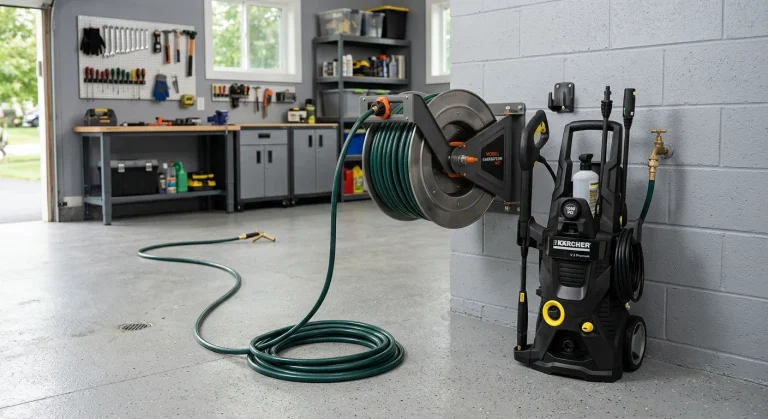
The right pressure washer hose reel is rated at or above your washer’s maximum pressure, holds the hose length you’ll actually use, matches your hose diameter and fittings, and mounts to a surface that can take the load. Everything else is preference. Auto-rewind saves effort, a manual crank often costs less and can hold more hose, and a garden hose reel is not a safe substitute for either.
This guide walks through those choices in order, then covers installation, winter storage, and the mistakes that cause leaks and failures. Specs and prices change often, so confirm details on the product page before you buy.
Do You Need a Retractable Pressure Washer Hose Reel?
Not always, but it helps in a fixed setup like a garage, shop, or wash bay. A reel keeps the hose off the floor, and one manufacturer notes that automatic retraction reduces trip hazards and abrasion.
The trade-offs are real:
- Cost: a reel adds to the price of the hose and washer.
- Fixed location: you mount it in one spot, so it suits stationary setups better than jobs at multiple sites.
- Another joint under pressure: the swivel can leak over time.
- Limited capacity: the reel’s size caps your hose length.
If you wash a car a few times a year with a short hose, a sturdy wall hook may be enough.
How to Choose a Pressure Washer Hose Reel
Match the Pressure Rating
One guide advises that a reel’s pressure rating should equal or exceed your washer’s maximum output, because a lower rating can damage the reel or hose. Residential washers typically run between 1,500 and 3,000 PSI, according to one buying guide.
Here’s a quick way to apply that rule:
| Your washer’s maximum | Look for a reel rated at least |
|---|---|
| Up to 2,000 PSI | 2,000 PSI |
| Up to 3,000 PSI | 3,000 PSI |
| Up to 4,000 PSI | 4,000 PSI |
Read specs closely. One listing states a 3,200 PSI working pressure in its specifications and up to 4,000 PSI in its description. Look for the working pressure, and treat headline maximums with caution.
Pick Hose Length and Diameter
Measure from the spot where the reel will hang to the farthest place you’ll clean, then add a few feet of margin. Very long runs of narrow hose can reduce pressure at the nozzle, so don’t buy more length than you need.
Consumer reels commonly use 1/4 in hose, while heavier-duty reels use 3/8 in. Lengths in current listings include 50, 60, 65, and 100 ft. For most driveways, patios, and siding, 50 to 65 ft covers a lot of ground from a single mounting spot.
Choose Auto-Rewind or Manual Crank
Spring-driven reels retract the hose automatically, and many pair that with a ratchet or stop-anywhere lock so you can fix the hose at the length you need. Manual crank reels skip the spring. One listing shows a 100 ft manual-crank reel rated at 4,000 PSI.
| Auto-rewind | Manual crank | |
|---|---|---|
| Convenience | High, one pull and release | Lower, you wind it by hand |
| Cost | Usually higher | Often lower |
| Capacity | Often 50 to 65 ft | Can hold longer hose |
| Wear points | Spring mechanism | Fewer moving parts |
Guide the hose back by hand instead of letting it snap, which protects the spring and the hose.
Check the Mounting
Reels can mount on walls, ceilings, or floors. One model’s guide arm rotates up to 225 degrees, which helps when you can’t line the reel up directly with where you work. Whatever you choose, anchor it to something solid. A guide on garden reels calls mounting to a sturdy wall or post essential for safe operation, and the same logic applies here. Use lag screws into wall studs, or masonry anchors in brick or concrete, and avoid hollow drywall.
Confirm Connections, Swivel, and Temperature
A short leader hose, sometimes called a whip hose, connects the washer to the reel. Some listings bundle the hose and leader, while others sell the reel alone, so read what’s in the box. One listing mentions an M22 connector, so check the thread type on your washer’s outlet before buying.
Also check the temperature rating. One reel lists 140°F, and another hose is rated from -40°F to 150°F. If you use a hot-water washer, don’t assume any reel will cope.
What Specs Look Like in Real Listings
These examples show how ratings, lengths, and hose types combine. They’re not recommendations, and we haven’t tested them.
- A 1/4 in x 50 ft reel with a polyester-braided hose rated to 3,100 PSI, a steel frame, and a 12-point ratchet lock.
- A 3/8 in x 50 ft reel with a single wire-braided hose rated to 4,000 PSI, aimed at heavier cleaning.
- Two retractable reels from one seller: a 65 ft model rated to 3,200 PSI and a 60 ft model rated to 4,000 PSI.
As a rule of thumb, home users on 1/4 in hose do well with 50 to 65 ft. Contractors and detailers who run higher pressures or longer jobs should look at 3/8 in hose and a heavier frame.
Installing and Using It Safely
- Read both manuals. Check the washer’s maximum pressure and the reel’s rated working pressure.
- Pick a solid spot. Choose a stud, masonry, or a purpose-built bracket, and place the reel so the hose pulls out straight.
- Mount at a reachable height. Use fasteners rated for the load.
- Connect and test. Tighten fittings as instructed, then run the washer at low pressure and check the swivel and joints for leaks.
- Pull only what you need. Lock the hose at that length and avoid sharp bends.
- Release pressure before disconnecting. Then drain the hose before storing it, especially if your garage or shed freezes in winter.
Pressurized water can injure skin and tissue. Never point the wand at people or pets. If a burst hose or leak sprays you at close range, seek medical attention.
Common Mistakes to Avoid
- Using a garden hose reel. One guide lists garden reels at 116 to 200 PSI working pressure with 600 PSI burst ratings, far below what a pressure washer produces.
- Buying on maximum PSI alone. Check working pressure and the manufacturer’s stated conditions.
- Guessing at length. Too short is annoying, but too long adds weight and bulk.
- Mounting to weak surfaces. Hollow drywall and thin panels won’t hold a reel under load.
- Ignoring early leaks. A drip at the swivel usually gets worse.
Final Thoughts
A good pressure washer hose reel fits your washer’s pressure, your work area, and your wall. Before you shop, write down your washer’s maximum PSI, the hose length you need, the outlet thread type, and where the reel will go. That short list will narrow your options faster than any ranking will.
FAQ
What PSI should a pressure washer hose reel be?
At least your washer’s maximum output. A lower-rated reel or hose can fail.
Can I use a garden hose reel with a pressure washer?
No. Garden reels are built for much lower pressure and aren’t safe for pressure washer output.
How long should the hose be?
Measure to your farthest cleaning spot and add a margin. Many home setups use 50 to 65 ft.
Is a retractable pressure washer hose reel better than a manual one?
Auto-rewind is easier to use. A manual crank can cost less and often holds more hose.
Can I use hot water?
Only if the reel and hose are rated for it. Listings show ratings ranging from about 140°F to 150°F, so check the specs.