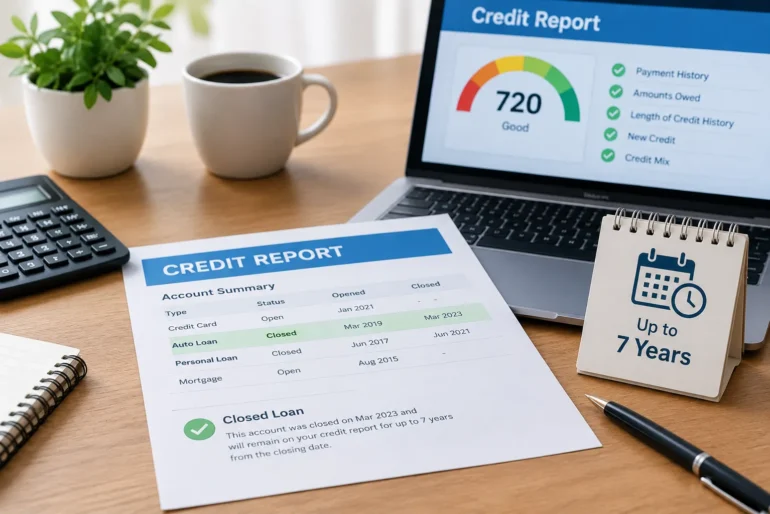
A closed loan stays on your credit report for several years after the account is fully repaid or closed by the lender. It does not disappear immediately, and in most cases, keeping an accurately reported closed loan on your record is beneficial because it shows your repayment history.
If you finished paying a home loan from SBI, a personal loan from HDFC Bank, or a consumer loan from Bajaj Finserv, don’t expect the account to vanish after the final EMI. Credit information companies continue to display closed accounts because lenders use past repayment records while evaluating fresh applications. A loan marked “Closed” is different from one marked “Settled,” “Written Off,” or “Default.”
The important question is not whether a closed loan appears on your report. It is whether the information attached to that account is accurate. Incorrect closure dates, outstanding balances, or repayment remarks deserve attention because they influence lending decisions long after the last EMI is paid.
Why Do Closed Loans Continue To Appear?
A closed loan remains visible because credit information companies maintain a historical record of borrowing and repayment instead of displaying only active accounts. Lenders reviewing a new application want to understand how previous loans were managed from the first disbursal until closure.
That history includes information such as:
- Loan opening date.
- Loan closure date.
- Repayment status.
- Payment delays, if any.
- Final account status.
Keeping this information available benefits both lenders and borrowers. Someone who repaid a ₹12 lakh home loan over 15 years without significant delays presents a different lending picture from someone whose account ended with unpaid dues.
Closed accounts also help explain the age of existing credit relationships. Removing every completed loan immediately after closure would leave lenders with very little repayment history to assess. For this reason, seeing a closed loan on your credit report is an expected part of the reporting process rather than an indication that something is wrong.
How Long Do Different Closed Loan Records Stay?
Different loan accounts remain visible for years after closure because lenders rely on historical repayment information while assessing fresh applications. The exact retention period depends on the reporting practices of the credit information company and applicable regulations rather than the type of loan itself.
| Closed Account Type | Details that Remain Visible After Closure |
| Home loan | Repayment history, closure status, loan dates |
| Personal loan | Closure status, repayment record, account details |
| Vehicle loan | Loan history and final account status |
| Credit card account | Payment history, closure date, account status |
The continued presence of a closed account should not be treated as an error. Instead, review whether the account status, repayment history, and closure information are correct before applying for fresh credit.
What Should You Check After Closing A Loan?
Completing the final EMI is only one part of closing a loan. The next step is confirming that the lender has reported the closure correctly, especially if one of the questions in your mind is “how to fix credit score” after repaying existing debt.
Review the following details carefully:
- Final account status.
- Outstanding balance.
- Loan closure date.
- Repayment history.
- Personal information linked to the account.
For example, if Axis Bank confirms that your personal loan has been closed but the report still shows an outstanding balance several weeks later, retain every supporting document instead of assuming the information will change automatically.
The Reserve Bank of India’s Master Direction – Credit Information Reporting requires regulated entities to furnish accurate and timely credit information to Credit Information Companies (CICs). Keeping your loan closure letter, final payment receipt, and lender communication makes it easier to support a correction request if reporting errors arise.
Why Does An Incorrect Closed Loan Status Matter?
A loan that has been repaid should show the correct account status in the credit report. If it continues to display an outstanding balance, an incorrect closure date, or a settlement remark that does not match the lender’s records, lenders reviewing a fresh application receive inaccurate information.
The consequences include:
- Additional verification before loan approval.
- Delays in processing applications.
- Requests for loan closure letters or payment proof.
- Questions about outstanding dues that no longer exist.
Suppose a borrower repaid a ₹7 lakh personal loan from ICICI Bank in full, but the account still appears with an unpaid balance months later. Even after producing repayment proof, the borrower could face additional document requests until the information is corrected through the reporting process.
That is why every borrower should verify loan information after receiving the final closure confirmation instead of assuming the reporting has already been completed correctly.
How Long Should You Wait Before Reviewing Your Report?
A lender needs time to complete its internal closure process and submit updated information through the credit information reporting system. Reviewing your report immediately after making the final payment does not always show the latest account status.
A practical timeline looks like this:
- Collect the loan closure letter after the lender confirms repayment.
- Keep the final payment acknowledgement safely stored.
- Review your report after the lender has had sufficient time to report the closure.
- Compare every account detail with your loan documents.
- Raise a dispute if the reported information does not match the lender’s records.
Checking only the loan status is not enough. Verify repayment remarks, closure dates, outstanding balances, and personal details at the same time so that every part of the account reflects the completed loan accurately.
Before You Apply For Another Loan
A correctly reported closed loan strengthens the repayment history available to lenders. An incorrectly reported one creates unnecessary questions that could delay approval even after every EMI has been paid.
Before applying for a fresh credit card, personal loan, or home loan, review your credit report carefully. Checking your report on Oolka is free, and you only pay if you want Oolka to take action. Instead of figuring out who to contact and what to write, let Oolka handle it. From dispute filing to lender communication and follow-ups, the process is managed for you after a free report check.
Under RBI’s Credit Information Reporting framework, eligible borrowers receive ₹100 per day as compensation if a valid dispute remains unresolved for more than 30 days because of delays by the lender or the Credit Information Company (CIC). Taking action as soon as you spot an error gives you the best chance of resolving it before it affects your next borrowing decision.
Closed Loans Are Part Of Your Credit History
Closing a loan does not remove it from your credit history, nor should it. Those records help lenders understand how previous borrowing was managed and whether repayments were completed successfully.
Instead of expecting closed accounts to disappear, focus on whether the information is accurate. If every detail matches your lender’s records, a closed loan becomes a positive part of your repayment history rather than a concern during your next credit application.