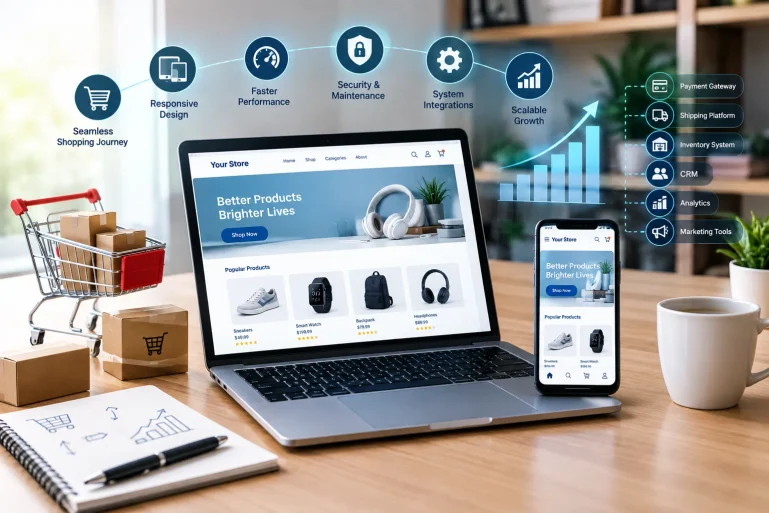
Ecommerce has changed how businesses connect with customers. A well-designed online store can help a company reach new markets, showcase its products, simplify purchasing, and build lasting customer relationships. However, creating a successful ecommerce website requires more than attractive visuals. The website must be reliable, responsive, secure, and prepared to support business growth.
As online competition increases, businesses are paying closer attention to the technology and development decisions behind their digital stores. A thoughtful development strategy can improve both customer experience and operational efficiency.
Understanding the Customer Journey
Before development begins, businesses should understand how customers move through the website. From discovering a product to completing an order, every step should feel straightforward.
Clear categories, useful search features, detailed product pages, visible calls to action, and simple checkout processes can reduce unnecessary friction. Customers should be able to find what they need without navigating through complicated menus or excessive pages.
Understanding customer behavior also helps businesses identify areas where the website can be improved over time.
Building a Flexible Ecommerce Foundation
An ecommerce website should be capable of growing alongside the business. Adding new products, introducing additional payment options, expanding into new locations, or connecting new business tools should not require rebuilding the entire platform.
Businesses can benefit from working with a Shopify development company when they need a structured ecommerce environment with features for product management, payments, inventory, applications, and store administration.
The right platform can provide a foundation that supports both current requirements and future expansion.
Responsive Design Is Essential
Customers access ecommerce websites through smartphones, tablets, laptops, and desktop computers. A website that works well on one device but performs poorly on another can create an inconsistent shopping experience.
Responsive design ensures that page layouts, images, buttons, menus, and product information adjust according to screen size. Mobile-friendly navigation is particularly important because customers increasingly expect convenient shopping experiences from their phones.
A responsive website can also make it easier for businesses to maintain a consistent brand experience across devices.
Website Speed Supports Better Experiences
Speed is another important component of ecommerce development. Visitors expect pages to load quickly, especially when browsing multiple products.
Large images, unnecessary scripts, inefficient code, and poorly configured hosting can affect performance. Developers can improve website speed through image optimization, caching, efficient code, content delivery solutions, and appropriate technical configurations.
Performance improvements should be included during development rather than treated as an afterthought.
Connecting Business Systems
An ecommerce website rarely operates independently. Businesses may need connections with payment gateways, shipping platforms, inventory systems, customer relationship management software, analytics platforms, and marketing tools.
Proper integrations can reduce repetitive administrative tasks and allow information to move more efficiently between systems. This can help teams manage orders, customer information, stock levels, and marketing activities more effectively.
A development strategy should therefore consider the complete business ecosystem rather than focusing only on the storefront.
Security and Maintenance Matter
Customers need confidence when entering personal and payment information online. Ecommerce websites should follow appropriate security practices and use reliable payment systems.
Regular maintenance is equally important. Software updates, backups, security monitoring, performance checks, and functionality testing can help prevent avoidable problems.
Ongoing maintenance also gives businesses opportunities to introduce improvements based on customer feedback and website performance data.
Choosing the Right Development Partner
The development partner can influence how effectively an ecommerce project moves from planning to launch. Businesses should look for professionals who understand website architecture, user experience, performance, security, integrations, and scalability.
A web development company in Mumbai may support businesses with customized development strategies that align technical decisions with their broader digital objectives.
The important consideration is not simply whether a website can be launched, but whether it can continue supporting the business as its requirements evolve.
Preparing for Future Ecommerce Growth
A modern ecommerce website should be designed with tomorrow’s requirements in mind. Customer expectations will continue to change, new technologies will emerge, and businesses will introduce new products and services.
A scalable architecture, intuitive experience, strong performance, and reliable maintenance strategy can make it easier to respond to these changes.
By treating website development as a long-term investment rather than a one-time task, businesses can create an ecommerce platform that supports customer engagement, operational efficiency, and sustainable digital growth.