Choosing a school is not simply about finding a campus with impressive facilities or strong academic results. For parents exploring CBSE schools in Bannerghatta Road, the more important question is whether a school’s teaching approach, learning environment, student support, and daily routine fit their child’s needs. With multiple options available, having clear criteria can make the shortlisting process more practical and less overwhelming.
The CBSE curriculum increasingly focuses on competency-based education, experiential learning, real-life application, and holistic development rather than relying only on rote learning. This makes it useful for parents to examine how schools translate these principles into everyday classroom experiences.
Start With the Learning Experience
Schools following the same board can still provide very different learning experiences. The difference often lies in how teachers explain concepts, encourage participation, use activities, and respond to individual learning needs.
Parents should therefore look beyond the syllabus and understand what learning actually looks like inside the classroom.
Ask How Concepts Are Taught
Instead of asking only which subjects are offered, ask how students learn them.
Do science lessons involve experiments? Are students encouraged to investigate questions? Do mathematics activities involve practical problem-solving? Are children asked to explain their reasoning?
These details can reveal whether learning focuses primarily on remembering information or also helps students understand and apply it.
1. Compare the Teaching Approach
Teachers have a direct influence on a child’s relationship with learning.
Parents can ask about teacher qualifications, professional development, classroom practices, and teacher-student interaction. It is also worth understanding how teachers support students who learn at different speeds.
CBSE’s curriculum encourages experiential, activity-centred, constructivist, and competency-focused approaches, making teaching methodology an important part of evaluating a school.
A useful comparison is therefore not simply who teaches the subject, but how students are encouraged to learn it.
2. Examine Assessment Beyond Marks
Assessment can reveal a school’s academic priorities.
Parents should find out whether students are assessed only through written tests or whether schools also use projects, presentations, practical activities, classroom participation, and other forms of evaluation.
CBSE’s assessment framework increasingly includes methods such as projects, debates, presentations, case-based questions, practical work, and self-assessment to evaluate broader competencies.
Questions parents can ask
- How often are students assessed?
- How is feedback provided?
- How are learning gaps identified?
- Are students given opportunities to improve their work?
- Does assessment measure understanding or mainly recall?
The answers can provide a clearer picture of the school’s academic culture.
3. Look at Practical and Skill-Based Learning
Academic concepts become more meaningful when students can connect them with real situations.
This is particularly relevant as CBSE introduces stronger skill-based learning across school education. From the 2026–27 academic session, skill education through Kaushal Bodh is being introduced for Classes VI–VIII with project-based activities involving different forms of practical work.
Parents can therefore explore whether a school provides opportunities for students to:
- Design and create
- Conduct experiments
- Work on projects
- Present ideas
- Solve practical problems
- Apply classroom concepts
These experiences can help students understand why their learning matters beyond examinations.
4. Evaluate Technology With Purpose
A school having smart classrooms or digital devices does not automatically mean technology is being used effectively.
The more important question is how students use it.
Do they research, create presentations, collaborate, analyse information, or use digital tools to understand difficult concepts?
CBSE’s current academic portal also highlights a framework for computational thinking and artificial intelligence for Classes III–VIII, reflecting the increasing role of these skills in school education.
Technology should therefore be evaluated for its educational purpose rather than simply its presence.
5. Consider Student Wellbeing
Academic performance is only one part of a child’s school experience.
Parents should understand how schools approach emotional wellbeing, peer relationships, counselling, student concerns, and academic support.
A supportive environment should allow students to communicate when they are struggling and receive appropriate guidance.
It is also useful to ask how teachers identify students who may need additional support rather than waiting until difficulties become serious.
6. Look Beyond Academics
Children develop interests and abilities outside traditional subjects.
Sports, music, theatre, art, public speaking, clubs, leadership activities, and other programmes can help students explore different strengths.
However, a long list of activities does not automatically indicate quality.
Parents should ask whether these opportunities are meaningfully integrated into school life and whether students have enough flexibility to participate without feeling overloaded.
7. Examine Infrastructure Through Daily Use
Facilities can be useful indicators, but their value depends on how students use them.
During a campus visit, parents can ask:
Are laboratories regularly used?
Do students have access to sports facilities?
Is the library part of everyday learning?
Are activity spaces connected to classroom projects?
This approach helps parents distinguish between facilities that genuinely support learning and facilities that simply appear impressive during a school tour.
8. Think About the Daily Commute
Distance can have a greater impact on a child’s routine than parents initially expect.
A lengthy journey can affect sleep, homework, extracurricular participation, and family time.
When comparing CBSE schools in Bannerghatta Road, parents should consider actual travel time during school hours rather than looking only at the distance on a map.
Transport arrangements, pick-up points, school timings, and after-school activities should also be considered before making a decision.
9. Understand Parent-School Communication
Parents need useful information about their child’s progress.
Ask how schools communicate academic updates, attendance, teacher feedback, events, and concerns.
It is also worth understanding how parents can approach teachers and whether meetings focus on meaningful discussions about the child’s development.
Effective communication should help families understand their child’s progress without creating unnecessary pressure.
10. Check Safety and Everyday Support
Safety is another factor that deserves attention during a campus visit.
Parents can ask about entry and exit procedures, transportation safety, emergency preparedness, medical support, supervision, and student protection policies.
These details may not appear in academic comparisons, but they directly affect a child’s everyday experience at school.
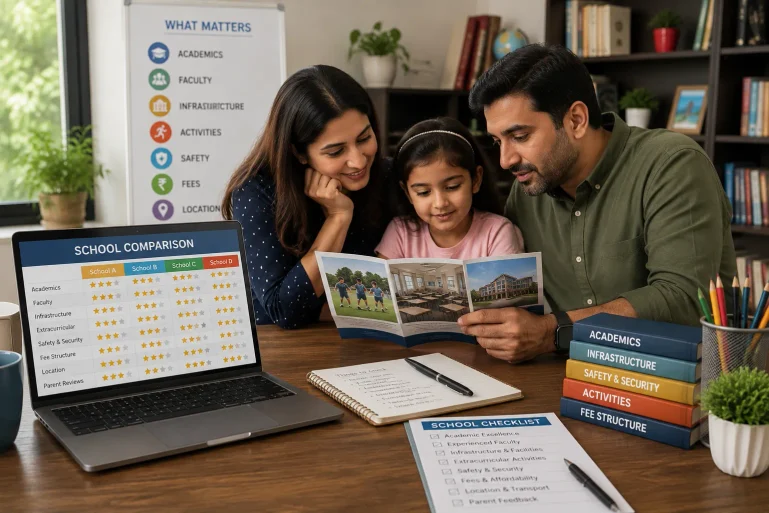
Create a Simple Comparison Framework
After visiting shortlisted schools, parents can create a comparison sheet covering:
- Teaching methodology
- Assessment
- Skill development
- Student wellbeing
- Technology
- Infrastructure
- Extracurricular activities
- Safety
- Parent communication
- Location and commute
- Fees and additional costs
The importance given to each factor can differ from family to family. For younger children, commute and pastoral support may carry greater weight, while older students may require closer attention to academic pathways and subject options.
Final Thoughts
Shortlisting schools in Bannerghatta becomes easier when parents look beyond rankings and facilities and consider how each school supports learning, practical skills, wellbeing, and individual growth.
For families seeking a CBSE education that combines academics with experiential learning, co-curricular exposure, technology, and student wellbeing, EuroSchool can be one option to explore. Its Bengaluru network includes a Bannerghatta campus and focuses on a broader learning experience alongside academics, giving families an example of how a contemporary school environment can support different aspects of student development.