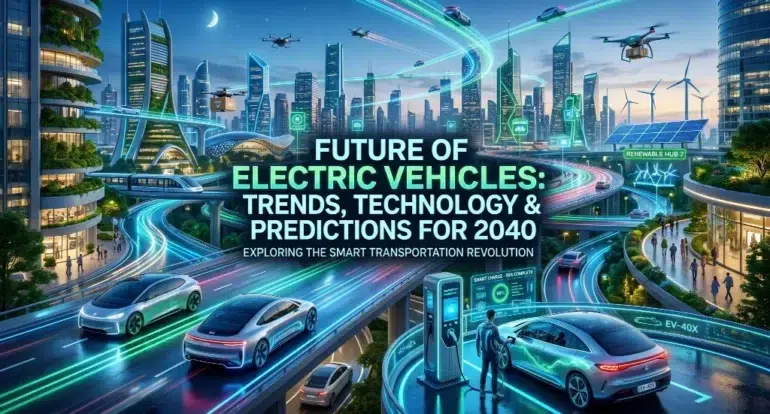
Will there be a demand for electric vehicles in the future? These vehicles are expected to account for the majority of global passenger car sales by 2040, driving an estimated ($1.8) trillion industry. Key trends include overall battery advancements, self driving integration, and shifting infrastructure priorities, all pointing toward an electric-dominated transportation ecosystem by the year 2040.
The future of sustainable vehicles is shaped by rapid technological innovations and evolving market trends that promise to revolutionize the automotive industry and accelerate the transition towards sustainable transportation. In this blog post, we’ll explore key advancements in EVs technology and emerging market trends that are driving the future of electric mobility.
What are Electric Vehicles?
Battery-powered vehicles like cars, trucks, or motorcycles that use one or more electric motors for propulsion instead of a gas-powered engine. Rather than stopping at a gas station to fill up, you plug the vehicle into an electrical outlet or charging station to recharge its battery. There are four types of it, which are given below.
- Battery Electric Vehicles (BEVs)
- Hybrid Electric Vehicles (HEVs)
- Plug-in Hybrid Electric Vehicles (PHEVs)
- Fuel Cell Electric Vehicles (FCEVs)
EVs VS Traditional Cars
| Electric Vehicles (EVs) | Traditional Cars |
| Run on electricity | Run on petrol or diesel |
| Use electric motors | Use fuel engines |
| Produce low or zero tailpipe emissions | Produce more air pollution |
| Need charging stations | Need fuel stations |
| Have fewer moving parts | Have more moving engine parts |
Smart vehicles are becoming popular because they help reduce fuel costs, lower pollution, and need less maintenance than traditional cars.
Why the Future of Electric Vehicles Looks Strong
- Rising fuel costs: Increasing petrol and diesel prices are pushing more people to switch to electric vehicles.
- Government support: Many governments are offering tax benefits and incentives to support EV adoption.
- Better battery technology: Modern EV batteries now provide longer driving range and faster charging.
- Lower maintenance costs: Sustainable vehicles need less maintenance because they have fewer moving parts.
- Growing environmental awareness: More people are choosing EVs to help reduce air pollution and carbon emissions.
Biggest Electric Vehicle Trends in 2040
- Faster Charging Technology: Future EVs are expected to charge much faster than current electric cars. For example, some organizations are developing batteries that can charge within 10 to 15 minutes.
- Longer Battery Life: Battery technology is improving to provide longer driving range and better durability. For example, solid-state batteries may allow EVs to travel over 1,000 kilometers on a single charge.
- Self-Driving EVs: Many smart vehicles are expected to include advanced self-driving features by 2040. For example, Tesla is already testing autonomous driving technology.
- AI Integration in Cars: Artificial intelligence is helping EVs become smarter and safer for drivers. For example, AI systems can suggest routes, control speed, and monitor battery performance.
- Solar-Powered Vehicles: Some electric transport systems may use solar panels to support battery charging during travel. For example, solar-powered cars can collect energy from sunlight while parked outside.
- Wireless Charging: Wireless charging technology may allow EVs to charge without using cables. For example, some companies are testing charging pads placed under parking spaces and roads.
- Smart Connectivity Features: Future plug-in vehicles are expected to be connected to phones, traffic systems, and smart devices. For example, drivers will be able to control car settings through mobile apps and voice commands.
Future Battery Technology in Electric Vehicles
Future EV battery technology is improving to solve common problems like slow charging, limited driving range, and high costs. New battery systems are also making eco-friendly vehicles safer, lighter, and more affordable for daily use.
Key Advancements in EV Battery Technology
Solid-State Batteries: Solid-state batteries use solid materials instead of liquid electrolytes, which helps improve battery performance and safety. These batteries can give EVs a longer driving range while reducing battery weight.
Faster Charging Speeds: New battery designs and high-voltage systems are helping EVs charge much faster than before. This can reduce waiting time at charging stations and make long-distance travel easier.
Battery Safety Improvements: Modern battery technology is reducing the risk of overheating and battery fires in electric vehicles. Safer battery materials are also helping improve overall vehicle reliability.
Lower Battery Costs: Battery prices are slowly decreasing because of large-scale production and improved manufacturing methods. This is making electric transports more affordable for more people.
Battery Recycling:Battery recycling programs are growing to recover materials like lithium, cobalt, and nickel from old EV batteries. This helps reduce waste and lowers the need for new mining projects.
How AI Will Improve Electric Vehicles
Artificial intelligence acts as the brain of electric vehicles (EVs), solving fundamental challenges like limited battery range and charging wait times. By optimizing energy consumption, preventing unexpected breakdowns, and enabling advanced autonomous features, AI transforms EVs into smarter, more efficient, and more personalized machines.
Future Charging Infrastructure for EVs
The future of Electric Vehicle (EV) charging infrastructure is shifting toward ultra-fast charging, AI-driven smart grids, and sustainable, localized power generation. The global market is rapidly expanding to meet surging demand, with the industry projected to reach over $200 billion as charging networks scale and evolve.
Top Companies Leading the EV Future
The electric vehicle (EV) market is strongly competitive globally. Legacy and new-energy automakers regularly battle for the top spots in sales, tech, and production scale. Below are the five companies currently leading the global EV future.
Tesla
As the global EV Innovator, Tesla continues to conquer with an unmatched combination of vehicle software, battery efficiency, and owned charging infrastructure.
- Market Status: Holds the single-brand EV lead in the United States and remains a top global volume leader.
- Key Strengths: High levels of vertical integration, massive economies of scale with Gigafactories worldwide, and development of managed Full Self-Driving (FSD) into essential markets like China.
- Leading Models: Model Y and Model 3
BYD
Headquartered in China, BYD is an industrial powerhouse and one of the world’s largest New Energy Vehicle (NEV) factories.
- Market Status: Aggressively competes with Tesla for the number one spot in global fully electric (BEV) and plug-in hybrid (PHEV) sales.
- Key Strengths: Complete vertical integration across battery cells (famous for their Blade Battery tech), semiconductors, and vehicle assembly, offering them a structural advantage in cost control.
- Leading Models: Seagull (Dolphin Mini) and Atto 3.
BMW
BMW has built a strong position in the car market by giving customers different choices like petrol, hybrid, and modern transportation on the same platform.
- Market Status: BMW is one of the top premium EV brands in Europe and its electric vehicle sales are growing steadily.
- Key Strengths: The company is known for its luxury features, smooth software system, and strong driving performance. BMW is also working on its new EV platform called Neue Klasse, which is expected to improve battery range and efficiency.
- Leading Models: i4, iX, and iX3.
Toyota
Toyota is well known for its success in hybrid vehicles and is now increasing its focus on electric mobility around the world.
- Market Status: Toyota is one of the world’s biggest car companies and benefits from its large manufacturing network and global presence.
- Key Strengths: Expanding EV offerings through dedicated electric platforms, solid-state battery research, and massive infrastructure investments.
- Leading Models: bZ4X.
Hyundai
The South Korean car company has quickly become one of the strongest competitors in the EV market.
- Market Status: The brand is growing fast in North America and Europe and is moving closer to the top global EV companies.
- Key Strengths: Its E-GMP platform supports very fast charging, V2L features, and modern car designs.
- Leading Models: Ioniq 5, Ioniq 6, and Kia EV6.
Conclusion
Eco-friendly vehicles are expected to play a major role in the future of transportation by 2040. Better battery technology, faster charging, AI features, and government support are helping EVs grow worldwide. As more companies invest in electric mobility, EVs will become more affordable, efficient, and environmentally friendly for everyday use.