

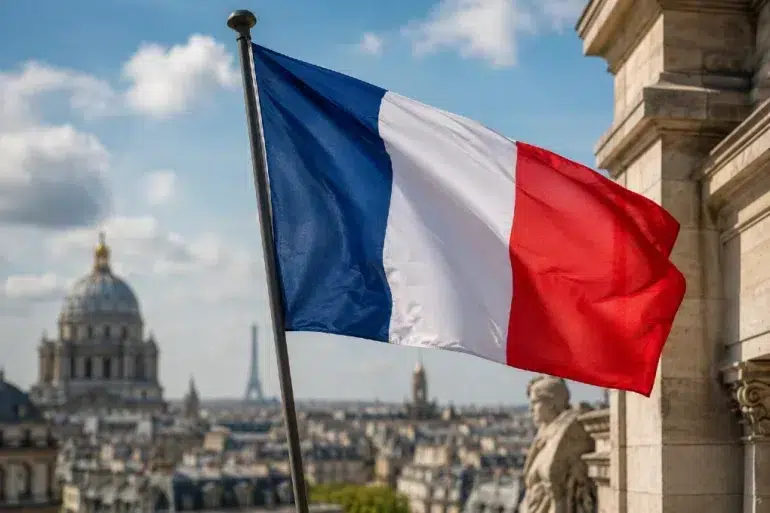
The Frankreich Flagge is one of the most recognizable national flags in the world. Even if someone does not speak French or German, the blue, white, and red vertical stripes instantly bring France to mind. You see it outside government buildings, at international sports events, during national ceremonies, and in travel photos from Paris, Marseille, Lyon, and beyond.
But the French flag is more than a simple three-color design. It carries a long story shaped by revolution, monarchy, civic identity, national unity, and modern French pride. Its design may look simple at first glance, yet each color has a place in France’s political and cultural memory.
For readers searching for Frankreich Flagge, the term simply means “France flag” in German. It usually refers to the national flag of France, also known as the French Tricolor or “Le Tricolore.” This article takes a clear, human look at what the flag means, where its colors came from, how it changed through history, and why it still matters today.
What Is the Frankreich Flagge?
The Frankreich Flagge is the national flag of France. It has three vertical bands of equal width: blue on the hoist side, white in the middle, and red on the outer side. This style is called a vertical tricolor.
France’s Constitution identifies the national emblem as the tricolor flag in blue, white, and red. The official French presidency also describes the flag as a symbol born from the French Revolution, combining white, associated with the king, with blue and red, traditionally linked to Paris.
The flag is often called:
- The French Tricolor
- Le Tricolore
- The blue, white, and red flag
- The national flag of France
- The French Republic flag
The simple design makes it easy to recognize, but that simplicity is part of its power. Unlike flags filled with coats of arms, stars, animals, or detailed symbols, the French flag relies on color and balance. That gives it a clean, bold, and timeless look.
Quick Facts About the French Flag
| Feature | Detail |
|---|---|
| Country | France |
| Common name | French Tricolor |
| French name | Le Tricolore |
| Colors | Blue, white, red |
| Layout | Three vertical stripes |
| Main symbolism | Nation, people, revolution, unity |
| Historical roots | French Revolution |
| Official order | Blue, white, red |
| Common proportion | 2:3 |
The French Tricolor became closely tied to revolutionary France in the late 18th century. Britannica notes that the order blue-white-red became the official national flag arrangement in 1794 for use by the people, army, and navy.
Frankreich Flagge Meaning: More Than Three Stripes
The meaning of the Frankreich Flagge is layered. There is no single short answer that captures everything. The flag connects royal France, revolutionary Paris, the birth of the republic, and the country’s modern identity.
A common explanation is that:
- Blue and red represent Paris
- White represents the monarchy or historic France
- Together, the colors represent unity between the people and the nation
This explanation is widely repeated because it connects directly to the French Revolution. During that period, the political meaning of colors became especially important. The flag was not just decoration. It was a public symbol of change.
The French presidency explains that blue and red were the colors of Paris, while white was the color of the king. When these colors came together during the Revolution, they symbolized a new relationship between the people and authority.
That is why the French flag is often understood as a bridge between past and future. It did not erase France’s history. Instead, it reshaped it into a new national symbol.
Why Is the Frankreich Flagge Blue, White, and Red?
The colors of the Frankreich Flagge did not appear randomly. They grew out of political events, local identity, and older French traditions.
Blue and red had long been connected with Paris. During the French Revolution, these colors became strongly associated with the city’s revolutionary energy. White had royal associations and was used in earlier French flags and symbols.
When the three colors were brought together, they created a flag that could speak to different parts of French society. It held the city, the monarchy, and the emerging nation in one design.
Blue
Blue is often linked with Paris and with older French heraldic traditions. In the flag, blue appears first, nearest the flagpole.
Its position gives it visual strength. When the flag is hanging or waving, blue often catches the eye first. In a symbolic sense, it can be seen as representing civic identity, watchfulness, and the people’s presence in public life.
White
White sits in the center. Historically, white was associated with the French monarchy and with earlier royal banners.
In the modern flag, white is not only about kings. It also works as a balancing color between blue and red. Visually, it gives the flag brightness and contrast. Symbolically, it reminds us that France’s modern identity was built through tension between old authority and new political ideas.
Red
Red appears on the outer side of the flag. Like blue, red has links to Paris. It also carries a broader emotional weight because red is often associated with courage, sacrifice, struggle, and public action.
In the context of France, red can naturally bring to mind the intensity of revolutionary change. It gives the flag energy and warmth.
The French Revolution and the Birth of the Tricolor
To understand the Frankreich Flagge, you have to understand the French Revolution. The Revolution did not only change French politics. It changed the symbols people used to understand the nation.
Before the modern tricolor became established, France used different royal and military symbols. Many were tied to kings, dynasties, and religious traditions. The Revolution created a need for a new kind of national image, one that could represent citizens rather than only the crown.
In 1789, revolutionary symbols began spreading through Paris. Cockades, which were small circular badges worn on hats or clothing, became important. Blue and red were associated with Paris, and white was added to form the tricolor combination.
Over time, this color combination moved from cockades and uniforms into the flag itself. By 1794, the blue-white-red vertical tricolor became the official national flag arrangement of France, according to Britannica’s history of the French flag.
This matters because the flag was not designed as a quiet background object. It came out of a period when people were arguing, marching, fighting, and redefining what France should be.
How the Frankreich Flagge Became a National Symbol
The Frankreich Flagge became powerful because it was tied to a major political transformation. A flag becomes meaningful when people see their history inside it. France’s tricolor did exactly that.
For revolutionaries, the flag represented a break from the old order. For later generations, it became a symbol of republican values, national unity, military honor, and civic pride.
Still, the flag’s journey was not perfectly smooth. France went through many political changes after the Revolution, including monarchy, empire, restoration, republics, and occupation. Symbols changed meaning depending on who was in power.
Yet the tricolor endured. Its survival says something important. Even when governments changed, the blue-white-red flag remained deeply connected to the idea of France itself.
The Order of the Colors: Why Blue Comes First
One common question is why the French flag is blue, white, and red rather than red, white, and blue.
The order matters. The accepted national arrangement places blue nearest the flagpole, followed by white and then red. In flag language, the side nearest the pole is called the hoist side.
This order helps distinguish the French flag from other national flags that use the same colors. Many countries use red, white, and blue, but the French vertical arrangement gives it a very specific identity.
For example:
| Country | Flag Style |
|---|---|
| France | Vertical blue-white-red |
| Netherlands | Horizontal red-white-blue |
| Russia | Horizontal white-blue-red |
| United States | Stars and stripes using red, white, and blue |
| United Kingdom | Union design using red, white, and blue |
Because the colors are common, layout becomes important. The French vertical tricolor is simple enough to remember and distinctive enough to stand apart.
Frankreich Flagge and French National Identity
The Frankreich Flagge is closely tied to how France presents itself at home and abroad. It appears in moments of celebration, mourning, protest, diplomacy, and sport.
You will see it at:
- Bastille Day ceremonies
- French government buildings
- Schools and town halls
- International sports competitions
- Military memorials
- Diplomatic events
- Public gatherings after national tragedies
The flag can feel official and emotional at the same time. At a football match, it may represent pride and excitement. At a memorial, it may represent grief and unity. At a public building, it represents the authority of the French Republic.
That flexibility is one reason the flag has lasted. It does not belong to only one type of event. It can carry different emotions while still staying recognizable.
The Frankreich Flagge in Travel and Culture
For travelers, the Frankreich Flagge often becomes part of the visual experience of France. It flies above town halls, near monuments, on boats, at airports, and around national celebrations.
If you visit Paris in July, especially around Bastille Day on July 14, the flag becomes much more visible. Blue, white, and red decorations appear across streets, public spaces, and official ceremonies.
The flag also appears in cultural branding. French restaurants, language schools, tourism campaigns, and souvenir shops often use the tricolor to suggest French identity. Sometimes it is used tastefully. Sometimes it becomes a quick visual shortcut.
For content creators, bloggers, and students, this is useful to understand. The flag is not just a graphic element. It carries meaning, so it should be used respectfully, especially in educational or historical content.
Symbolism of the French Tricolor Today
Today, the Frankreich Flagge represents the French Republic and its national values. Many people connect the flag with the famous French motto: liberty, equality, fraternity.
Strictly speaking, those words are the national motto, not the literal design printed on the flag. But over time, the flag and the motto have become closely linked in public imagination.
The tricolor often suggests:
- National unity
- Republican citizenship
- Historical memory
- Public freedom
- Civic equality
- Shared identity
- Cultural pride
That does not mean every French person feels exactly the same way about the flag. Like all national symbols, it can mean different things to different people. Some see it as a source of pride. Others view it through political, historical, or personal experiences.
But across official life, the flag remains the clearest visual symbol of the French nation.
Design Simplicity and Why It Works
The Frankreich Flagge works visually because it is simple. Three vertical stripes. Three strong colors. No text. No complicated emblem.
That simplicity gives it several advantages:
- It is easy to reproduce
- It is visible from far away
- It works in print and digital formats
- It is easy for children to recognize
- It remains clear when waving in the wind
- It can be used in formal and informal settings
Good flag design often depends on clarity. The French flag shows how powerful a basic design can be when history gives it meaning.
The colors also have strong contrast. White separates blue and red, preventing the design from looking too heavy. Blue gives depth. Red gives energy. White gives balance.
Common Mistakes People Make About the French Flag
Because the Frankreich Flagge looks simple, people sometimes assume there is not much to learn about it. That leads to a few common mistakes.
Mistake 1: Thinking the colors have only one meaning
The colors can be interpreted in several ways. Blue and red are linked with Paris, white with the monarchy, and the combination with revolutionary unity. But modern interpretations also connect the flag with national values and republican identity.
Mistake 2: Confusing it with other red, white, and blue flags
Many countries use these colors. The French flag is specifically vertical blue-white-red. Getting the order wrong can change the flag entirely.
Mistake 3: Treating the flag as only a tourist symbol
The flag is used in tourism, but it is much more than that. It is a political, historical, and civic emblem.
Mistake 4: Assuming the shade never changes
Different shades of blue and red have appeared over time. The official design is defined by color names in the Constitution, but exact shades have varied in public use. Wikipedia’s overview of the flag notes that darker and lighter versions have both been used in modern France.
Frankreich Flagge in Schools and Learning
The Frankreich Flagge is a useful topic for students because it connects art, history, politics, geography, and language.
A teacher could use the flag to explain:
- The French Revolution
- National identity
- The role of symbols in politics
- European flag design
- French vocabulary
- German search terms for countries and flags
- The difference between monarchy and republic
For example, a student searching the German phrase “Frankreich Flagge” may first want a basic image or meaning. But after learning the background, they can better understand why the flag became such a major symbol in European history.
That makes the topic especially suitable for educational blogs, travel websites, and cultural explainers.
How to Use the French Flag Respectfully in Content
If you are writing a blog post, creating a presentation, or designing an educational graphic, the French flag can be a strong visual. But it should be used with care.
Here are practical tips:
- Use the correct order: blue, white, red
- Avoid stretching the flag out of proportion
- Do not add random symbols over it
- Use it respectfully in historical or cultural contexts
- Avoid using it in ways that could suggest official endorsement
- Pair it with accurate information, not stereotypes
This is especially important for websites that publish travel, education, or cultural articles. A flag can improve visual appeal, but accuracy builds reader trust.
Difference Between “Frankreich Flagge” and “French Flag”
The term Frankreich Flagge is German. In English, people usually say “French flag” or “flag of France.”
The search intent behind the term can vary. Some readers may be German speakers looking for the French national flag. Others may be English-speaking website visitors who found the phrase through search. That is why an article targeting this keyword should explain the phrase clearly without overusing it unnaturally.
Here is the simple breakdown:
| Term | Language | Meaning |
|---|---|---|
| Frankreich | German | France |
| Flagge | German | Flag |
| Frankreich Flagge | German | France flag |
| French flag | English | National flag of France |
| Le drapeau français | French | The French flag |
This small language note can make the article more helpful. It answers the reader’s basic question while giving extra context.
Why the Frankreich Flagge Still Feels Modern
Some national symbols feel old-fashioned, but the Frankreich Flagge still looks modern. Its clean geometry fits easily into digital design, sports graphics, travel branding, and educational materials.
The flag also benefits from strong global recognition. France is associated with art, fashion, food, literature, cinema, philosophy, football, diplomacy, and tourism. Because of that, the tricolor appears in many settings around the world.
When people see the flag, they may think of Paris, the Eiffel Tower, French cafés, Bastille Day, the Louvre, the French language, or the French national football team. These associations keep the flag culturally active.
A flag survives not only because governments use it, but because people keep recognizing it. The French flag has that kind of staying power.
The Frankreich Flagge and Bastille Day
Bastille Day, celebrated on July 14, is one of the most important moments for the French flag. The holiday marks the storming of the Bastille in 1789, a major event in the French Revolution.
During Bastille Day celebrations, the tricolor appears everywhere. It is flown during military parades, public ceremonies, fireworks displays, and community events.
For visitors, this is one of the best times to see how the flag functions as a living symbol. It is not just hanging in the background. It becomes part of national memory and public celebration.
The flag’s presence during Bastille Day also reminds us that the tricolor is deeply connected to revolution, citizenship, and the idea of the people shaping the nation.
Frequently Asked Questions About the Frankreich Flagge
What does Frankreich Flagge mean?
Frankreich Flagge means “France flag” in German. It refers to the national flag of France, which has three vertical stripes in blue, white, and red.
What are the colors of the French flag?
The colors are blue, white, and red. The blue stripe is nearest the flagpole, white is in the center, and red is on the outer side.
Why does France use a tricolor flag?
France uses a tricolor flag because the design grew out of the French Revolution. It combined colors associated with Paris and the monarchy into a new national symbol.
Is the French flag the same as the Dutch flag?
No. Both flags use red, white, and blue, but the designs are different. The French flag has vertical stripes in blue, white, and red. The Dutch flag has horizontal stripes in red, white, and blue.
What is the French flag called in French?
It is commonly called “Le Tricolore,” which means “the tricolor.”
Conclusion
The Frankreich Flagge may look simple, but its meaning is anything but small. Its blue, white, and red stripes carry the memory of Paris, the monarchy, the French Revolution, and the modern French Republic. It is a flag shaped by history, but it still feels clear and powerful today. You can learn more about the broader flag history of France.
For travelers, it is a familiar sign of France. For students, it opens the door to understanding revolution and national identity. For French citizens, it remains one of the strongest symbols of unity, public life, and shared memory.
What makes the flag special is not only its design. It is the story behind the design. The tricolor shows how three colors can become a national language of their own, speaking across centuries without needing a single word.