

Heidelberg’s own OEE page puts average press effectiveness across all format classes at “around 20 percent.” That’s a press maker describing its own category of machine. OEE combines availability and speed, then docks the result for bad output, so 20 percent doesn’t mean presses sit idle four days out of five. It does mean most of the hours a press could give never turn into good sheets. Nobody knows the true industry average, and every figure in circulation comes from a vendor, a consultant or one author’s sample. Still, I think planning is the cheapest place to win time back. Let me say why.
Where press hours actually go
Heidelberg’s number has company. Jim Dunn wrote in Printing Impressions in May 2016 about a weighted average of roughly 23 percent across 320 late-model offset presses, with a top performer he put at 80 percent. His OEE counted makereadies and press checks alongside maintenance, repairs and running time. One author, one sample, ten years old. Heidelberg gives 27 percent as the average for its Speedmaster XL 106 with Push to Stop, and says the high end of the Speedmaster range reaches 50 percent and up. Vendor source, no date on the page.
So 20, 23, 27. The definitions differ, the run lengths differ and so do the job mixes. A shop running 500-sheet jobs and a shop running 50,000-sheet jobs will score differently on the same press, which is why none of these figures belong on a slide as a benchmark.
How much of a press day goes to make ready? I couldn’t find a trustworthy industry-wide share. Anyone quoting one with confidence is guessing. What does exist is smaller, and more useful.
Twenty-three minutes, times a lot of jobs
Moquin Press appears in a Kaizen Institute case study. Between December 2025 and March 2026 its average makeready fell from 23 minutes per job to 17, a 26 percent cut that the case puts at 312 hours of press time reclaimed per year, verified through the Heidelberg Performance Portal. A consultant published it, so it reads as promotional, and the press isn’t named. The case also doesn’t say what share of total press time those minutes represent, so I won’t invent one.
The mechanism seems plain enough, though this part is my own reading of how changeovers work and not a measured figure. What the press just printed, and what stock size it just handled, probably decides how long the next changeover takes. If that holds, the same ten jobs in a different order would add up to a different total of setup time, with no new equipment and no extra shift.
My view, and it is only a view: for a shop with several presses, sequencing deserves a hard look before any capital purchase, since a new press still waits through changeovers. Jobs per week, times the minutes you think you lose on each. The answer might surprise an owner.
What an ERP for printing industry shops puts on the planning board
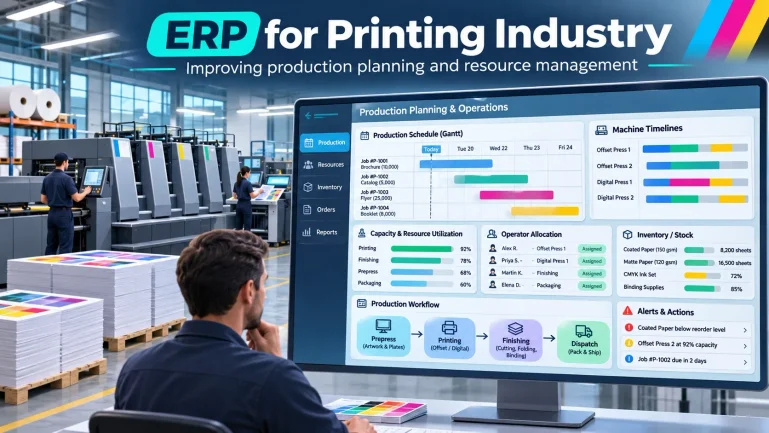
PrintXpand’s Job Planning page describes the board a planner would actually use. A Gantt-style timeline shows jobs against machines and operators, with capacity heatmaps per resource and real-time availability. Jobs arrive from confirmed eCommerce orders or manual entry in the PrintERP, already carrying specs and artwork, plus substrate and deadlines. The system auto-places them by machine availability and priority, and the planner either accepts the placement or drags it somewhere else. That last step matters to me more than the auto-placement does.
Dependencies are the quiet part. The page describes chains between production steps, so bindery can’t start before the sheets exist, and deadline management that works backward from the due date through each step. Infor’s documentation for its APS describes the same logic in general terms: each demand is pulled backward from its due date, and planning switches to forward if that turns out infeasible. As far as I can tell, backward planning is standard APS logic and not a PrintXpand invention, and I’d be wary of any vendor that implied otherwise.
Operators get less attention than machines. A press can be free on the board and still produce nothing because the person who runs it is on another shift. Infor’s APS checks that crew and machines are on shift and not busy. PrintXpand’s page puts machine and operator scheduling in one live view that shows availability and overload, along with blockages. When a job falls behind, the page says alerts fire automatically.
Is the stock actually there?
A job planned onto a press with no paper behind it costs an afternoon. And this is where the ERP page and the rest of PrintXpand’s site disagree by omission. The ERP page covers vendor inventory checks only. A separate inventory page, for a separate module in a suite of 12, describes a shop’s own stock: substrates and inks, plus blanks, packaging materials and finished goods across warehouses.
The reservation step stood out to me. Per that page, materials are held as stock reserved against each job ticket when the ticket is created, and consumption is logged against it as production runs. Min and max thresholds can raise a purchase order or a PrintXpand Connect vendor order. Waste is tracked per job and per machine, and flagged when usage exceeds what was expected.
The page leaves a couple of things out. Whether vendors’ own stock levels are visible, for one. And what any of it saves, since it publishes no outcome numbers at all. Everything is qualitative. I’d treat the feature list as unproven until a shop’s own stock counts reconcile with what the system says is on the shelf.
Where the Auto-Schedule Stops Being Right
Most writing on this subject says a scheduler plus real-time dashboards clears out spreadsheet chaos and lifts on-time delivery and utilization. Some of that is true. It leaves out a harder fact.
Lunardi, Birgin, Ronconi and Voos studied a real online printing shop in the European Journal of Operational Research in 2021, and the problem they modeled had resumable operations, periods when machines are unavailable, and sequence-dependent setup times, a combination that is computationally hard, which is why their local search and metaheuristic methods beat a partly exact off-the-shelf solver by a wide margin and why practical tools search for a good plan and stop. Any ERP for printing industry planning ends up with a heuristic auto-schedule, not an optimum. I don’t read that as a flaw. It’s what arithmetic allows.
The second problem sits in the numbers from the first section. Reported press OEE of roughly 20 to 27 percent is measured under different conditions in every shop. A vendor’s utilization dashboard therefore shows how your shop compares with its own past, and not with anyone else’s. PrintXpand’s analytics page, to its credit, says its KPIs are benchmarked “against your own history.” That’s the only comparison I’d trust.
So the plan is only as good as the setup-time data feeding it, and planners still override. A planner might know that one particular color change near the end of a shift always runs long. As far as I know, no scheduler picks that up unless someone records it (that’s my opinion, none of the sources test it), and on that day the planner who remembers it beats the algorithm. PrintXpand’s accept-or-drag design concedes the same point. Dataline, a print software supplier, says its system “knows all the machines and specifications” and can therefore estimate production time. That’s a vendor claim, and a reasonable one. An estimate still isn’t a measurement.
A one-press shop with an owner who knows every job by heart doesn’t need any of this. The calendar on the wall is fine.
The data nobody keys in
Estimates get corrected only by actuals. PrintXpand’s job tickets page describes the manual state it replaces: managers walking the floor, labor time estimated, status lagging behind reality. Operators scan QR codes at each stage, and each scan records time and operator, plus status. Time per stage is the raw material for every better estimate afterward.
Machines can report too. CIP4 introduced JDF and JMF in 2000, JDF as an information exchange standard and JMF as a message protocol so devices can send feedback to control software. XJDF followed in 2018, a simplified version for exchange between management applications. How many presses on a given floor actually speak JMF, and how well, varies by device. I have no list. I doubt a reliable one exists.
Meanwhile the FESPA Print Census 2025, run with Keypoint Intelligence and released in May 2026, surveyed 774 businesses in 89 countries. Its headline: nearly half of print service providers report no automation in place. For a lot of shops the data feed starts at zero.
PrintXpand, where I work, builds this kind of planning layer, and we’ve seen it across 350+ print businesses. My opinion is that the schedule matters less than whether job-stage times get captured at all. Nobody has published the real spread of changeover times across shops, so a week with a stopwatch beside the press would tell an owner something no figure above can.