

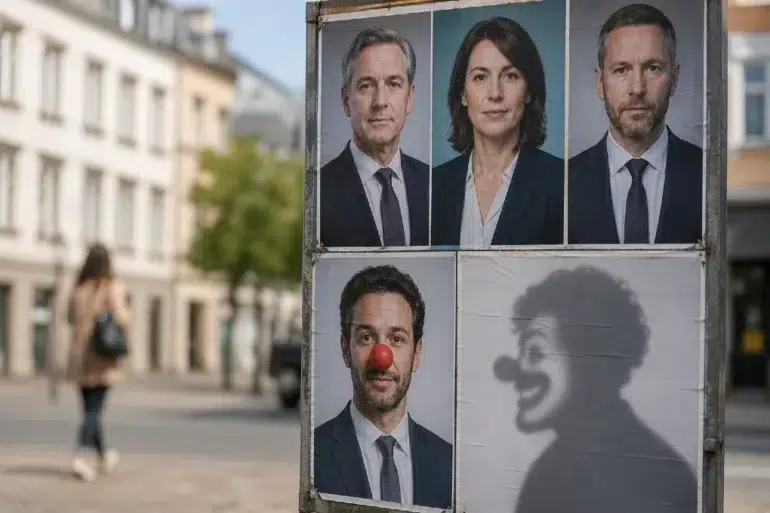
Die Partei Wahlplakate are not ordinary campaign posters. They are loud, absurd, uncomfortable, funny, and sometimes deliberately irritating. That is exactly why people notice them.
In Germany, election posters are part of the political landscape. Before federal, state, municipal, and European elections, streets fill with faces, slogans, promises, party colors, and carefully polished messages. Most posters try to look serious. They show trust, stability, leadership, or hope.
Then Die PARTEI appears with posters that seem to mock the entire ritual.
That is what makes Die Partei Wahlplakate so interesting. They are not just campaign material. They are a form of political satire that uses the same public space as traditional parties but refuses to behave like them. Instead of promising clean solutions, they expose how predictable, empty, or theatrical political messaging can become.
What Are Die Partei Wahlplakate?
Die Partei Wahlplakate are election posters created by Die PARTEI, a German satirical political party whose full name is “Partei für Arbeit, Rechtsstaat, Tierschutz, Elitenförderung und basisdemokratische Initiative.”
The party was founded in 2004 by people connected with the satirical magazine Titanic. From the beginning, it positioned itself as a political joke with a serious target: the way politics presents itself to the public.
Its posters often copy the visual language of regular campaign advertising, then twist it. A typical poster may look like a normal election ad at first glance, but the slogan usually breaks the illusion. It may be sarcastic, exaggerated, intentionally vague, or sharply critical of another party.
That contrast is the point.
A regular campaign poster usually says, “Trust us.” A satirical poster says, “Look at how strange this whole system is.”
Why These Posters Stand Out in German Elections
German election streets can feel visually repetitive. Most mainstream posters follow familiar formulas:
A candidate looks directly into the camera.
A short slogan promises security, fairness, progress, climate action, or economic strength.
The party logo sits neatly in the corner.
The colors match the party identity.
This style is clear and safe, but it can also feel predictable. Die Partei Wahlplakate cut through that predictability by refusing to sound polished.
They often work because they create a small mental interruption. A passerby sees a poster and thinks, “Wait, what did that say?” That moment matters. In public communication, attention is the first battle.
Satire gives these posters an advantage because they do not need to sound like everyone else. They can be rude, strange, ironic, playful, or intentionally over the top. While other parties compete to look competent, Die PARTEI competes to be remembered.
The Political Satire Behind the Posters
Political satire is not only about making people laugh. At its best, it highlights contradictions.
Die Partei Wahlplakate often make fun of campaign clichés by exaggerating them. If a normal party promises change, a satirical poster may promise something absurdly unrealistic. If another party uses patriotic messaging, Die PARTEI may respond with a slogan that exposes how easy such emotional language can be manipulated.
This approach works because modern voters are used to political marketing. Many people know that campaign posters simplify complex issues. They understand that slogans are designed to persuade quickly, not explain deeply.
Die PARTEI takes that awareness and turns it into a joke.
Instead of hiding the marketing trick, the poster makes the trick visible.
How Die Partei Uses Absurdity as a Campaign Tool
Absurdity is one of the strongest tools in satirical advertising. It allows a message to feel light on the surface while carrying a sharper meaning underneath.
For example, a satirical poster may appear childish, silly, or unserious. But the target is often very serious: empty promises, political opportunism, nationalism, bureaucracy, media spectacle, or the way parties copy each other’s campaign language.
That is why Die Partei Wahlplakate can be read on two levels.
On the first level, they are funny street posters.
On the second level, they are commentary on how election communication works.
This layered style helps them reach different audiences. Some people enjoy the joke. Others think about the criticism behind it. Some dislike it completely, which also keeps the poster in public conversation.
The Visual Style of Die Partei Wahlplakate
The design of Die Partei Wahlplakate is often part of the joke.
Many political posters are carefully designed to look professional and reassuring. Die PARTEI may use a rougher, more chaotic, or deliberately awkward style. Sometimes the layout feels intentionally cheap. Sometimes the photo choice feels strange. Sometimes the slogan is the entire visual punchline.
This is not necessarily bad design. It is anti-polished design.
That matters because satire often works by breaking expectations. If a poster looks too perfect, it may feel like every other campaign ad. If it looks slightly wrong, people look twice.
Common visual traits can include:
- Bold, simple typography
- Harsh contrast
- Unflattering or unexpected images
- Minimal design with one sharp line
- Parody of mainstream campaign layouts
- Deliberately awkward political branding
This style tells voters immediately that the poster is not trying to play the usual game.
Why Humor Works in Political Messaging
Humor lowers resistance.
When people see a standard political message, they may immediately judge it through party loyalty. If they support the party, they may agree. If they dislike the party, they may ignore it. But humor can sneak past that first wall.
A funny political poster can make even skeptical people pause. They may not vote for the party, but they still remember the message.
That is a real communication advantage.
Humor also travels well. A poster on the street can become a photo on social media. A clever slogan can move from a local neighborhood to national conversation in a few hours. In that sense, Die Partei Wahlplakate are built not only for sidewalks but also for screenshots, reposts, and online debate.
The poster is the starting point. The reaction becomes part of the campaign.
Are Die Partei Wahlplakate Serious or Just a Joke?
This is the question that follows Die PARTEI everywhere.
Are the posters serious politics, or are they just comedy?
The honest answer is: both.
The party uses comedy as its public language, but many of its jokes point toward real political frustrations. When a poster mocks vague slogans, it is also criticizing vague politics. When it copies the tone of mainstream parties, it is showing how formulaic campaign messaging can become.
That does not mean every poster carries a deep policy argument. Some are simply jokes. Some are intentionally provocative. Some are designed to annoy.
But political satire does not need to behave like a policy paper. Its role is different. It questions, disrupts, and exposes.
In that sense, Die Partei Wahlplakate are serious because they make people think about the seriousness of politics itself.
The Role of Satire in German Political Culture
Germany has a long tradition of political cabaret, satire magazines, parody, and critical humor. Satire has often been used to question authority, expose hypocrisy, and challenge political language.
Die PARTEI fits into that tradition, but with one major difference: it entered the formal political arena.
That makes its posters more unusual. They are not only jokes about parties from the outside. They are campaign messages from a party that participates in elections.
This creates a strange tension. Die PARTEI mocks the system while also using the system. It criticizes political theater while also performing inside it. That contradiction is central to its identity.
The posters become a stage where satire and electoral politics overlap.
Why Younger Audiences Often Notice These Posters
Younger voters are often difficult for traditional campaigns to reach. Many are skeptical of polished political messaging. They are used to meme culture, irony, short-form content, and online humor.
That makes satirical election posters feel more familiar to them.
Die Partei Wahlplakate often behave like offline memes. They are short, visual, sharp, and easy to share. A strong poster can work almost like a political punchline in public space.
This does not mean all young voters support Die PARTEI. Many may simply enjoy the humor. But attention is still valuable. A party that gets people to photograph and discuss its posters gains cultural visibility beyond its actual campaign budget.
That is one reason satirical posters can appear more influential than their physical size suggests.
How These Posters Challenge Traditional Campaign Advertising
Traditional campaign advertising usually tries to simplify a party’s message. It reduces complex issues into emotional promises.
Satirical posters challenge that by showing how absurd simplification can become.
For example, if every party promises a better future, a satirical poster may offer a ridiculous version of the same promise. That makes the viewer question the original format. Why do so many election posters sound similar? Why do slogans often avoid details? Why do candidate photos feel so staged?
This is where Die Partei Wahlplakate become more than decoration. They act like commentary placed directly inside the campaign environment.
They use the same poster boards, the same street corners, and the same election season visibility as everyone else, but their purpose is different.
They do not just ask for votes. They ask the public to notice the performance.
Real-World Impact: Attention, Debate, and Controversy
Satirical posters are rarely neutral. Some people find them refreshing. Others find them disrespectful, childish, or offensive.
That reaction is part of the risk.
A mainstream party usually avoids messages that could alienate too many voters. Die PARTEI often does the opposite. It leans into controversy because controversy creates attention. A slogan that makes people argue may travel further than a safe slogan that everyone forgets.
This does not mean every controversial poster is effective. Satire can miss the mark. A joke can be misunderstood. A message can feel clever to one group and tasteless to another.
Still, the public debate around these posters proves their communication power. Even when people complain about them, they are talking about them.
That is something many traditional campaign posters fail to achieve.
What Marketers Can Learn from Die Partei Wahlplakate
Even outside politics, these posters offer lessons for communication, branding, and public attention.
The first lesson is simple: sameness is forgettable.
If every message in a space looks and sounds the same, the message that breaks the pattern becomes visible. Die PARTEI understands this well. Its posters often stand out because they reject the visual grammar of serious politics.
The second lesson is that tone matters. A short line can carry more force than a long explanation if the tone is sharp enough.
The third lesson is that a campaign does not always need to persuade directly. Sometimes it can win attention by creating conversation.
For bloggers, marketers, and content creators, the takeaway is not to copy political provocation blindly. The real lesson is to understand the audience, the setting, and the expectation, then decide where to break the pattern.
Common Themes in Die Partei Wahlplakate
Although the posters vary across elections and regions, several themes often appear:
- Mocking empty political promises
- Parodying mainstream campaign slogans
- Using absurd patriotism to criticize nationalism
- Turning candidate-centered advertising into comedy
- Making fun of bureaucracy and political language
- Creating slogans that feel like memes
- Using shock value to force public reaction
These themes help explain why Die Partei Wahlplakate continue to attract attention. They are not random jokes. They are often built around recognizable weaknesses in political communication.
Do These Posters Actually Influence Voters?
It is hard to measure the direct influence of satire on voting behavior. A person may laugh at a poster without voting for the party. Another person may share it online but still support a mainstream candidate.
However, influence is not only about votes.
Political communication also shapes mood, conversation, and public perception. Satirical posters can make people more aware of campaign language. They can turn political advertising into a topic of discussion. They can give frustrated voters a way to express dissatisfaction.
In smaller parties, visibility itself can be a major achievement. A poster that people remember is already doing more work than a poster people ignore.
So while Die Partei Wahlplakate may not convert every amused viewer into a supporter, they do influence how people experience the election atmosphere.
The Difference Between Satire and Misinformation
One important point should be clear: satire works best when the audience understands that it is satire.
A satirical poster may exaggerate, parody, or twist political language, but it should not trick people into believing false information. The goal is usually to expose a truth through exaggeration, not to spread confusion.
This line matters in modern politics. Voters already face misleading claims, manipulated images, and emotionally charged content online. Satire has a place, but it depends on context and recognition.
Die PARTEI’s identity makes that easier because many people know the party is satirical. Still, every campaign message exists in a public environment where not everyone reads it the same way.
That is why effective satire needs sharpness, but also clarity.
Why the Posters Keep Returning to Public Debate
Every election season brings new campaign visuals, and Die Partei Wahlplakate often return to the conversation because they offer something predictable in a different way.
People expect them to be unexpected.
That is a strange but powerful brand position. Voters may not know the exact slogan before seeing it, but they expect irony, provocation, and political comedy. That expectation itself becomes part of the party’s identity.
Mainstream parties build trust through consistency. Die PARTEI builds recognition through disruption.
The result is a poster style that feels less like traditional advertising and more like political street theater.
The Art of Saying Something by Not Sounding Serious
One of the cleverest things about Die Partei Wahlplakate is that they often say serious things through unserious language.
A polished campaign may say, “We stand for democratic values.”
A satirical poster may make a joke that exposes the opposite behavior in politics.
A mainstream party may promise change.
A satirical poster may mock the endless repetition of “change” as a campaign product.
This does not make satire superior to normal political debate. Elections still need policy, accountability, and serious discussion. But satire can reveal what ordinary campaign language hides.
It makes people notice the gap between slogans and reality.
How Readers Should Understand Die Partei Wahlplakate
The best way to understand these posters is not to ask only, “Is this funny?”
A better question is, “What is this poster making fun of?”
Is it mocking another party?
Is it mocking voter expectations?
Is it mocking the format of campaign posters?
Is it mocking nationalism, bureaucracy, empty promises, or media attention?
Once you ask that, the poster becomes easier to read. The joke is usually not just the slogan. The joke is the relationship between the slogan, the campaign format, and the political moment.
That is why some posters remain memorable long after an election ends.
Conclusion
Die Partei Wahlplakate show how political satire can turn a simple campaign poster into a public conversation. They stand out because they do not follow the usual rules of election advertising. Instead of looking polished, they often look disruptive. Instead of offering safe slogans, they use irony, absurdity, and exaggeration.
Their real strength is not only humor. It is the way they reveal how political messaging works. They remind voters that campaign posters are not neutral objects. They are designed to persuade, simplify, and shape attention.
Die PARTEI takes that familiar format and bends it until people notice the machinery behind it. Whether someone sees the posters as clever, annoying, childish, or sharp, they are difficult to ignore.
That is why they remain such a recognizable part of modern <a href=”https://en.wikipedia.org/wiki/Die_PARTEI”>German elections</a>. They prove that satire can live on street corners, lamp posts, and campaign boards, right beside the serious promises of mainstream politics.
FAQs
What does Die Partei Wahlplakate mean?
Die Partei Wahlplakate means election posters by Die PARTEI, a German satirical political party known for using humor, parody, and political provocation in its campaigns.
Why are Die Partei posters popular?
They are popular because they break the normal style of election advertising. Their slogans are often funny, strange, or controversial, which makes people notice and share them.
Are Die Partei Wahlplakate serious political messages?
They are satirical, but many contain serious criticism. They often mock political clichés, campaign promises, and the way parties communicate with voters.
Why does Die PARTEI use satire in elections?
Die PARTEI uses satire to challenge traditional politics, attract attention, and comment on the absurd side of campaign culture.
Do Die Partei posters influence elections?
They may not directly change every voter’s decision, but they influence public conversation, media attention, and how people think about political advertising.