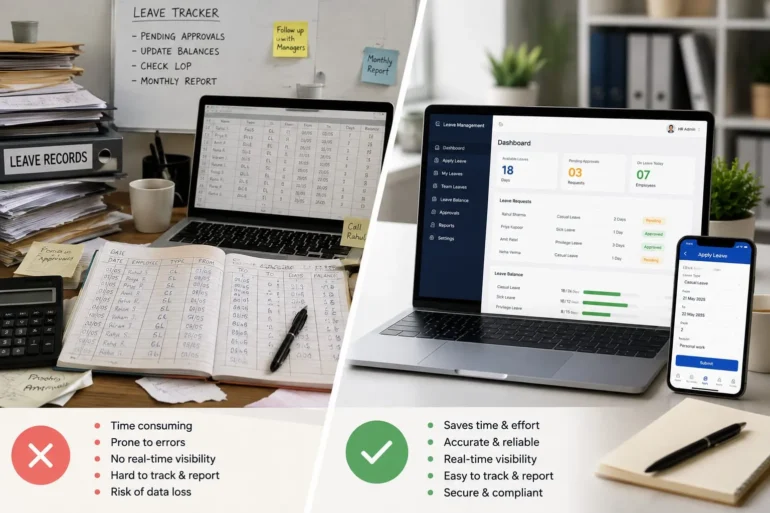
Sooner or later, most HR teams ask the same question. Is it time to move off registers and Excel sheets and onto something built specifically for this job? Manual tracking still feels familiar and familiar can feel safer even when it’s quietly not working anymore. That’s when a leave management system comes into the picture. It fixes a lot of daily headaches. Here’s a straight comparison of both, based on what actually plays out inside a growing company.
What is Leave Management System?
A leave management system is software that handles the entire leave process in one place — applications, approvals, balances and payroll integration, all sitting under one roof instead of scattered across messages and files. Employees submit their requests via the app, managers approve the request with one click and balances change automatically. There is nothing to type into a spreadsheet manually anymore.
What is Manual Leave Tracking?
Manual leave tracking is the older, more familiar way of doing things — someone sends a WhatsApp message or fills a paper form, a manager nods or replies over email and HR updates a register or spreadsheet to reflect it. It works reasonably well for a company of ten people sitting in one room. Once the team grows and approvals start happening across five different channels, the same process starts falling apart quietly, one missed update at a time.
Leave Management System vs Manual Leave Tracking
The difference between the two shows up most clearly once a company crosses a certain size. Below is how they actually compare on the things that matter day to day.
| Factor | Leave management system | Manual leave tracking |
| Applying for leave | Submitted through the platform in a few taps | Message, email, or verbal request, scattered across channels |
| Balance tracking | Updates automatically the moment leave is approved | Updated manually, often delayed or miscalculated |
| Approval trail | Logged with timestamps, easy to trace later | Often verbal or buried in old chats, hard to prove |
| Payroll accuracy | LOP and encashment calculated automatically | Prone to manual errors, disputes at payroll time |
| Compliance updates | State-specific rules applied automatically | Depends on someone remembering to update a formula |
| Scalability | Handles growing headcount without added effort | Gets harder to manage as the team grows |
Benefits of Choosing a Leave Management System Over Manual
Here are the benefits businesses can avail themselves of by choosing an automated leave management system over manual tracking:
- Payroll disputes become less common since information about leaves goes directly into payroll without manual processing.
- Accurate balances since there is no need for reconciliations at the end of each month.
- An approval record that can help to resolve any disputes instantly rather than looking through emails.
- Compliance handled automatically, even when leave rules change by state.
- Less HR time spent on repetitive admin, freeing up bandwidth for hiring and onboarding.
- Better workforce visibility, since HR always knows who’s on leave and when they’re due back.
- Easier scaling, whether the team is at twenty people or two hundred
This is also where leave management connects to something HR teams don’t always plan for upfront — hiring. As headcount grows, leave data and staffing gaps need to line up cleanly with recruitment plans and that’s usually where hr recruitment software becomes just as important as the leave system itself. Platforms that bring both together give HR a much clearer read on who’s available, who’s joining and where the gaps actually are.
Which One Should You Pick?
There’s no single right answer — it depends on where the business stands today. A small team with simple, predictable leave patterns can probably get by on manual tracking a while longer without much damage. But any company past twenty employees, juggling multiple leave types, or dealing with state-specific compliance is very likely losing more time to manual errors than it would ever spend on proper software. They will rely on an HRMS that offers integrated attendance, leave and HR recruitment software.
The cost of manual tracking rarely shows up as one big bill. It shows up quietly — in payroll disputes, in employees who can’t get a straight answer about their leave balance, in HR spending hours each month fixing things that never should have gone wrong in the first place.