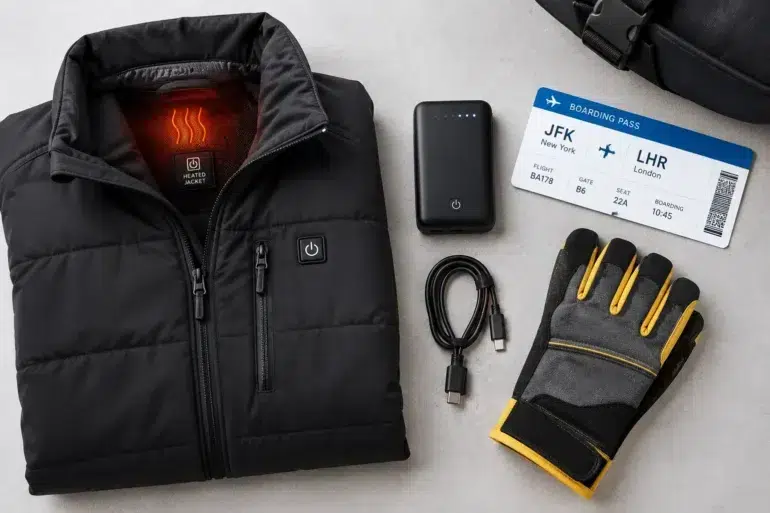
There’s no single best heated jacket for everyone, but there is a right pick for how you’ll use it. For a cold job site, start with a jacket that runs on tool batteries you already own. For flights and commuting, look for a slim jacket with a small battery that meets airline limits. For hiking, hunting, or skiing, put weather protection and battery runtime first.
This guide shows how to match a jacket to your day, what the specs on a product page really mean, and how to handle airline battery rules. It draws on published hands-on reviews and manufacturer details, not our own lab testing, so confirm current models and prices before you buy. Many “best of” lists are built around affiliate links, which is one more reason to check the specs yourself.
Which Heated Jacket Fits Your Situation
| If you mostly… | Prioritize | Skip |
|---|---|---|
| Work outdoors on a job site | Durable shell, a battery platform you already use, enough runtime for a full shift | Slim fashion cuts with little room to move |
| Travel or commute | Slim, packable build, small battery that meets airline limits | Large battery packs over 100 Wh |
| Hike, hunt, ski, or ride | Water resistance, long runtime on low, real insulation | Thin shells with no insulation |
| Want the lowest price | Basic multi-zone heat, USB-C charging, detachable hood | Unknown sellers with no warranty or returns |
How to Choose the Best Heated Jacket: What the Specs Mean
A heated jacket has thin heating elements, usually across the chest and back and sometimes the pockets or collar. A rechargeable lithium-ion battery in a pocket powers them, and a button sets the heat level. These specs decide whether one feels warm or just feels like a gadget.
| Spec | What it tells you | What to look for |
|---|---|---|
| Battery capacity (Wh) | Runtime and whether it’s legal to fly with | Wh printed on the battery, ideally 100 Wh or less |
| Voltage | Compatibility and power | A battery you’re happy to carry or already own |
| Heat zones | Where the warmth lands | Core and back at minimum, pockets and collar if you run cold |
| Heat settings | How well you can control it | Three levels is common |
| Runtime on low and high | Real-world battery life | Figures for both settings, not just the best case |
| Shell | Weather protection | Waterproof for rain and snow, water-resistant for light use |
| Insulation | How well warmth stays in | Down, synthetic fill, or a fleece lining |
| Care | Day-to-day upkeep | Removable battery and clear washing instructions |
Do the Battery Math
Capacity is usually listed in watt-hours (Wh) or milliamp-hours (mAh). To convert, multiply mAh by the battery’s voltage, often 3.7 V for power banks, then divide by 1,000. A 20,000 mAh power bank works out to about 74 Wh. That number matters twice, once for runtime and once for airline rules.
Don’t Trust Maximum Heat Alone
One outdoor-gear tester turned every jacket on high and checked the batteries hourly to measure battery life. That shows why advertised runtimes usually describe the lowest setting. The same tester points out that how warm a jacket feels depends on more than how hot it gets. A hands-on review of one travel jacket reported roughly nine hours on the lowest setting. Expect noticeably less on high.
Best Heated Jacket for Work
Tool-Battery Jackets
If you already own Milwaukee or DeWalt cordless tools, a jacket that shares those batteries saves money and hassle. Milwaukee’s M12 heated jackets run on Milwaukee batteries, and the standard TOUGHSHELL and AXIS models are described as wind- and water-resistant. DeWalt sells a 20-volt heated jacket in men’s and women’s sizes.
What to Check for Job Sites
- Battery platform: Make sure the jacket’s battery voltage matches the batteries you own, and budget for a spare for long shifts.
- Safety requirements: If your employer requires flame-resistant or high-visibility clothing, a standard heated jacket may not qualify. Ask your safety manager before you buy.
- Mobility: Reaching, bending, and lifting are the real test. Try the jacket with your usual layers underneath.
- Durability: A tougher shell with reinforced elbows holds up better around tools and rough surfaces.
Best Heated Jacket for Travel
Jackets That Pack Down
For travel, weight and packability matter as much as heat. Travel + Leisure’s hands-on review of the Venture Heat MAX Heated Down Jacket noted a water-resistant nylon shell, synthetic-down insulation, three heating zones, and limited sleeve stretch for layering. Outdoor Life also included the Eddie Bauer Radiator Heated Down Jacket in its tested lineup.
Flying With a Heated Jacket
The battery is what airport rules care about. Check these points before you pack:
- Spare lithium-ion batteries, including power banks, belong in carry-on bags only, and each is limited to 100 Wh.
- Batteries between 101 and 160 Wh need airline approval, and you can bring only two.
- One manufacturer advises that you can wear a heated jacket on a plane but shouldn’t switch it on during the flight.
- If the battery detaches, carry it in your cabin bag rather than checking it.
Airlines also keep tightening their own rules. As of May 1, 2026, American Airlines requires power banks to stay out of overhead bins, and Southwest limits passengers to one power bank of up to 100 Wh as of April 20, 2026. Check your airline’s current policy before you fly.
Best Heated Jacket for Outdoor Use
Outdoor use puts the most strain on a jacket, so weather protection and battery life count most here.
- Best overall in one test: Bob Vila’s testers picked the Fieldsheer Mobile Warming Heated Ranch Jacket as best overall. It was the only jacket in their guide with four heat settings instead of three, and the only one adjustable through a phone app.
- Budget pick: The same guide named the TideWe softshell heated jacket with a detachable hood as the best bang for the buck.
- Waterproof option: Fieldsheer lists the Guardian LX as a waterproof heated jacket, priced at $299 when that source checked. Prices change, so confirm before buying.
Cold drains lithium-ion batteries faster, so keep a spare in an inside pocket close to your body. Wear a moisture-wicking base layer under the jacket, and add a shell if it’s windy or wet.
Fit Matters: Men’s and Women’s Options
Best Heated Jacket for Men
Look for shoulder room, sleeve length, and enough space for a base layer. The Ororo Men’s Classic Heated Jacket 2.0 is listed with four zones across both hand pockets, mid-back, and neck, plus three heat settings, a detachable hood, and machine-washable construction. The TideWe softshell mentioned above is another widely cited men’s option.
Best Heated Jacket for Women
Women’s cuts differ in torso length, hip room, and sleeve proportions, so check the size chart instead of assuming a unisex fit. Bob Vila’s testers picked the Milwaukee Women’s M12 Heated Axis Quilted Jacket as their best women’s jacket. One roundup says Ororo’s four-zone women’s jacket heats the pockets, collar, and mid-back, which targets the cold hands many wearers complain about.
Common Mistakes, Care, and Safety
- Buying on maximum temperature alone. A hotter jacket with a tiny battery can leave you cold by lunch.
- Ignoring battery weight. Longer runtime usually means a bigger, heavier pack. One tester noted that the Venustas puffer vest had long battery life, but the battery was large and heavy.
- Skipping insulation. A heated jacket adds warmth. It doesn’t replace a coat that holds heat in.
- Washing it carelessly. Remove the battery and follow the care label.
- Storing batteries in extreme heat. Don’t leave them in a hot car, and don’t charge them unattended on soft surfaces.
If you have reduced skin sensation, for example from nerve damage, ask your doctor before using heated clothing, since you may not feel a burn developing. Stop using any jacket with a damaged battery or wiring, and check the Consumer Product Safety Commission’s recall database before you buy from a lesser-known brand.
Final Thoughts
The best heated jacket is the one that fits your day. Match the battery platform to your work, keep travel batteries under airline limits, and favor runtime and weather protection if you spend long hours outside. Before you buy, check the battery’s Wh rating, read the size chart, and confirm the return policy.
FAQ
How long does a heated jacket battery last?
It depends on the heat setting. Low can run many hours, as one reviewed travel jacket showed at roughly nine, while high drains the battery much faster.
Can you wash a heated jacket?
Usually, yes, after you remove the battery. Follow the care label, since some models are machine washable and others aren’t.
Can you fly with a heated jacket?
Yes, but keep spare batteries in your carry-on, stay within the 100 Wh limit unless the airline approves more, and check your airline’s current policy.
Are heated jackets safe?
Used as directed with an undamaged battery, they’re generally safe. People with reduced skin sensation should ask a doctor first.
What’s the best heated jacket for very cold weather?
Look for strong insulation, a waterproof or wind-resistant shell, several heat zones, and a battery with enough capacity for your longest time outside.