

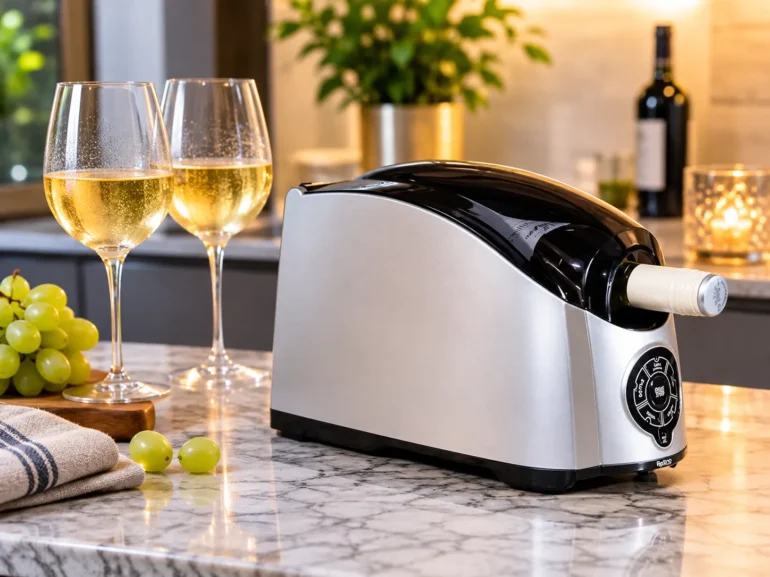
The guests arrive in twenty minutes and the Sauvignon Blanc has been sitting on the counter since noon. Most people reach for a bowl of ice and water, which works, but it’s messy, it drips on the table, and it slowly waters down whatever’s left in the bucket by the second pour.
There are faster options, and a few of them get a room-temperature bottle down to drinking temperature quicker than ice ever will.
Serving Temperature: Whites at 43 to 50, Reds Near 55
White wine and lighter styles show best somewhere around 43 to 50°F. Reds want warmer, closer to 55°F. Serve a white too warm and the alcohol dominates; serve it too cold and the aromatics flatten out.
The practical problem isn’t knowing the number. It’s hitting it without planning six hours ahead.
The Freezer Trick, and Its Limits
A bottle laid flat in the freezer drops temperature faster than one standing upright, because more glass touches the cold shelf. Wrapping it in a damp paper towel first speeds things further, since evaporation pulls heat off the surface.
Twenty minutes usually does the job for a white. The risk is forgetting it. A bottle left in a freezer overnight can push the cork out or crack, so set a timer on your phone, not a mental note.
What a Rapid Wine Chiller Does Differently
Active rotating chillers spin the bottle while spraying it with ice water, and they hit 43°F in roughly six minutes from a fridge-cool start, or ten to twelve from full room temperature. The catch is that they need about two cups of ice per bottle, a power outlet, and they’re loud enough that you’ll hear them from the next room.
Electric thermoelectric coolers skip ice entirely. They take longer, 15 to 45 minutes depending on your starting point, but hold a set temperature for up to 24 hours with no noise and no vibration, which matters in a small apartment or an open-plan kitchen. Some run on 12V, so they travel to a tailgate or a campsite.
Bottle shape is the detail that trips people up, which is one reason it pays to compare the specs on several models when you’re looking for the best rapid wine chiller rather than buying the first one you see. Many chambers top out around 3.66 inches in diameter, gel sleeves usually want bottles under 3 inches, and Champagne bottles with their wide punt-heavy base get rejected by most of them.
Gel Sleeves: Good at Holding Cold, Not Making It
A gel-filled insulated sleeve lives in the freezer, folds flat, and slides over a bottle in seconds. It’ll hold wine cold for three to four hours once frozen. No power, no ice, no noise, nothing to clean beyond wiping the vinyl.
It won’t chill a warm bottle quickly. What it does well is keep an already-cold bottle cold through a long dinner, which is a different job and arguably the more common one.
Stack the Methods When Time Is Tight
If you’re short on time, stack the approaches instead of picking one:
- Give the bottle 30 minutes in the fridge first so the chiller isn’t starting from scratch
- Wrap it in a wet paper towel before any freezer or ice contact
- Use an active chiller or freezer for the final push to serving temperature
- Slip a frozen gel sleeve on once it’s poured-ready to hold the temperature at the table
Who Needs a Dedicated Chiller
If you open wine a few times a year, a gel sleeve and a freezer timer cover you fine. The people who get real mileage out of a dedicated chiller are the ones hosting regularly, running a home bar, or serving guests who want white when only red is cold, situations where guessing and re-chilling turns into a running task all evening.