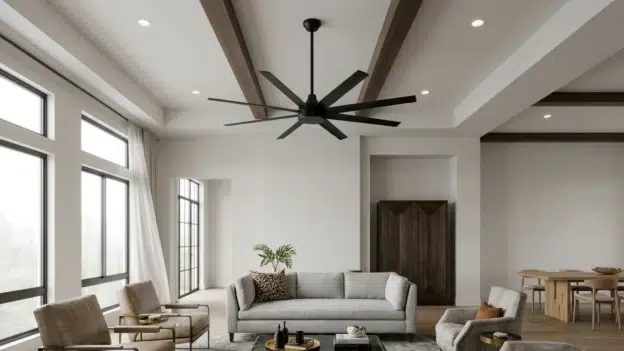
A practical guide to fan size, airflow, lighting, controls and mounting height
Short answer: Good ceiling fans for large living rooms are usually large-diameter models with documented airflow, useful lower-speed settings and a mounting configuration that suits the ceiling. Many buyers compare fans in the 60- to 72-inch range, while unusually wide or high-ceiling rooms may justify a larger model. The right choice depends on the room—not on diameter or blade count alone.
The market does not use one universal definition of a “large living room fan.” Products promoted for big rooms range from conventional 52-inch models to 60-, 62-, 65-, 72-, 84- and even 96-inch fans. That wide range explains why a simple list of popular products is less useful than a comparison based on room dimensions, ceiling height, published CFM, lighting and installation clearance.
A good fan should distribute air across the occupied area without looking out of scale or creating an uncomfortable blast at normal seating height. It should also provide controls that suit daily use and fit the room’s existing lighting plan.
What Makes a Ceiling Fan Good for a Large Living Room?

The fan fits the usable living area
Measure the part of the room that people actually use, not only the total open floor plan. In a combined living, dining and kitchen layout, one fan may serve the seating zone while another solution handles adjacent areas. A single oversized fan is not automatically the most balanced approach.
Published airflow supports the size claim
Blade span indicates potential coverage, while CFM describes the volume of air moved at a reported setting. Published CFM is more useful than judging performance from wattage, blade count or a “high airflow” label. Figures should still be compared within a similar product category and under comparable test conditions.
The lower speeds remain comfortable
Maximum airflow matters, but living rooms are occupied for long periods. A fan should also offer gentle lower settings for conversation, television viewing and cooler weather. A high maximum CFM does not compensate for poor day-to-day control.
Lighting and controls match daily use
An integrated light may be valuable when the fan replaces a central fixture. A room with recessed, track or pendant lighting may look cleaner with a no-light model. Remote control is especially useful when wall wiring is limited, but buyers should verify the exact functions supported by each model.
What Size Ceiling Fan Should a Large Living Room Use?
A 60- to 72-inch span is a practical comparison range for many large living rooms, but it is not a universal rule. The correct span depends on room width and length, ceiling height, furniture placement, fan location and published performance.
Around 60 inches
A 60-inch fan can suit a large enclosed living room or a clearly defined seating area within an open plan. It may also be easier to position around ceiling lights, beams and built-in cabinetry than a wider model.
Approximately 65 to 72 inches
This range is frequently considered for broad living rooms, great rooms and combined living-and-dining spaces. It offers more visual presence and potential coverage, but the fan still needs adequate wall clearance and an appropriate finished hanging height.
Above 72 inches
Fans in the 84-inch-and-larger category may suit unusually wide rooms, lofts or high-ceiling great rooms. They should not be selected merely because the room is described as large. Confirm scale, CFM, structural support and every clearance requirement first.
Is a 72-Inch Fan Too Big for a Living Room?
Not necessarily. A 72-inch fan can be appropriate when the room is wide enough, the ceiling provides sufficient height and the blades remain safely clear of walls, beams, tall furniture and light fixtures. It can be too large when installed in a narrow room or when its sweep dominates the ceiling and concentrates too much air over one seating position.
The better question is whether the complete fan fits the room. Compare its diameter, published airflow, lowest operating speed, installed height and mounting requirements instead of deciding from diameter alone.
Useful Ceiling Fan Types for Large Living Rooms
| Fan type | Main benefit | Good fit for | Verify before buying |
| Large fan with light and remote | Combines air movement, central lighting and convenient control | Living rooms replacing a central light fixture | Light output, CCT, dimming and separate controls |
| Large no-light fan | Keeps the ceiling visually simpler | Rooms with recessed, pendant or track lighting | Published CFM and actual control functions |
| High-CFM large fan | Prioritizes documented air movement | Wide or open-plan seating areas | Lower-speed comfort and comparable test data |
| Large fan for high ceilings | Allows a suitable downrod configuration | Great rooms, lofts and vaulted ceilings | Installed height, slope limit and structural support |
Three Breezary Configurations Worth Comparing
These examples illustrate three different ways to serve a large living room. They are not a ranked Top 3, and the best option still depends on the actual room and current product documentation.
| Model | Documented configuration | Potential living-room fit | Important check |
| 40026-L | 60-inch, six blades, integrated LED light | Large room that needs a more moderate span and central lighting | Confirm controls, installed height and current location rating |
| 23012-AB-NL | 65-inch, eight ABS blades, no light, DC motor, six speeds, remote, reverse; published up to 9,422 CFM | Wide room with a separate lighting plan and airflow priority | Compare CFM within the same product class and verify clearances |
| 42004 | 72-inch, seven blades, light, remote, six speeds, reverse, three CCT settings, dimming and timer | Large living room needing a wide span plus integrated lighting and control | Confirm mounting configuration and complete installed height |
When a Light and Remote Control Make Sense
For rooms where the ceiling fan also serves as the primary overhead fixture, Large Ceiling Fans With Lights and Remote Control can reduce the need for separate pull chains or additional ceiling wiring. The useful comparison is not simply “with remote.” Check whether the remote controls fan speed, light output, color temperature, dimming, reverse operation and timers, because functions vary by model.
Lighting should be evaluated as carefully as airflow. Verify published brightness information where available, the available color temperatures, whether dimming is supported and whether the light can operate independently from the fan. Do not assume that every integrated LED module is replaceable or that every remote offers the same features.
Airflow, Blade Count and Everyday Comfort
More blades do not automatically make a better living-room fan. A three-blade fan can move more air than a five-, seven- or eight-blade design when its diameter, blade profile, pitch, motor and operating speed are better optimized. Blade count also affects appearance, but it is not a substitute for published CFM.
Maximum airflow is only one part of comfort. Large living rooms benefit from a useful range between the lowest and highest settings. A powerful fan that cannot provide gentle circulation may feel excessive when people are seated directly below it.
High Ceilings, Vaulted Ceilings and Downrods
A high ceiling does not automatically require the widest fan. It requires a mounting configuration that places the fan at an effective and safe height. Measure the complete installed height, including the canopy, downrod, motor housing and any light kit—not just the downrod length.
· Confirm the ceiling slope and the model’s documented slope limit.
· Keep the blade sweep clear of beams, lighting, walls and upper-level railings.
· Check that the ceiling structure and electrical box support the fan’s installation requirements.
· Use only approved downrods and mounting components for the selected model.
· Use a qualified installer when the ceiling or mounting condition is complex.
Living Room Fans and Bedroom Fans Have Different Priorities
A fan that looks balanced in an open living room may overwhelm a bedroom, while a bedroom-sized fan may not distribute air across a large living area. Living rooms often prioritize broader coverage, lighting and convenient shared control. Bedrooms typically place more emphasis on room scale, gentle low-speed operation and any documented sound information.
For that reason, Large Bedroom Ceiling Fans should be evaluated separately instead of copying the living-room size directly into another room. Compare the bedroom’s dimensions, ceiling height, bed position, installed height and controls before selecting a model.
Style Still Matters in a Large Living Room
A ceiling fan is one of the largest visible fixtures in the room. Modern three-blade designs, multi-blade windmill looks, black industrial finishes, wood-grain blades and lighter neutral finishes can all work, but the fan should relate to the furniture, flooring, ceiling color and architectural details.
Style should narrow the choice only after performance and installation requirements are satisfied. A decorative fan is not a good recommendation if its airflow is undocumented or if its mounting system does not fit the ceiling.
A Practical Buying Checklist
Before selecting from a group of large-room fans, work through the following checks:
1. Measure the living area’s width and length and identify the main occupied zone.
2. Record the ceiling height and note any slope, beams, lights or upper-level obstructions.
3. Choose a realistic blade-span range, then verify wall and fixture clearances.
4. Compare published CFM and available speed settings within the same type of fan.
5. Decide whether the room needs an integrated light, a no-light design or independent lighting.
6. Verify remote functions, reverse operation and any timer or light controls.
7. Confirm included downrods, complete installed height and mounting requirements.
8. Check the current product page for price, inventory, warranty and location rating.
How to Define a “Good” Large Living Room Fan
The best way to compare Large Living Room Ceiling Fans is to match documented specifications to the room. A good fan is not automatically the widest, highest-CFM, most expensive, most-reviewed or highest-blade-count model. It is the one whose size, airflow, lighting, controls and mounting limits fit the actual living space.
This specification-based approach is more reliable than a fixed Top 5 list. Breezary supports single-unit online purchases as well as small-batch and multi-room discussions, allowing buyers to compare configurations without assuming that one model fits every home.
Frequently Asked Questions
What size ceiling fan is good for a large living room?
Many buyers compare 60- to 72-inch models, but there is no universal size. Room dimensions, ceiling height, furniture placement, published CFM and installation clearances determine the appropriate fan.
Is a 60-inch ceiling fan big enough for a large living room?
It can be, especially for an enclosed room or a defined seating zone. Compare the fan’s published airflow and the room’s proportions rather than relying only on diameter.
Is a 72-inch ceiling fan too big for a living room?
Not when the room is wide enough and provides the required clearance and installed height. It may be too large for a narrow room or a ceiling crowded by beams and fixtures.
What type of ceiling fan is best for a living room?
A well-matched large fan with documented airflow, comfortable speed control and the required lighting configuration is usually the best type. The exact choice depends on the room.
Should a living-room ceiling fan have a light?
Choose a lighted fan when it must replace or supplement the central ceiling fixture. Select a no-light model when the room already has suitable recessed, pendant or track lighting.
Do more blades make a better living-room fan?
No. Blade count influences design and aerodynamic load, but it cannot prove airflow. Compare the full fan design and published CFM.
Are DC-motor ceiling fans always better?
A DC motor can support useful speed and control options, but the label alone does not establish airflow, sound level or reliability. Compare the complete documented specifications.
Can a large ceiling fan be installed on a vaulted ceiling?
Potentially, if the model supports the ceiling slope and the approved mounting components provide safe blade clearance and an appropriate installed height.
Do ceiling fans cool a large living room?
Ceiling fans mainly improve comfort by moving air across occupants and mixing room air. They do not replace air conditioning or lower room temperature in the same way as a cooling system.
Final Recommendation
Good ceiling fans for large living rooms usually combine a suitable span, documented airflow, comfortable speed control and a mounting configuration that matches the ceiling. A 60- to 72-inch fan may suit many large living spaces, while unusually wide or high-ceiling rooms may need a different solution. Compare the complete product specifications rather than choosing by size, popularity or blade count alone.