

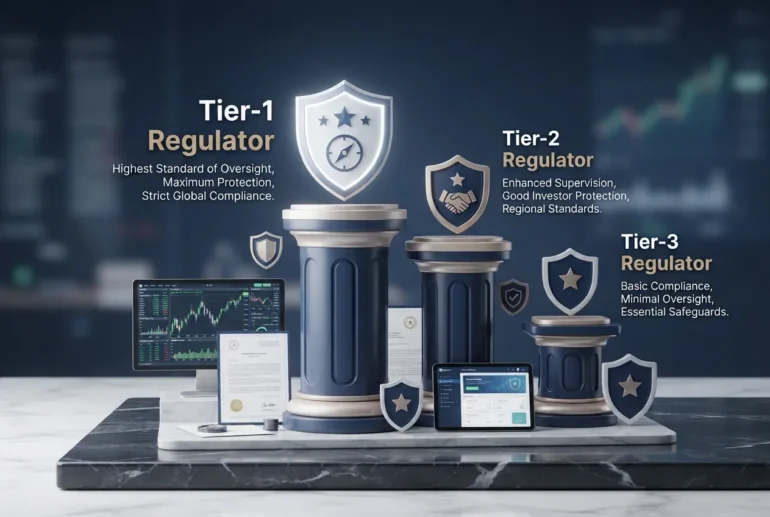
We need protection in everything we do, but this applies even more when our money is on the line. Financial regulators supervise whether participants adhere to laws and strict standards. But here is when things get interesting: not all regulators offer the same level of security. Why? Because they are divided into different tiers.
When traders are interested in financial services like forex or CFDs, they mostly research which strategies make them successful. What they leave behind is who is overseeing the activities of the brokers they choose. This makes it important to find a reliable source that provides detailed regulatory information and lists safe brokers available across various jurisdictions.
Tier-1 Regulators
Tier-1 regulators have strict rules and guidelines. To operate, brokers need to follow their protocols. They have a trusted reputation, are known worldwide, and inspire more confidence for traders. As you might have expected, the names from this category are often from major global economies. They include the United Kingdom, Australia, the United States, and the European Union.
Examples are the NFA and CFTC in the USA, the FCA in the United Kingdom, and ASIC in Australia.
Here is what they are guaranteeing you:
- You can trade with confidence and don’t need to constantly worry about whether the brokers will protect your investments.
- The brokers in this category must follow stringent rules, so you won’t fall prey to fraud or scams. This means you won’t lose your money because of the mistakes of others.
- You are assured that the broker is not manipulating prices when you trade. The regulators are also keeping an eye on these activities.
- The broker has high ethical standards, giving you a better experience as a client.
Tier-2 Regulators
Although they fall into the secondary category, the regulatory bodies still impose strict rules. Of course, they are not as rigorous as the first ones. They mostly oversee the actions of the brokers in the locations where they are based.
Among the Tier-2 regulators, we can mention FSA in Japan, MAS in Singapore, and FINMA in Switzerland.
Here is what they provide:
- Rigorous rules and standards. Brokers need to respect rules like minimum capital requirements. They must segregate client funds and prioritize consumer data.
- Regulators also require brokers to put in place the necessary procedures to handle communication with traders. This way, clients will find it easier to solve disputes and complaints.
- They offer details about transparency. Brokers must give full information regarding fees, risks, and other trading conditions.
- One disadvantage is that they have milder compensation schemes. Some of them don’t have this plan at all, which makes the trader exposed to a bigger risk.
Tier-3 Regulators
Tier-3 regulators operate in offshore locations. Usually, they have less strict rules compared with those from the top tiers. Names include the FSA in Seychelles, CIMA in Cayman Islands, VFSC in Vanuatu, and FSC in Mauritius.
Here are more details on what you can expect from them:
- Provide tax benefits to encourage investors to bring foreign capital within their borders. This is why some view them as very attractive investment opportunities.
- Offshore licensed brokers provide more tradable assets than those in top tiers.
- The regulatory bodies are less stringent, making some brokers try to get away with fraud. This is why it is important to be diligent when looking for services with Tier-3 regulators.
- A few traders started to use offshore brokers to avoid taxes in their residency areas. This led several countries to ban trading in these markets.
The Bottom Line
When people want to start trading, most of them do it by searching for the best strategies to achieve success. But few are the ones who check which regulatory bodies oversee the activities of the brokers they choose. This factor should be part of a trader’s research when looking for a broker, as they come with different levels of protection.