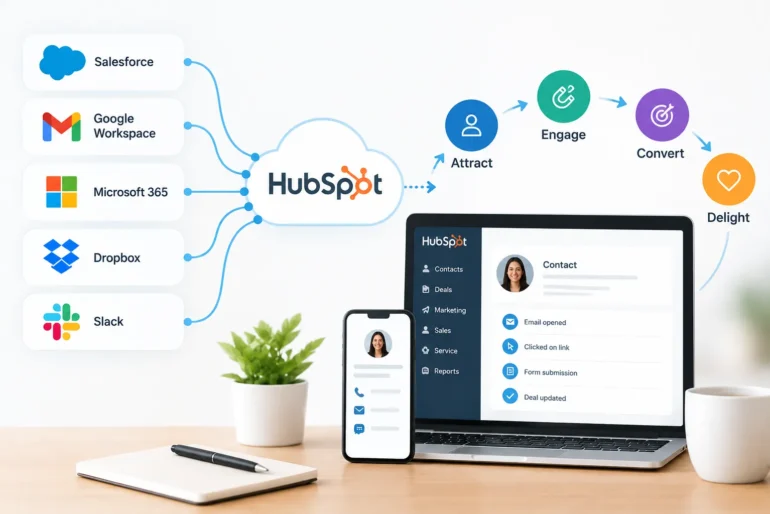
A customer journey can involve dozens of interactions, from the first website visit and enquiry to sales conversations, onboarding, support, and repeat purchases. When the systems behind these interactions operate independently, valuable customer information can become scattered across different platforms.
Connecting cloud applications with HubSpot creates a more unified environment where customer data, workflows, sales activities, and business processes can work together. Instead of moving information manually between applications, businesses can create automated connections that help teams respond faster and deliver more consistent customer experiences.
Connect Every Customer Interaction
Customers expect businesses to recognise their needs regardless of which channel they use. They may submit a website form, speak with a sales representative, respond to an email, or contact customer support.
When these interactions are stored in disconnected systems, employees may not have the complete context they need. Integrating HubSpot with cloud-based applications helps bring relevant information together, giving teams a clearer picture of each customer’s journey.
With effective HubSpot integration services, businesses can connect CRM data with websites, customer portals, ecommerce platforms, marketing applications, payment systems, internal business software, and other digital tools. This creates a connected technology environment where customer information can move between systems more efficiently.
Turn Customer Data into Actionable Information
Data becomes more valuable when businesses can use it at the right moment. A CRM may contain customer profiles and sales activity, while another cloud application may hold transaction, subscription, product, or service information.
Connecting these systems can provide a more complete view of customer behaviour.
For example, when a customer completes an online purchase, the relevant information can be synchronised with HubSpot. Sales teams can understand previous interactions, marketing teams can create more relevant campaigns, and customer service teams can access information that helps them respond more effectively.
This reduces information gaps and supports more informed customer engagement.
Automate the Work Behind the Customer Experience
Many customer-facing activities depend on repetitive internal processes. New leads need to be assigned, follow-ups need to be scheduled, customer information needs to be updated, and teams need notifications when important actions occur.
Cloud applications can help automate these processes when they are connected to HubSpot.
A new lead submitted through a cloud-based application, for instance, can automatically create or update a HubSpot contact and trigger an appropriate workflow. A change in customer status can initiate an internal notification, while a completed transaction can update relevant CRM records.
Business process automation reduces manual administration and allows employees to focus on customer engagement and strategic activities.
Create Personalised Customer Experiences
Personalisation requires more than simply adding a customer’s name to an email. Businesses need access to relevant information about customer interests, interactions, purchases, preferences, and engagement.
Integrated systems make this information easier to use.
When customer data from different applications is connected with HubSpot, businesses can create more targeted marketing campaigns, sales workflows, and communication strategies. Customers can receive content based on their interactions rather than generic messages that may not match their needs.
This can help businesses build stronger relationships while making their digital experiences more relevant.
Build Cloud Applications Around Business Requirements
Every business has different processes and technology requirements. Off-the-shelf applications may provide useful features, but they may not always support unique workflows or integration requirements.
This is where working with a cloud app development company can provide greater flexibility.
Custom cloud application development allows businesses to create software that supports specific operational needs while connecting with existing platforms such as HubSpot. Developers can build custom dashboards, customer portals, workflow applications, internal systems, and specialised business tools that communicate with the CRM.
This approach allows the technology ecosystem to evolve around the business rather than forcing business processes into rigid software structures.
Connect HubSpot with the Rest of Your Technology Stack
HubSpot rarely exists as the only business application. Organisations may also use accounting software, ecommerce platforms, ERP systems, payment gateways, customer portals, analytics tools, communication platforms, and internal applications.
API integration provides a way for these systems to exchange information.
For example, a cloud application can send customer or transaction information to HubSpot, while HubSpot workflows can trigger actions within connected business systems. This creates a more efficient flow of information across the organisation.
A well-planned integration strategy can also reduce duplicate data entry and help businesses maintain more consistent information across their technology environment.
Give Teams the Context They Need
A connected customer journey also improves internal collaboration. Sales, marketing, customer service, and operations teams often interact with the same customers at different stages.
Without shared information, employees may have to search through multiple systems before understanding what has already happened.
Integrated cloud applications can provide teams with access to the information relevant to their responsibilities. Sales representatives can see engagement history, customer service teams can understand account activity, and marketing teams can use behavioural data to improve campaigns.
Greater visibility helps teams work from the same information and reduces communication gaps.
Scale Customer Operations with the Cloud
Customer volumes, transactions, and digital interactions can increase rapidly as a business grows. Technology needs to support this expansion without creating unnecessary complexity.
Cloud-based applications provide a scalable foundation for adding users, features, integrations, and business capabilities. As customer requirements evolve, businesses can introduce new workflows and functionality while maintaining connections with HubSpot and other core systems.
Cloud infrastructure can also support remote access, system availability, data management, and flexible application deployment, making it suitable for modern distributed business environments.
Measure the Journey from One Connected View
A connected technology ecosystem can improve more than day-to-day operations. It can also give businesses better visibility into customer journey performance.
By connecting CRM data with information from other applications, organisations can analyse lead sources, customer engagement, conversion activity, sales performance, service interactions, and other important metrics.
These insights can help identify where customers experience friction and where internal processes can be improved. Business leaders can use the information to refine marketing strategies, optimise sales processes, improve customer support, and make more informed technology decisions.
Build a Customer Journey That Works Behind the Scenes
A seamless customer experience depends on what happens behind the scenes. Customers may never see the integrations, APIs, workflows, databases, or cloud infrastructure powering their interactions, but these technologies influence how quickly and effectively a business can respond.
Combining HubSpot with cloud applications creates opportunities to connect customer information, automate business processes, personalise engagement, and improve collaboration between teams.
The right technology strategy can also provide a foundation for future digital transformation. Businesses can introduce new applications, integrations, automation capabilities, and customer-facing features without rebuilding their entire technology environment.
Ultimately, the goal is not simply to connect two platforms. It is to create a connected digital ecosystem where customer data moves efficiently, teams have the right information, and business processes support every stage of the customer journey. With the right integration and cloud development strategy, businesses can turn fragmented digital interactions into a more seamless, scalable, and customer-focused experience.