

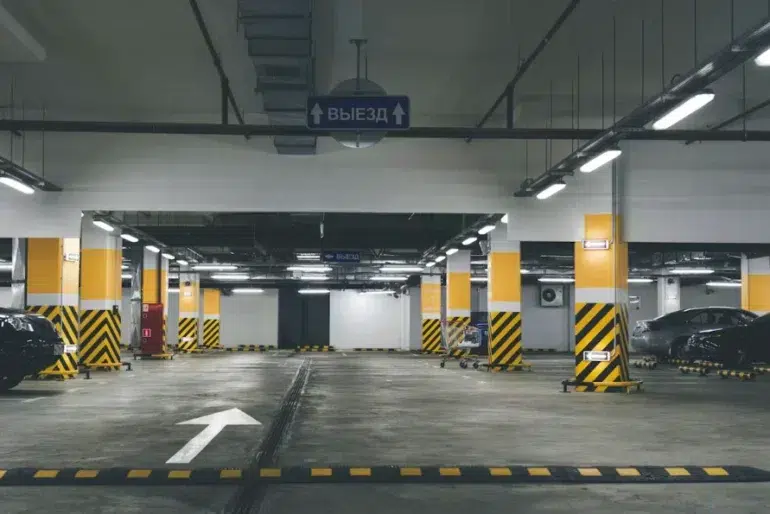
Car parks are getting smarter. Apps show free spaces, cameras read number plates and EV chargers are appearing in every retail park. Yet the first thing most drivers notice is much simpler: are the cars parked neatly, or at odd angles, half on the footpath and nose-first against a shop window?
One of the cheapest ways to get this right needs no app, no power and no Wi-Fi. Wheel stops are low blocks fixed at the end of each bay, and they show drivers exactly where to stop. For small business owners, they are a quick upgrade that makes a car park safer and tidier from day one. Here is how they help, and what to check before choosing them.
Improving Parking Space Layouts with Wheel Stops
Painted lines show drivers the sides of a bay. They do not show how far forward to drive. So some drivers stop short and leave the back of the car in the aisle, while others roll on until the bumper touches the wall.
A wheel stop removes the guesswork. When the tyre meets it, the driver knows the car is in the right place. Every car ends up in roughly the same position, which keeps aisles clear for traffic and makes the whole car park look tidier.
For a small business with only a few spaces, this matters even more. One badly parked car can easily take up two bays.
Wheel stops are also useful in special bays:
• EV charging bays: they keep cars at the right distance from the charger, so the cable reaches and the unit is not knocked.
• Accessible bays: they help keep the marked access zones clear.
• Bays facing each other: they stop drivers pulling straight through into the opposite space.
Protecting Pedestrian Areas and Building Frontages
Many car parks sit right next to footpaths, shop fronts, glass entrances, planting and walls. These are exactly the places a car can reach when a driver misjudges the stop.
Part of every car sits beyond its wheels. This is called the overhang. Even if the tyres stop at the kerb, the bumper can still hang over the footpath and block prams, wheelchairs and people walking past. A wheel stop set back a little from the edge keeps the whole car, overhang included, inside the bay. The right distance depends on the layout and on whether drivers park forwards or reverse in, so it is worth measuring a few typical cars before fixing anything down.
The same idea protects buildings. A bumper resting against a glass frontage, cladding or a fire exit door can cause costly damage, or simply look bad to customers. Wheel stops prevent these small, everyday knocks. They also protect kerbs, trees and equipment such as pay machines and EV chargers.
One honest limit: a wheel stop guides a slow-moving car. It is not designed to stop a vehicle driven at speed. Where that risk exists, for example at a busy shop entrance, bollards or barriers are the right tool, and wheel stops work alongside them.
Choosing Wheel Stops for Commercial and Industrial Car Parks
Not every site needs the same product. A few simple questions help narrow down the choice.
What vehicles use the site? A supermarket car park full of cars needs a different solution from a depot used by vans and lorries. Heavier vehicles need stronger, often longer, wheel stops and stronger fixings.
Which material suits the site?
• Rubber, often made from recycled tyres, is flexible, follows uneven ground and does not crack. It is also quiet when a tyre touches it.
• Plastic is light, easy to handle and usually comes in bright colours.
• Concrete is very heavy and solid, but it can chip or crack and is hard to move or replace.
Is it easy to see? A wheel stop is low, so people can miss it. Yellow or white bodies and reflective strips make it visible day and night and reduce the risk of tripping. Keep wheel stops away from walking routes where possible.
How will it be fixed? Most wheel stops are bolted down, with different fixings for asphalt and concrete. Pre-drilled holes make installation faster. Leaving a gap at each end of the wheel stop lets rainwater drain and gives people room to walk through. On a small site, a local contractor can usually fit a row of wheel stops in a few hours.
Is the height right? Some cars have very little ground clearance, so a low-profile wheel stop avoids scraped bumpers.
When comparing products, look at the material, the fixings included, the colour and reflective options, and whether the product meets local standards. A good range of commercial wheel stops should cover cars, vans and heavier vehicles, so one supplier can equip every area of the same site.
Conclusion
Smart parking technology gets the headlines, but a well-organised car park still starts with the basics. Wheel stops help drivers park straight and in the right place, keep aisles and footpaths clear, and protect buildings, kerbs and equipment from everyday knocks. Choose them for the vehicles you expect, the ground you have and the visibility you need, fix them properly, and check the bolts and reflective strips from time to time. For a modest cost, the result is a car park that is safer, tidier and easier for everyone to use.