

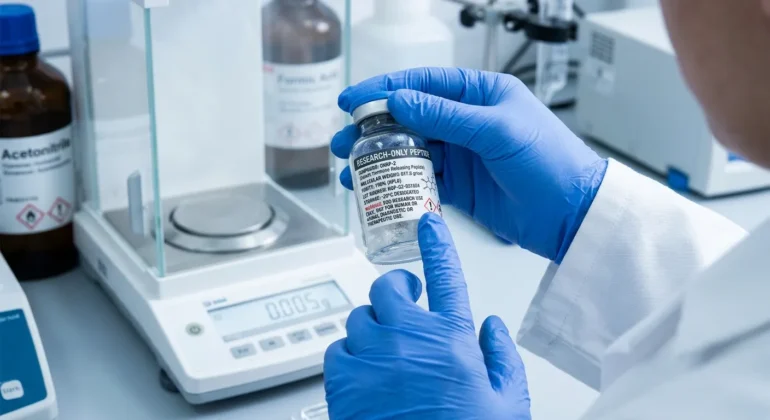
Scroll through a wellness feed in 2026 and peptides turn up dressed in the language of self-improvement. The label on the actual vial says something far quieter. Vive Peptides, a US-based supplier of research-grade peptides, ships freeze-dried powders with a purity specification of 99% or higher by HPLC, and each lot is analyzed by an independent USA-based laboratory. The point worth stating before anything else: everything in its catalog is sold strictly for laboratory and research use only and is not approved for human consumption. What follows reads one label slowly, the way a careful reader checks the fine print on any product.
What does Research Use Only mean on a peptide label?
It means the maker is declaring that the product is meant for laboratory experiments and nothing else. The intended user is a scientist or an institution working with cell cultures, isolated tissues or animal models, not someone looking for something to put in their own body.
Labels of this kind usually state that the material is not approved for human consumption and that nothing attached to it counts as medical advice. Picture a reagent in a university chemistry stockroom. The chemical may be real, pure and carefully documented, yet nobody ever evaluated it for a person to use.
The phrase also reveals what the seller is not claiming. A research label promises nothing about how a compound behaves in a person, because nobody has established that. A social post pairing a research vial with a personal result is mixing two things the label itself keeps apart.
How is a research peptide different from a supplement or a medicine?
The difference comes down to who oversees the product, who is meant to handle it and what the label may say. A supplement generally sits on a shelf with an ingredient panel written for ordinary adult consumers, under FDA rules for foods and supplements. An approved medicine has passed formal review and reaches a patient through a licensed clinician, with approved directions and safety warnings.
A research peptide follows neither path. It has no approved use, no directions for people and no safety review for human exposure, and its label is limited to laboratory-use statements. Calling it a supplement does not make it one, and calling it a medicine does not either.
Why do research peptides keep showing up beside wellness routines?
Because online sellers and influencers blur categories that regulators keep separate. A vial photographed next to a smoothie or a bottle of vitamins looks like a consumer product, even when the fine print says otherwise.
Short videos reward confidence. A caption can borrow the vocabulary of laboratory science, such as 99% pure, lab tested or USA made, while skipping the sentence that matters most: the product is not meant for people. Purity figures describe how clean a powder is. They say nothing about whether using that powder is safe or wise. A high purity number and a certificate of analysis signal careful manufacturing for research, nothing more.
What is in the KLOW peptide blend?
The KLOW peptide blend from Vive Peptides combines four research peptides in one formulation: GHK-Cu, BPC-157, KPV and TB-500. It arrives as a white lyophilized powder with the same 99% or higher HPLC purity specification, and the idea is that a single in vitro or preclinical experiment can look at several overlapping pathways together. Its focus is inflammatory signaling and tissue repair pathways in laboratory models.
- GHK-Cu: copper-binding tripeptide. Isolated from human plasma albumin in 1973.
- BPC-157: synthetic chain of 15 amino acids. Sequence derives from a protein in gastric juice.
- KPV: three residues: lysine, proline, valine. C-terminal end of alpha-MSH.
- TB-500: fragment of thymosin beta-4. Studied for cell movement and repair mechanisms.
Each part has its own research history. GHK goes back to 1973, when Loren Pickart isolated the tripeptide from human plasma albumin and suggested it worked by binding metal ions such as copper. BPC-157 was characterized in the early 1990s by Predrag Sikiric and colleagues at the University of Zagreb, whose foundational papers in 1993 and 1994 described the 15-amino-acid fragment of a larger protein found in human gastric juice.
In practice, laboratories examine GHK-Cu in cell culture work on tissue remodeling and related signaling, and BPC-157 in preclinical repair models. KPV is a recurring tool in experiments on inflammatory signaling, while TB-500 is used where cell movement is the question. Bundling suits experimental design: a team can watch several related pathways under identical conditions rather than preparing four separate materials. That is laboratory efficiency, not a prediction about any living person.
The evidence has limits. Cell culture and animal findings are early observations, many promising laboratory results never carry over to people, and some reveal problems only later. A research label and an approved status are very different things.
What does a trustworthy research peptide label include?
A trustworthy research listing is boring in the best way. It documents what the material is and how pure it is, and it keeps the human-use question firmly closed. Judging by how the supplier describes its own catalog, a few markers are worth recognizing:
- A clear Research Use Only notice on every product page, stating that the item is not approved for human consumption and offers no medical advice.
- A batch-specific certificate of analysis from an independent lab, using HPLC with UV detection coupled to mass spectrometry, showing the purity result, the mass confirmation and the chromatogram as the lab issued them.
- A searchable certificate library, so a visitor can look up a peptide, lot number or size rather than trusting a stock image. As of October 2026 it held 126 certificates across 25 peptides.
- Manufacturing context, such as compounding at a US-based lab that follows cGMP.
None of these markers makes a compound suitable for personal use. They simply separate documented laboratory supplies from vague products.
Is it safe for anyone to try a research peptide personally?
No, and the label is the reason. A Research Use Only product has not been evaluated for human use, so there is no approved purity norm for people, no vetted directions and no clinician overseeing what happens afterward. Vive Peptides sells the compound strictly for laboratory and research use only, and it is not approved for human consumption or for veterinary use.
Anyone curious about a compound seen online is better served by a conversation with a licensed clinician, who can explain what is actually approved and what is still an experiment. Be skeptical of any creator or forum thread that answers a personal question with a research vial.
What to keep in mind
Research Use Only is an honest phrase, and that honesty is the point. It says the material belongs in a laboratory, that no one has vouched for it as a supplement or a medicine, and that the paperwork behind it, however impressive, speaks to quality and not to personal use. When a post asks readers to look past that line, the label is the best reason to look away.