You’re staring at a multiple-choice question with four acids listed, and you need to pick the weak one. Take a breath, because there’s a reliable way to do this. A weak acid is one that only partly breaks apart (ionizes) when it dissolves in water. A strong acid breaks apart almost completely. So if you’re asked which one of the following is a weak acid, the answer is usually the one that isn’t on the short list of strong acids you need to memorize.
This guide walks through that shortcut, explains why it works, and shows you how to avoid the traps that cost students marks in high school chemistry, AP Chemistry, first-year college courses, and Year 11 and 12 exams in Australia.
The Quick Answer: How to Spot a Weak Acid
Most introductory courses expect you to know the common strong acids by heart:
- Hydrochloric acid (HCl)
- Hydrobromic acid (HBr)
- Hydroiodic acid (HI)
- Nitric acid (HNO₃)
- Sulfuric acid (H₂SO₄)
- Perchloric acid (HClO₄)
If an acid appears in a question and isn’t one of these, treat it as weak unless you’re told otherwise. That one habit answers most textbook questions in seconds.
Some quick examples:
- HCl, HNO₃, CH₃COOH, HClO₄: the weak acid is CH₃COOH (acetic acid).
- HBr, HI, HF, H₂SO₄: the weak acid is HF (hydrofluoric acid).
What Makes an Acid Weak?
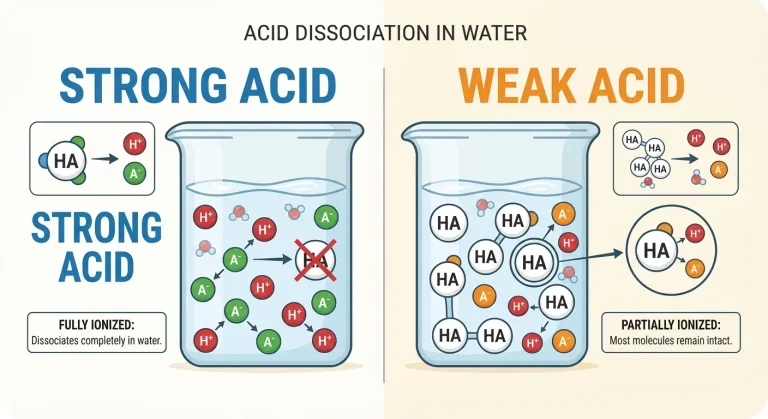
When an acid dissolves, it donates hydrogen ions (H⁺) to water. A strong acid hands over nearly all of them. A weak acid hands over only a small fraction, and the rest stays as intact acid molecules.
Take acetic acid, the acid in vinegar. In water, it sets up an equilibrium:
CH₃COOH ⇌ H⁺ + CH₃COO⁻
The double arrow matters. It tells you the reaction runs in both directions, and at any moment most of the acetic acid hasn’t ionized. Compare that with hydrochloric acid, which is written with a single arrow because it ionizes essentially completely.
Ka and pKa
Chemists measure acid strength with the acid dissociation constant, Ka. A larger Ka means a stronger acid, since more of it ionizes. Because Ka values are often tiny numbers, you’ll also see pKa, which is the negative log of Ka. A lower pKa means a stronger acid.
Acetic acid has a Ka of about 1.8 × 10⁻⁵ at room temperature, and a pKa of about 4.76. Those numbers are small, which tells you it’s a weak acid.
A Quick Percent Ionization Example
Here’s what “weak” looks like in practice. In a 0.1 M acetic acid solution, only about 1.3% of the molecules ionize. The pH works out to roughly 2.87. A 0.1 M solution of hydrochloric acid, by contrast, has a pH of about 1, because nearly every molecule releases its hydrogen ion.
Same concentration, very different behavior. That’s the whole idea of acid strength.
Common Weak Acids You’ll See in Class
Here are the weak acids that show up most often, with approximate Ka values at 25°C. Exact figures vary slightly between textbooks, so use the values from your course materials on tests.
| Acid | Formula | Approximate Ka | Where you’ll meet it |
|---|---|---|---|
| Acetic acid | CH₃COOH | 1.8 × 10⁻⁵ | Vinegar, buffer problems |
| Formic acid | HCOOH | 1.8 × 10⁻⁴ | Ant venom, organic chemistry |
| Hydrofluoric acid | HF | about 7 × 10⁻⁴ | Etching glass, exam trick questions |
| Carbonic acid | H₂CO₃ | 4.3 × 10⁻⁷ (first step) | Soda water, blood chemistry |
| Hydrocyanic acid | HCN | about 6 × 10⁻¹⁰ | Equilibrium and toxicity examples |
| Phosphoric acid | H₃PO₄ | about 7 × 10⁻³ (first step) | Cola drinks, fertilizers |
Notice something about the organic acids: anything with a carboxyl group (–COOH) is almost always a weak acid. If you see that group in a question, that’s a strong hint.
Strong Acids vs. Weak Acids Side by Side
| Feature | Strong acid | Weak acid |
|---|---|---|
| Ionization in water | Nearly complete | Partial |
| Equation arrow | Single arrow (→) | Double arrow (⇌) |
| Ka value | Very large | Small |
| Conductivity (same concentration) | High | Lower |
| Examples | HCl, HNO₃, HClO₄ | CH₃COOH, HF, H₂CO₃ |
How to Pick the Weak Acid in a Multiple-Choice Question
Work through the options like this:
- Cross out anything on the strong acid list. HCl, HBr, HI, HNO₃, H₂SO₄, and HClO₄ are out.
- Look for a carboxyl group. Formulas ending in –COOH, like CH₃COOH, point to a weak acid.
- Check for the usual suspects. HF, HCN, H₂CO₃, and H₃PO₄ are weak.
- Use Ka if the question gives it. Choose the acid with the smallest Ka (or the largest pKa) if you’re asked for the weakest one.
- Double-check similar-looking formulas. More on that below.
Watch Out for These Traps
HF looks like it belongs with the strong acids. HCl, HBr, and HI are all strong, so students assume HF is too. It isn’t. HF is a weak acid, and teachers love testing this.
Similar formulas, different strengths. Nitric acid (HNO₃) is strong, but nitrous acid (HNO₂) is weak. Sulfuric acid (H₂SO₄) is strong, but sulfurous acid (H₂SO₃) is weak. Perchloric acid (HClO₄) is strong, but hypochlorous acid (HClO) is weak. As a rule of thumb, oxyacids with more oxygen atoms on the same central atom tend to be stronger.
Sulfuric acid is a special case. It’s treated as strong because its first ionization is essentially complete. Its second step is only partial, which is why some questions about it get tricky. Unless your course says otherwise, count it as strong.
Common Mistakes Students Make
A few confusions come up again and again:
- Mixing up strong and concentrated. Strength describes how much an acid ionizes. Concentration describes how much acid is dissolved. You can have a dilute strong acid or a concentrated weak acid.
- Assuming weak means harmless. Hydrofluoric acid is weak, yet it’s highly hazardous and can cause severe burns and deep tissue damage. Strength tells you about ionization, not safety.
- Relying on pH alone. A very concentrated weak acid can have a lower pH than a very dilute strong acid. Compare solutions at the same concentration before drawing conclusions.
- Forgetting the conjugate base. A weak acid has a conjugate base that’s relatively stronger than the conjugate base of a strong acid. That’s why acetate ions can accept hydrogen ions, which is the basis for buffers.
Why Weak Acids Matter Outside the Classroom
This isn’t only exam material. Weak acids are all around you:
- Vinegar gets its sour taste from acetic acid.
- Citrus fruits contain citric acid, another weak acid.
- Fizzy drinks contain carbonic acid, formed when carbon dioxide dissolves in water.
- Buffers often pair a weak acid with its conjugate base to hold pH steady. Blood relies on a carbonic acid and bicarbonate buffer system.
Because weak acids ionize only partially, they’re gentler and more controllable than strong acids. That’s exactly why they’re so useful in food, medicine, and lab work.
Wrapping It Up
When a test asks which one of the following is a weak acid, don’t panic and don’t guess. Memorize the strong acid list, rule those out, and look for carboxyl groups or familiar names like HF, HCN, and H₂CO₃. Then confirm with Ka or pKa if the question gives you numbers. With a little practice, you’ll be picking the right answer in seconds, and you’ll understand the chemistry behind it too.
FAQ
What is the easiest way to identify a weak acid?
Memorize the six common strong acids: HCl, HBr, HI, HNO₃, H₂SO₄, and HClO₄. Most other acids you’ll meet in introductory chemistry are weak.
Is HF a strong or weak acid?
HF is a weak acid, even though the other hydrogen halides (HCl, HBr, HI) are strong. It’s still very dangerous to handle.
Is acetic acid a weak acid?
Yes. Acetic acid has a Ka of about 1.8 × 10⁻⁵, and only a small percentage of its molecules ionize in water.
Can a weak acid be more dangerous than a strong acid?
It can be. Hydrofluoric acid is the classic example. Acid strength measures ionization, not toxicity or corrosiveness in every situation.
Does a lower pH always mean a stronger acid?
No. pH also depends on concentration. Compare acids at the same concentration to judge their relative strength.