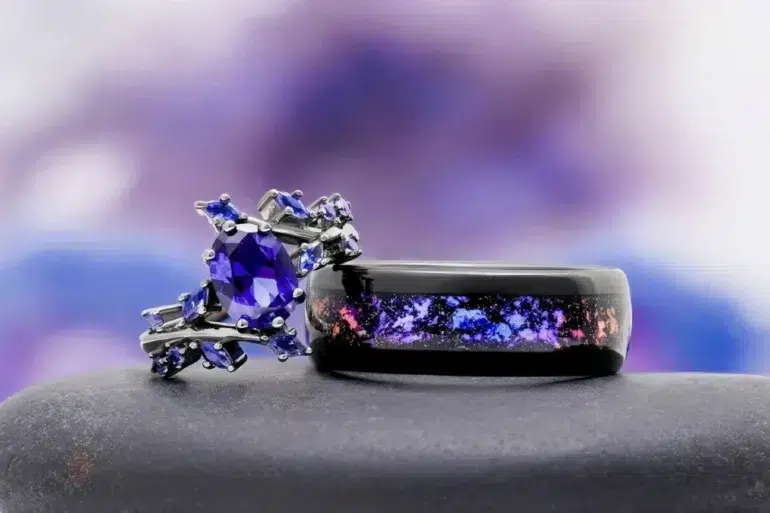
Few gemstones have carried as much meaning through history as sapphire. Long before it became a familiar sight in fine jewelry cases, this deep-hued stone was tied to the heavens, to truth, and to the idea that certain objects could hold quiet power. Its rich blue seemed to belong to a different order than the everyday, and cultures separated by thousands of miles arrived at strikingly similar conclusions about what it represented. To understand why sapphire still feels significant on a hand or at the throat today, it helps to trace the long story of what people have believed about it.
Ancient associations with the sky and the divine
In the ancient world, sapphire was often read as a fragment of the sky brought down to earth. Its color echoed the vault of the heavens, and that resemblance gave it a spiritual charge that plain description cannot capture. Some early peoples imagined that the world itself rested on an enormous sapphire, and that the sky took its color as a reflection. Others associated the stone with celestial bodies and the movement of the stars, treating it as a link between the human and the cosmic. Anyone curious about how these early ideas developed can explore the meaning and symbolism of sapphire in more depth, but the essential thread is simple: from the very beginning, sapphire was understood as a stone that pointed upward, toward something larger than daily life.
Royalty, clergy, and the color of authority
For much of recorded history, deep blue was an expensive and difficult color to command, and sapphire made it permanent. That rarity tied the stone to those who held power. Monarchs wore it as a mark of standing, and it appeared in crowns, scepters, and ceremonial ornaments meant to signal legitimacy. The clergy adopted it as well, associating its calm blue with heaven, devotion, and the promise of higher truth. Bishops were known to wear sapphire in their rings, and the stone came to stand for wisdom and clear judgment in those entrusted with guidance. Because it was worn by rulers and religious figures alike, sapphire absorbed a double meaning: worldly authority on one hand, and spiritual seriousness on the other. That blend of grandeur and gravity still clings to the stone today.
Protection, wisdom, and folklore
Beyond its ties to power, sapphire gathered a wide body of folklore built around protection and clarity of mind. Travelers were said to carry it as a guard against harm on long journeys, and it was believed to shield the wearer from envy and ill intent. Many traditions held that the stone encouraged honesty, so much so that it was thought to reveal deceit or lose its brightness in the presence of a dishonest heart. Others regarded it as an aid to concentration and calm, a steadying influence for anyone facing a difficult decision. Whether or not any of this held literal weight, the pattern is telling: people reached for sapphire when they wanted to feel protected, focused, and truthful. Those are enduring human wishes, and the stone became a way to carry them close.
Sapphire in different world traditions
The stone’s meaning shifted from region to region, yet the core themes stayed remarkably consistent. In parts of South and East Asia, sapphire was linked to discipline, fate, and the influence of the planets, and it was treated with care because its power was thought to be real and considerable. In the Mediterranean and Near East, it was woven into stories of prophecy and sacred insight. Across medieval Europe, it stood for constancy and faithfulness, qualities prized in both friendship and vows of loyalty. Some of the associations that people reach for today can be grouped simply:
- Truth and honesty, from the belief that the stone rewarded a sincere heart.
- Wisdom and clear thinking, tied to its use by scholars and clergy.
- Protection, drawn from its role as a traveler’s talisman.
- Loyalty and constancy, valued across many cultures as a mark of steadfastness.
What is striking is not the differences between traditions but the overlap. Very different societies looked at the same blue stone and saw seriousness, steadiness, and a link to something higher.
Why the meaning endures in modern jewelry
Symbolism does not survive for centuries by accident. Sapphire endures partly because its associations are ones people still care about: honesty, wisdom, loyalty, and a sense of calm. When a stone carries that kind of history, wearing it becomes more than decoration. A pendant or a ring set with sapphire quietly references a long lineage of meaning, and many wearers find that appealing precisely because it is understated rather than loud. The color helps too. Deep blue reads as composed and confident without demanding attention, which suits the way many people want their jewelry to feel. Today the market for sapphire jewelry for women reflects that lasting appeal, offering designs that let the stone’s character come forward while sitting comfortably in everyday life. The meaning is not something added on by marketing; it is inherited, and that is what gives modern sapphire pieces their weight.
Wearing sapphire with intention
Knowing the history changes how a piece feels to wear. Choosing sapphire because it has long stood for clarity or loyalty gives the stone a personal dimension that goes beyond its color. Some people select it to mark a milestone that called for steadiness, or to carry a reminder of a value they want to keep close. Others simply enjoy the connection to a tradition that spans continents and centuries. There is no single correct way to wear it. A sapphire can be a discreet daily companion or a piece reserved for occasions that matter. What ties these choices together is intention: when you understand what the stone has meant to so many people before you, putting it on becomes a small, deliberate act rather than an afterthought. That is the quiet gift of a gemstone with a long memory.
A stone that still speaks
Sapphire has traveled a remarkable road, from the skies of ancient imagination to the hands of rulers and clergy to the jewelry boxes of ordinary people. Along the way it gathered a coherent set of meanings that have proved durable: truth, wisdom, protection, and loyalty. Those ideas are not relics. They still describe things people hope to embody and remember. That is why a sapphire, however simply it is set, tends to feel like more than a pretty stone. It carries a story that many cultures helped to write, and every time it is worn, that story continues in a small and personal way.