

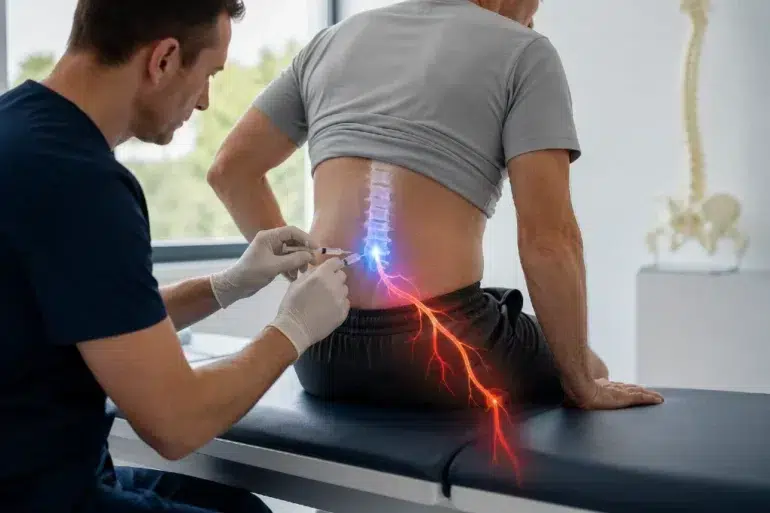
Back pain can feel simple at first. A stiff lower back. A sharp pull when you bend. A burning line of pain that travels down the leg or into the arm. But when the pain comes from an irritated spinal nerve, the problem often sits deeper than tight muscles. That is where PRT Spritz treatment may enter the conversation.
PRT stands for periradicular therapy. In simple terms, it is an image-guided injection placed close to an irritated nerve root in the spine. The goal is not to “fix” the spine in one visit or remove a slipped disc. The goal is usually to calm inflammation, reduce nerve irritation, and make movement easier so the patient can continue recovery with physiotherapy, posture changes, and daily activity adjustments.
For people dealing with sciatica, herniated disc pain, spinal nerve irritation, or pain that travels from the neck into the arm, this treatment may offer relief when tablets, rest, or basic exercises are not enough.
What Is PRT Spritz?
PRT Spritz is commonly used as a patient-friendly term for a periradicular injection, often called periradicular therapy. The word “Spritze” is German for “injection,” which is why many people searching online use phrases like PRT Spritz, PRT injection, or PRT Spritze.
The treatment targets pain near a spinal nerve root. A nerve root is the part of the nerve that exits the spinal canal before traveling into the arm, chest, hip, leg, or foot. When that area becomes compressed or inflamed, pain can radiate away from the spine.
Doctors often use imaging guidance, such as CT or fluoroscopy, to place the needle accurately near the affected nerve root. CT-guided periradicular therapy is described as a procedure where a thin needle is passed close to the spinal nerve root under computed tomography monitoring, allowing medication to be delivered near the irritated area.
The injected medication may include a local anesthetic, an anti-inflammatory steroid, or a combination depending on the doctor’s judgment, patient history, and local medical practice.
Why Spine and Nerve Pain Can Travel
One confusing thing about nerve-related spine pain is that the pain is not always felt where the problem begins.
A person may have a disc issue in the lower back but feel pain running through the buttock, thigh, calf, or foot. Someone else may have a neck problem but feel tingling, burning, or weakness in the shoulder, arm, or hand.
This pattern is often linked to radiculopathy or radicular pain. Cleveland Clinic describes radiculopathy as symptoms caused when nerve roots are compressed or irritated. These symptoms can include pain, numbness, tingling, and weakness.
That is why a treatment placed near the irritated nerve root can sometimes help pain felt far away from the spine.
Common Conditions Where PRT Spritz May Be Considered
Doctors may discuss PRT Spritz when symptoms suggest nerve root irritation rather than simple muscle soreness.
It may be considered in situations such as:
| Condition | How It May Cause Pain |
|---|---|
| Herniated disc | Disc material may press on or irritate a nerve root |
| Sciatica | Pain may travel from the lower back into the leg |
| Spinal stenosis | Narrowing around the spine may crowd nerve structures |
| Degenerative disc disease | Wear-related changes may irritate nearby nerves |
| Foraminal narrowing | The nerve exit opening becomes tighter |
| Cervical radiculopathy | Neck nerve irritation may send pain into the arm |
| Lumbar radiculopathy | Lower back nerve irritation may send pain into the leg |
PRT is generally used in patients with nerve root irritation, often when pain radiates into the arms or legs. Causes can include herniated discs and wear-related narrowing of the spinal canal or nerve exit holes.
This is important because not every backache is suitable for this procedure. If the pain comes mainly from muscles, general stiffness, poor sleep posture, or non-specific back strain, a nerve-root injection may not be the first choice.
How PRT Spritz Treatment Works
The idea behind PRT Spritz is fairly direct. If a nerve root is irritated, swollen, or inflamed, placing anti-inflammatory medication close to it may reduce the irritation.
That can lead to several possible benefits:
- Less sharp nerve pain
- Reduced burning or shooting sensations
- Easier walking, sitting, or standing
- Better ability to do physiotherapy
- Lower need for strong pain medication
- Improved daily function during recovery
A 2022 study on CT-guided periradicular injections noted that the treatment can provide early pain relief and may help patients perform physical therapy more effectively.
That point matters. The injection is usually not the entire recovery plan. It is often one part of a broader plan that may include exercise therapy, core strengthening, weight management, ergonomic changes, and better movement habits.
What Happens Before the Procedure?
Before a doctor recommends PRT Spritz, they usually want to understand the pain pattern clearly.
A typical evaluation may include:
- Medical history
- Physical examination
- Neurological checks for strength, sensation, and reflexes
- MRI or CT scan review
- Discussion of previous treatments
- Medication and allergy review
- Blood thinner and bleeding-risk assessment
Doctors may ask where the pain travels, whether there is numbness, whether coughing or bending worsens symptoms, and whether walking or sitting changes the pain.
For example, pain that starts in the lower back and runs down the back of the leg may suggest sciatic nerve involvement. Pain that begins in the neck and travels into the thumb or fingers may suggest cervical nerve root irritation.
The more clearly the pain matches the imaging findings, the more logical the injection target becomes.
What Happens During PRT Spritz?
The exact steps can vary by clinic, but the general process is usually straightforward.
The patient lies on a treatment table, often on the stomach for lower back injections or in another position depending on the target area. The skin is cleaned carefully. Local anesthetic may be used to numb the skin.
The doctor then uses imaging guidance to guide a fine needle toward the area near the affected nerve root. Once the needle position is confirmed, medication is injected close to the irritated nerve.
The injection itself is usually short. The preparation and positioning may take longer than the actual injection.
Some patients feel pressure. Some feel a brief reproduction of their usual nerve pain when the needle approaches the irritated area. That sensation should be reported to the medical team immediately, but it can sometimes help confirm that the correct region is being treated.
CT-Guided PRT Spritz vs Blind Injection
Accuracy is one reason imaging guidance matters.
In CT-guided treatment, the doctor can see the needle position in relation to the spine, bones, and target area. This helps place the medication near the nerve root while avoiding unnecessary guesswork.
A review on CT-guided spine injections notes that image-guided injections can provide significant pain relief in some patients and may delay the need for decompressive surgery in selected cases.
That does not mean surgery is always avoidable. It simply means that for some patients, targeted injection therapy may provide enough relief to continue conservative care.
How Soon Can Pain Relief Start?
Some people feel relief within hours because of the local anesthetic. Others notice improvement over several days as the anti-inflammatory effect develops.
A realistic timeline may look like this:
| Time After Treatment | Possible Experience |
|---|---|
| First few hours | Temporary numbness or early pain relief |
| First 1 to 3 days | Soreness at injection site may occur |
| First week | Nerve pain may begin to calm |
| 2 to 4 weeks | Function and movement may improve |
| Several weeks later | Doctor may assess whether another session is needed |
Pain relief is not guaranteed. Some patients feel a major difference. Others feel partial relief. A smaller group may not respond at all, especially if the nerve compression is severe or if long-term nerve damage has already developed.
How Long Does PRT Spritz Relief Last?
This depends on the cause of the nerve irritation.
If pain is mainly driven by inflammation around a disc herniation, relief may last long enough for the body to settle and for physiotherapy to work better. If the spine has advanced narrowing, severe arthritis, or repeated mechanical compression, symptoms may return.
Some people need only one injection. Others may receive a short series of injections spaced apart. Doctors usually avoid unlimited steroid injections because repeated steroid exposure can carry risks.
A patient who uses the pain-free window wisely often does better. That means improving posture, gently rebuilding strength, avoiding repeated flare-up movements, and following the rehabilitation plan.
Benefits of PRT Spritz Treatment
The biggest possible benefit of PRT Spritz is targeted relief. Instead of medication spreading through the whole body like oral painkillers, the injection is placed close to the suspected pain source.
Potential benefits include:
- Targeted treatment near the irritated nerve
- Reduced radiating pain
- Improved walking or sitting tolerance
- Better sleep due to less nerve pain
- Lower reliance on oral pain medication
- Support for physiotherapy progress
- Possible delay or avoidance of surgery in selected cases
For someone who cannot sit through work, walk normally, or sleep because of leg pain, even partial relief can make a meaningful difference.
Risks and Side Effects to Know
Like any medical procedure, PRT Spritz has possible risks. Most side effects are mild, but patients should understand them before treatment.
Possible side effects may include:
- Temporary soreness at the injection site
- Brief increase in pain
- Bruising
- Temporary numbness or weakness
- Facial flushing after steroid use
- Blood sugar changes, especially in diabetes
- Infection, rarely
- Bleeding, rarely
- Allergic reaction, rarely
- Nerve irritation, rarely
Patients taking blood thinners, people with infections, uncontrolled diabetes, pregnancy considerations, or contrast allergies should discuss these issues clearly before the procedure.
A careful clinic will review medication lists and medical history before treatment. Never hide blood thinner use, recent fever, or previous injection reactions.
Who May Not Be a Good Candidate?
This treatment may not be suitable for everyone.
A doctor may avoid or delay the procedure if a patient has:
- Active infection
- Uncontrolled bleeding disorder
- Certain blood thinner risks
- Severe allergy to planned medication
- Uncontrolled diabetes
- Unclear pain source
- Progressive neurological weakness
- Symptoms suggesting emergency spinal compression
Severe or worsening weakness, loss of bladder or bowel control, numbness in the saddle area, fever with back pain, or major trauma should be treated as urgent medical warning signs.
In those situations, waiting for an injection appointment may be unsafe.
PRT Spritz vs Epidural Steroid Injection
People often confuse PRT Spritz with epidural steroid injections. They are related but not always the same.
A periradicular injection targets the area close to a specific nerve root. An epidural injection places medication into the epidural space, where it may spread over a broader area.
| Feature | PRT Spritz | Epidural Injection |
|---|---|---|
| Main target | Specific nerve root region | Epidural space |
| Best suited for | More focused nerve root irritation | Broader spinal inflammation patterns |
| Imaging use | Often CT-guided or fluoroscopy-guided | Often fluoroscopy-guided |
| Medication spread | More targeted | Often broader |
| Common use | Radicular arm or leg pain | Back or leg pain from nerve inflammation |
The best option depends on symptoms, imaging, and the doctor’s experience.
Real-World Example: Lower Back Pain With Sciatica
Imagine a 46-year-old office worker who develops lower back pain after lifting a heavy box. At first, it feels like a normal strain. But within a week, the pain starts running down the back of the thigh and into the calf.
Sitting becomes difficult. Driving hurts. Coughing sends a sharp shock down the leg.
An MRI shows a lumbar disc herniation irritating a nerve root. The patient tries anti-inflammatory medication, rest, and gentle physiotherapy, but the leg pain remains intense.
In this type of case, a doctor may consider PRT Spritz to calm the nerve irritation. If the injection reduces pain, the patient may finally be able to walk more comfortably and continue rehabilitation.
The injection does not erase the disc problem overnight. But it may reduce the painful inflammatory response around the nerve.
Real-World Example: Neck Pain Traveling Into the Arm
Now picture a 55-year-old person with neck pain that travels into the shoulder and thumb. There is tingling in the fingers and pain when turning the head.
Imaging shows narrowing near a cervical nerve root. The pain pattern matches the scan. If conservative treatment has not helped enough, the doctor may discuss a targeted nerve root injection.
In this case, the goal is to reduce nerve inflammation and improve daily function. The patient still needs posture work, neck-friendly activity changes, and follow-up care.
What to Do After the Procedure
After treatment, most clinics monitor the patient for a short period. Driving rules vary, especially if sedating medication was used, so patients should follow the clinic’s instructions.
Helpful aftercare steps may include:
- Rest on the day of treatment
- Avoid heavy lifting for 24 to 48 hours
- Follow the doctor’s medication instructions
- Track pain changes over the next week
- Resume physiotherapy when cleared
- Report fever, severe worsening pain, or unusual weakness
The days after the injection are not the time to test the spine with heavy work. Relief should be used carefully, not as a signal to rush back into painful habits.
How to Improve Results After PRT Spritz
The injection may calm the pain, but long-term improvement often depends on what happens next.
Patients often get better results when they combine treatment with:
- Core and hip strengthening
- Gentle walking
- Weight management if needed
- Better sitting posture
- Safer lifting habits
- Regular physiotherapy
- Less prolonged bed rest
- Better workstation setup
- Smoking reduction, if relevant
The spine responds to daily habits. A single injection can help pain, but repeated poor movement patterns can bring symptoms back.
Questions to Ask Your Doctor
Before agreeing to treatment, patients should feel comfortable asking direct questions.
Useful questions include:
- Which nerve root is being targeted?
- What did my MRI or CT show?
- Is my pain pattern consistent with the scan?
- What medication will be injected?
- How many injections might I need?
- What risks apply to my medical history?
- When should I restart physiotherapy?
- What symptoms should make me call urgently?
- What happens if the injection does not help?
A good explanation should connect the symptoms, imaging findings, and treatment plan in a way the patient can understand.
Common Myths About PRT Spritz
“It cures every type of back pain.”
No. PRT Spritz is mainly considered for nerve root irritation. General back stiffness, muscle strain, or non-specific pain may need a different approach.
“If it works, I do not need physiotherapy.”
That is usually the wrong lesson. Pain relief often creates a better window for movement therapy. Skipping rehab may increase the chance of relapse.
“It removes a herniated disc.”
The injection does not remove disc material. It may reduce inflammation and pain around the nerve.
“More injections always mean better results.”
Not necessarily. If the first injections do not help, doctors may reconsider the diagnosis or discuss other treatment options.
“Pain relief means the spine is fully healed.”
Pain can improve before the underlying irritation has fully settled. That is why careful return to activity matters.
When to Seek Urgent Help
Most back and nerve pain is not an emergency, but certain symptoms should never be ignored.
Seek urgent medical care if you have:
- New loss of bladder or bowel control
- Numbness around the groin or saddle area
- Rapidly worsening leg or arm weakness
- Fever with severe back pain
- Severe pain after major trauma
- Unexplained weight loss with persistent spine pain
- History of cancer with new severe back pain
These symptoms may suggest a serious condition that needs immediate evaluation.
Is PRT Spritz Worth Considering?
PRT Spritz may be worth discussing when pain clearly follows a nerve-root pattern and conservative treatment has not provided enough relief. It is especially relevant when imaging shows a disc herniation, foraminal narrowing, or another cause that matches the symptoms.
It is not magic. It is not a replacement for medical evaluation, movement therapy, or lifestyle changes. But for the right patient, it can reduce pain enough to make recovery feel possible again.
The best results often come when the injection is used as part of a larger plan. That plan may include physiotherapy, better movement habits, realistic activity pacing, and follow-up with a spine specialist.
Conclusion
PRT Spritz treatment is a targeted option for certain types of spine and nerve pain, especially when an irritated nerve root causes pain to travel into the arm or leg. It may help calm inflammation, reduce radiating pain, and make everyday movement easier.
Still, the most important step is proper diagnosis. Back pain can come from many sources, and nerve pain needs careful evaluation. When symptoms, examination, and imaging all point to the same irritated nerve area, PRT Spritz may become a useful part of the treatment plan.
For many patients, the real value is not only pain relief. It is the chance to move again, sleep better, restart therapy, and slowly rebuild confidence. Understanding the role of spinal nerve roots nerve roots can also help patients see why pain sometimes travels far from the original problem area.
PRT Spritz is best viewed as a focused medical tool, not a standalone cure. Used carefully, with the right diagnosis and follow-up care, it may help people with spine-related nerve pain take a safer step toward recovery.