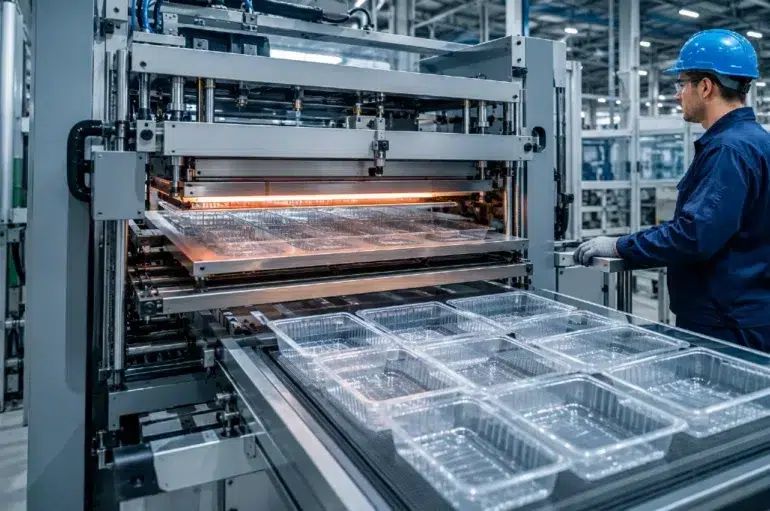
Manufacturing teams face relentless pressure, cut costs, accelerate timelines, and still hold quality to a high standard. It’s a brutal balancing act. That’s precisely why industrial thermoforming applications have carved out such a dominant role across so many production environments.
From automotive interiors to sterile medical trays, this process delivers a combination of design flexibility and cost efficiency that competing methods struggle to replicate. According to Plastics Today, thermoforming tooling runs at just 25% of injection molding tooling costs, a genuinely significant edge for short-run jobs.
Industrial Thermoforming Technologies, Reimagined
The thermoforming process in industry is barely recognizable compared to where it started. Basic sheet heating and rudimentary mold pressing have given way to something far more capable, faster cycles, tighter tolerances, and geometries that would have seemed unrealistic a decade ago.
Engineers and operators who work with RapidMade thermoforming solutions gain access to a fully integrated production system. Rapid tooling, built on advanced 3D-printed MJF nylon molds, can be delivered within one to two weeks. Pair that with CNC trimming, custom finishing, and rigorous quality inspection, and you’ve got a process that sidesteps the brutal lead times and steep upfront investment that haunt traditional tooling approaches.
With that foundation in place, it’s worth looking at how the underlying technologies actually work.
Vacuum Forming Applications in Heavy-Gauge Manufacturing
Among the most widely deployed processes, vacuum forming applications rely on negative pressure to pull heated thermoplastic sheets tightly over a mold. Heavy-gauge vacuum forming earns its keep on large enclosures, vehicle body panels, and industrial equipment covers. Precision heating controls have improved considerably; operators can now maintain tighter tolerances even on oversized, awkward geometries.
Pressure Forming Manufacturing for Fine Detail Parts
When a part needs sharper edges, refined textures, or cleaner surface finishes, pressure forming manufacturing is where you turn. Rather than pulling plastic onto a mold, it pushes the material in using compressed air from above, delivering results that genuinely rival injection-molded aesthetics. For visible components in consumer goods or medical devices, that distinction matters quite a lot.
Twin-Sheet and Large-Format Thermoforming Advances
Twin-sheet forming bonds two heated plastic sheets into a single hollow, structurally rigid part, lighter than a solid equivalent without sacrificing integrity. And large-format capabilities now extend to parts exceeding three meters in length. That opens real doors for aerospace panels, agricultural equipment components, and commercial vehicle applications that demand both scale and strength.
Applications Across Key Industries
Thermoforming in modern manufacturing reaches far wider than most people initially assume. Speed, material versatility, and scalable tooling make it a natural fit wherever demanding production requirements meet real budget constraints.
Automotive and EV Components
Interior door panels, dashboard trims, and EV battery enclosures are all regular candidates for thermoforming. Weight reduction drives much of this; lighter plastic parts directly improve range and fuel efficiency without compromising structural performance. That’s a meaningful value proposition for EV manufacturers competing on every kilogram.
Industrial Logistics and Packaging Solutions
Dunnage trays, reusable insert trays, and protective transit containers represent some of the most practical industrial thermoforming applications in logistics. These parts absorb impact, reduce packaging weight, and protect components through the full distribution chain. According to Utz Group, thermoformed packaging can reduce product damage rates by up to 50%, keeping goods arriving in pristine condition.
Medical and Sterile Packaging Innovations
Thermoforming is deeply embedded in medical manufacturing; cleanroom-compatible trays, sterile device packaging, and surgical instrument holders all depend on it. Tight dimensional accuracy and compatibility with sterilization protocols aren’t optional here. They’re requirements with no room for compromise.
Displays, Consumer Goods, and Appliances
Point-of-sale displays, cosmetic packaging, and appliance panels all benefit from pressure forming’s capacity for sharp, polished surfaces at genuinely competitive costs. Design teams can pursue complex contours without inflating tooling budgets, a freedom that other processes rarely afford at this price point.
Trends Accelerating Thermoforming’s Real-World Impact
Smart manufacturing and sustainability aren’t theoretical ambitions anymore. They’re actively reshaping how thermoforming equipment is designed, operated, and evaluated.
Smart Manufacturing and Industry 4.0 Integration
IoT-connected equipment, digital design tools, and automated process controls are now standard features on modern thermoforming lines. Real-time monitoring catches thermal deviations before they become scrap runs, improving consistency across high-volume production without adding headcount.
Sustainability and Advanced Materials
Bio-based plastics, multi-layer recyclable materials, and 100% post-consumer recycled PET are gaining real traction. These aren’t compromises; they frequently improve material performance while supporting the corporate sustainability commitments that procurement teams are increasingly required to meet.
Why Manufacturers Choose Thermoforming Over Alternatives
| Factor | Thermoforming | Injection Molding | 3D Printing |
| Tooling Cost | Low | Very High | None |
| Lead Time | 1–6 Weeks | 8–16 Weeks | Days |
| Part Size | Small to Very Large | Small to Medium | Small |
| Surface Quality | High | Very High | Moderate |
| Best For | Low-Mid Volume | High Volume | Prototyping |
Thermoforming occupies a practical sweet spot, with less financial commitment than injection molding, better unit economics than 3D printing when production scale kicks in.
Frequently Asked Questions
What’s the difference between vacuum forming and pressure forming?
Vacuum forming uses negative pressure to pull plastic onto a mold. Pressure forming pushes compressed air from above, producing sharper detail, better surface texture, and tighter tolerances, making it the right call for visible or aesthetically demanding components.
Which industries rely most heavily on thermoforming?
Automotive, medical, packaging, consumer goods, and logistics are consistent heavy users. EV manufacturers and aerospace companies are also adopting it rapidly for lightweight structural and enclosure components.
What materials perform best in heavy-gauge thermoforming?
ABS, HDPE, polycarbonate, PETG, and polypropylene all hold up well. The right choice depends on end-use demands, temperature resistance, impact strength, chemical exposure, or optical clarity.
Is thermoforming a genuinely sustainable option?
Yes. Using recycled content like 100% PCR PET, thermoforming can cut carbon emissions by 15% versus molded fiber alternatives, while reducing material waste compared to heavier forming methods.
The Practical Next Step for Serious Manufacturers
The case for industrial thermoforming applications keeps building, with lower tooling costs, compressed lead times, strong surface quality, and scalability that holds up under real production pressure. The thermoforming process in industry continues advancing through smarter controls, better materials, and expanded format capabilities.
Whether you’re evaluating vacuum forming applications for large enclosures, exploring pressure forming manufacturing for detail-critical components, or preparing to scale full production runs, thermoforming deserves an honest, thorough look. Find an experienced partner, run a prototype, and put the process to work on a real challenge. The results tend to speak for themselves.