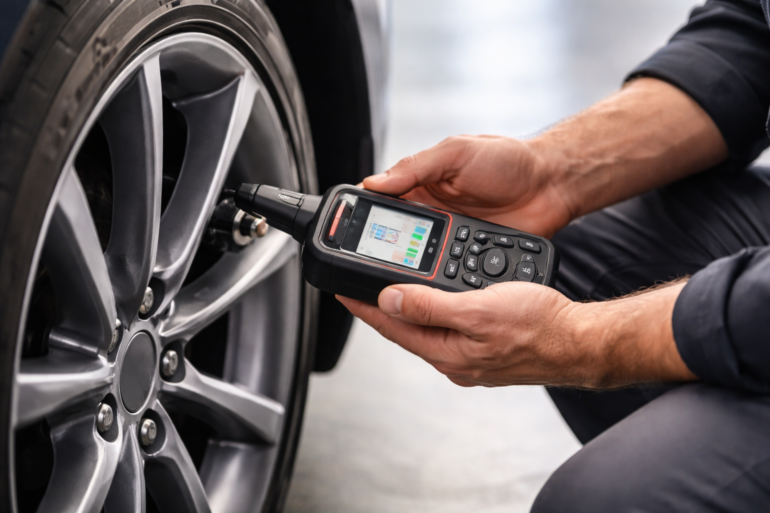
A TPMS Scan Tool is one of those devices most drivers never think about until the tire pressure warning light refuses to go away. Then suddenly, it matters a lot. If you have ever inflated all four tires, started the car, and still seen that amber TPMS light staring back at you, you already know the frustration.
The reason is simple. A tire pressure light does not always mean the tire itself is the only problem. Sometimes the issue is low pressure. Sometimes it is a weak sensor battery, a failed sensor, a relearn problem after tire service, or a communication fault inside the system. That is where a TPMS Scan Tool becomes useful. Instead of guessing, it lets you see what the system is actually reporting and helps narrow the problem down much faster.
Modern vehicles rely on tire pressure monitoring systems to warn drivers when one or more tires are significantly underinflated. NHTSA says newer vehicles have TPMS, but it also notes these systems usually warn only when pressure is already significantly low, which is why routine pressure checks still matter. Underinflated tires can hurt handling, braking, tire life, and fuel economy. The U.S. Department of Energy also says proper tire pressure can improve gas mileage, while underinflation can reduce fuel economy.
That is why a TPMS Scan Tool is not just a shop gadget. It is a practical diagnostic device for reading sensor data, checking system health, identifying bad sensors, and handling relearn procedures after rotation, replacement, or repair. For a technician, it saves time. For a serious DIYer, it can prevent unnecessary parts swapping and help solve a warning light that basic air pressure checks cannot fix.
What a TPMS Scan Tool actually does
At its core, a TPMS Scan Tool communicates with the tire pressure monitoring system and its wheel sensors. Depending on the tool and the vehicle, it may activate sensors wirelessly, read each sensor’s ID, show pressure and temperature data, display battery status, identify sensor location, and access the vehicle through the OBD port for relearn or fault code work. Official product documentation from major TPMS tool makers such as Autel and Bartec describes these exact functions, including activation, sensor data reading, TPMS diagnostics, and relearn support.
In plain English, the tool tells you whether the sensor is alive, what it is sending, and whether the car is recognizing it correctly. That matters because the same dashboard light can be triggered by several completely different faults.
A basic pressure gauge can tell you whether the tires are low. A TPMS Scan Tool goes further by telling you whether the sensor itself is transmitting, whether its ID matches the vehicle record, and whether the system needs a reset or relearn.
Why tire pressure sensor problems are often misdiagnosed
Many TPMS issues get misdiagnosed because the dashboard warning is vague. A steady light might mean one or more tires are underinflated. A flashing light followed by a solid light often points to a TPMS malfunction, not just low air. Without a TPMS Scan Tool, people often do one of three things. They add air and hope. They replace the wrong sensor. Or they ignore the light altogether.
That is risky. NHTSA has long linked proper tire inflation to better safety outcomes, and the Department of Energy has published data showing real fuel economy losses when tires are significantly underinflated. Even a small pressure problem can affect how the car feels on the road, especially in wet weather or during sudden braking.
A good TPMS Scan Tool cuts through that guesswork. It gives a more precise answer to a simple question: is this a pressure issue, a sensor issue, or a system communication issue?
Common problems a TPMS Scan Tool can diagnose
A TPMS Scan Tool helps diagnose several common faults that all look similar from the driver’s seat.
Low tire pressure
This is the obvious one, but it is still worth mentioning. Sometimes the TPMS light is doing exactly what it should. A scan tool can confirm which tire is low and show live or current sensor readings. That can save time when a tire looks visually normal but is actually several PSI below the recommended placard pressure.
Dead or weak TPMS sensor battery
Most direct TPMS sensors run on sealed batteries that are not typically replaced separately. As sensors age, battery failure becomes more common. A compatible TPMS Scan Tool may show battery condition or simply reveal that one sensor is not responding at all. Official tool manuals and product pages list battery status checks among supported sensor data items on many tools.
Failed or damaged sensor
Sensors can fail from age, corrosion, impact, improper installation, or damage during tire service. If one wheel does not transmit while the others do, the TPMS Scan Tool quickly points you in the right direction. That is much better than replacing all four sensors out of frustration.
Relearn issues after tire rotation or sensor replacement
This is one of the biggest reasons shops rely on a TPMS Scan Tool. After rotating tires, installing new sensors, or replacing wheels, the vehicle may need a relearn so it can match sensor IDs and wheel positions correctly. Bartec states that there are three basic relearn methods for TPMS sensors: stationary relearn, OBD relearn, and auto learn. Autel documentation similarly describes OBD relearn as a process for writing sensor IDs to the TPMS module.
Sensor ID mismatch
A car may be looking for one set of sensor IDs while the wheels now contain another. This can happen after replacement or when programmable aftermarket sensors were not properly cloned or relearned. A TPMS Scan Tool helps compare what the sensor is broadcasting with what the vehicle expects.
TPMS module or communication faults
Sometimes the problem is not in the wheel at all. A diagnostic-capable TPMS Scan Tool may help reveal system faults in the control module or show that the vehicle is not receiving expected signals. That is especially valuable when the dash light flashes and then stays on.
How the diagnostic process usually works
Using a TPMS Scan Tool is not complicated in theory, but doing it correctly matters.
A typical workflow looks like this:
- Confirm the warning light behavior on the dashboard
- Check all four tires against the placard pressure, not the number on the tire sidewall
- Activate each sensor with the TPMS Scan Tool
- Read sensor ID, pressure, temperature, battery status, and frequency if supported
- Identify non responding or incorrect sensors
- Perform a relearn if the vehicle requires it
- Clear fault codes if the tool and vehicle support that function
- Test drive if the vehicle uses an auto learn process
This process matters because TPMS systems vary by make and model. Some vehicles relearn automatically after driving. Others need the car placed in learn mode. Others require an OBD connection to write the IDs directly. Manufacturer procedures differ, which is why coverage and software updates are important when choosing a TPMS Scan Tool. Official Bartec and Autel materials both emphasize that relearn procedures vary and that tool support must match the vehicle application.
TPMS Scan Tool vs a regular OBD2 scanner
This is where many buyers get confused. A standard OBD2 scanner may read generic trouble codes and, on some vehicles, access TPMS related codes. But that does not mean it can activate wheel sensors, read individual sensor transmissions, or perform relearn procedures.
A TPMS Scan Tool is built for tire pressure monitoring service specifically. It speaks the language of TPMS sensors. It can usually trigger the sensor directly and retrieve wheel level data that a generic scanner cannot access.
Here is a simple comparison:
| Feature | Regular OBD2 Scanner | TPMS Scan Tool |
|---|---|---|
| Read generic engine codes | Yes | Sometimes |
| Read TPMS sensor ID | Usually no | Yes, on supported vehicles |
| Activate TPMS sensors | No | Yes |
| Check sensor battery/status | Usually no | Yes, on supported tools |
| Perform TPMS relearn | Limited | Yes, on supported vehicles |
| Diagnose wheel-by-wheel TPMS faults | Limited | Stronger capability |
That difference is why a TPMS Scan Tool is often the better answer when the tire light is the real problem.
Real world example of how a TPMS Scan Tool saves time
Imagine a driver replaces two tires after a puncture and has the wheels rotated at the same visit. The car leaves the shop with a flashing TPMS light that later turns solid. The tires are inflated correctly, so the driver assumes a bad sensor and starts shopping for replacements.
A technician checks the system with a TPMS Scan Tool. Three sensors respond normally. One sensor also responds, but its ID is not registered in the module. The issue is not a dead sensor at all. It is a relearn problem. A quick OBD relearn restores normal operation.
Without the tool, that driver might have spent money on a sensor that was never faulty.
What features matter most when choosing a TPMS Scan Tool
Not every TPMS Scan Tool is built the same. Some are entry-level activation tools. Others are full service devices with programming, relearn, code reading, and broader diagnostics.
When evaluating one, these features matter most:
Vehicle coverage
Coverage is everything. A great TPMS Scan Tool on paper is useless if it does not support the cars you actually work on. Shops usually need broad domestic, Asian, and European coverage. DIY users should at least verify compatibility with their vehicle make, model, and year.
Sensor activation
The ability to trigger sensors and confirm they are alive is a core function. Without this, diagnosis becomes slower and less reliable.
Relearn support
This is one of the biggest value points. Tools that support stationary, OBD, and auto relearn workflows are far more versatile. Bartec specifically outlines these three relearn categories in its TPMS materials.
Sensor programming or cloning
Some advanced tools can program aftermarket sensors or clone existing IDs. That matters for repair shops and tire businesses more than occasional drivers.
Software updates
Vehicle databases evolve. New model support and updated relearn procedures often come through software updates. If the TPMS Scan Tool is not updated, its usefulness drops over time.
Ease of use
A tool can be technically powerful and still be frustrating. A clean interface, solid vehicle lookup, and clear prompts matter a lot in day to day work.
Can a TPMS Scan Tool help DIY users?
Yes, but with a caveat. A TPMS Scan Tool can be extremely helpful for a confident DIY user who rotates tires, changes seasonal wheel sets, or wants to confirm sensor health before paying for service. It makes diagnosis more informed and can prevent unnecessary trips to the shop.
At the same time, not every TPMS job is a good driveway project. Tire dismounting, valve stem service, sensor replacement, and some relearn procedures are better handled with proper equipment. The tool helps you understand the problem. It does not replace safe tire service practices.
For many DIY users, the biggest value is clarity. If the tool shows one dead sensor, you know what you are dealing with. If all sensors respond but the car still has a warning, you can point the shop toward a module or relearn issue instead of starting from scratch.
Mistakes to avoid when diagnosing TPMS faults
A TPMS Scan Tool is most useful when paired with a disciplined process. These are the most common mistakes people make:
- Setting tire pressure based on the maximum PSI on the tire sidewall instead of the vehicle placard
- Assuming the warning light always means a puncture
- Replacing a sensor before verifying that it is actually dead
- Ignoring software coverage and vehicle compatibility
- Skipping the relearn after rotation, replacement, or tire service
- Confusing indirect TPMS systems with direct sensor based systems
That last point matters. Some vehicles use indirect TPMS, which estimates pressure loss through wheel speed data instead of in-wheel pressure sensors. A TPMS Scan Tool is most relevant to direct TPMS systems where physical sensors are installed in the wheels.
Why TPMS still matters even if you check tires manually
Some drivers assume TPMS is unnecessary if they already inspect their tires. The smarter view is that both systems help. Manual checks are still essential because TPMS often warns only after pressure drops past a threshold. NHTSA says drivers should still conduct a monthly tire pressure check even on vehicles with TPMS.
That means TPMS is not a replacement for maintenance. It is a backup warning system. And when that warning system itself has a problem, a TPMS Scan Tool is what helps separate a true pressure issue from a faulty sensor or bad relearn.
Frequently asked questions
Can a TPMS Scan Tool reset the warning light?
Yes, in many cases, but only after the actual problem is fixed. If a tire is still low, a sensor is dead, or the vehicle still needs a relearn, the light will usually return.
Does every car need a relearn after tire rotation?
No. Some vehicles relearn automatically after driving, while others require a manual or OBD based procedure. That is one reason a TPMS Scan Tool with vehicle specific instructions is so useful.
Can a TPMS Scan Tool read sensor battery life?
Many can show battery status or at least indicate when a sensor is not transmitting properly. The exact data depends on the vehicle, sensor type, and tool capability.
Is a TPMS Scan Tool worth buying for one car?
It depends on how often you deal with wheels, seasonal tire swaps, persistent warning lights, or DIY maintenance. For one-time use, shop service may be cheaper. For repeat use, the tool can pay for itself in saved diagnostic time and fewer wrong part purchases.
Final thoughts
A TPMS Scan Tool is valuable because it turns a vague dashboard warning into specific, usable information. It helps you identify whether the problem is low tire pressure, a dead sensor, a failed relearn, or a larger system fault. That makes repairs faster, more accurate, and less frustrating.
In practical terms, this tool is about confidence. Instead of guessing why the warning light is on, you can verify sensor data, match IDs, follow relearn steps, and make better decisions about service. For shops, that means efficiency. For drivers and DIY users, it means fewer surprises and fewer wasted dollars.
If you want to understand how modern <a href=”https://en.wikipedia.org/wiki/Tire-pressure_monitoring_system”>tire monitoring</a> systems work in the bigger picture, it becomes clear why the right diagnostic tool matters. The sensor, the vehicle module, and the relearn process all have to line up. When they do not, a TPMS Scan Tool is often the fastest way to see what went wrong and how to fix it.
A well-chosen TPMS Scan Tool does not just read data. It helps diagnose tire pressure sensor problems with precision, supports safer driving habits, and makes TPMS service far more straightforward than trial and error ever could.