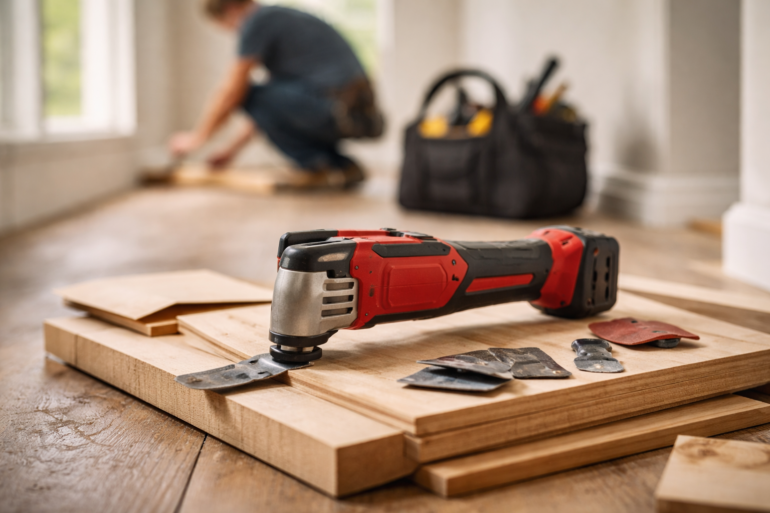
If you spend any time around remodeling work, punch-list repairs, trim installs, flooring touch-ups, or quick on-site fixes, you start to notice a pattern. The same tool keeps showing up in different hands for different jobs. That tool is often the Milwaukee Multi Tool, and it has earned that spot because it solves awkward problems fast. Tight corners, flush cuts, sanding edges, scraping adhesive, cutting through nail-embedded wood, and cleaning out grout are exactly the kind of jobs where a bulky saw or single-purpose tool feels like overkill.
What makes the Milwaukee Multi Tool so appealing is not just versatility. It is the way Milwaukee has built its cordless oscillating platform around speed, control, lower vibration, and battery compatibility with the broader M18 system. Milwaukee says its M18 FUEL oscillating multi-tool delivers 10,000 to 20,000 OPM, a 4.2 degree oscillation angle, vibration dampening technology, tool-free blade changes, and compatibility with all M18 batteries. Those details matter because they directly affect how quickly you cut, how stable the tool feels in your hands, and how comfortable it is to use over longer stretches.
There is also a bigger reason this category keeps growing. The home improvement market remains massive, with continued demand driven by remodeling, repairs, upgrades, and aging housing stock. Recent market research also shows a large and growing DIY home improvement segment, which helps explain why more homeowners are buying professional-grade tools instead of settling for entry-level options.
So why do both DIYers and professionals keep reaching for a Milwaukee Multi Tool? The answer is simple. It saves time, fits into tight spaces, handles a surprisingly wide range of materials, and does all of that with the convenience of a cordless platform many users already own.
What a Milwaukee Multi Tool Actually Does
An oscillating multi-tool works by moving its accessory side to side through a very small arc rather than spinning like a drill or reciprocating like a saw. That motion gives it a level of control that is hard to match when you need to cut flush to a surface, trim something in place, sand into corners, or scrape material without damaging the surrounding area. Oscillating multi-tools are commonly used for sawing, sanding, scraping, grinding, grout removal, and polishing, especially in spaces that are difficult to reach with larger tools.
That is the real appeal of a Milwaukee Multi Tool. It is not supposed to replace every saw or sander in your garage or trailer. It is the tool you grab when the job is too detailed, too cramped, too awkward, or too delicate for anything larger.
A few common examples include trimming door jambs for flooring, cutting out damaged drywall sections, notching trim, removing old caulk or adhesive, sanding patch filler in corners, slicing through PVC, cutting a protruding nail or screw, and removing grout around a cracked tile. That mix of jobs is exactly why one tool can appeal to a weekend DIYer and a full-time remodeler at the same time.
The First Big Reason: It Handles Awkward Jobs Better Than Most Tools
This is probably the number one reason people end up loving a Milwaukee Multi Tool. It solves jobs that other tools make frustrating.
A circular saw is fast, but it is useless in a tight inside corner. A reciprocating saw is powerful, but it can be too aggressive for fine finish work. A jigsaw can cut curves, but it is not the tool you want for a clean flush cut against trim. The Milwaukee Multi Tool fills that gap.
Because the blade oscillates through a narrow angle, the tool stays more controlled at the cut line. That makes it useful for:
- Flush cuts against flooring, trim, or framing
- Plunge cuts into drywall, wood, or subfloor
- Trimming shims, dowels, and protruding fasteners
- Removing grout between tiles
- Sanding corners and narrow edges
- Scraping thinset, paint, caulk, or old adhesive
For DIYers, that means fewer situations where you have to stop and improvise. For pros, it means fewer return trips to the truck and fewer workarounds on site.
The Second Big Reason: The M18 FUEL Version Is Built for Speed and Control
Not all oscillating tools feel the same when you actually put blade to material. Some feel underpowered, some vibrate too much, and some bog down the moment the cut gets serious.
Milwaukee’s M18 FUEL oscillating multi-tool is positioned as a premium solution for heavier work. According to Milwaukee, the tool uses a POWERSTATE brushless motor, runs from 10,000 to 20,000 OPM, and has a 4.2 degree oscillation angle designed to improve cutting speed. Milwaukee also highlights vibration dampening technology, a variable speed dial, an Auto-Load feature for more controlled starts, and a 180 degree LED light for visibility.
Those features are not just marketing language. In real use, they translate into a few practical benefits:
Faster cutting when the material pushes back
If you are cutting hardwood trim, nail-embedded wood, or old renovation material that is not perfectly clean, speed alone is not enough. The tool has to maintain momentum. Milwaukee specifically says the M18 FUEL model is designed to handle demanding applications, including large cuts through hardwoods and nail-embedded wood.
Better control on delicate cuts
The Auto-Load feature is one of those details that sounds small until you use it. Milwaukee says it allows the tool to start slowly on precise cuts and ramp up under load. That helps reduce the jumpy feeling some oscillating tools have at the start of a plunge cut.
Less fatigue over time
Vibration is a real issue with oscillating tools. Even strong users feel it during repetitive use. Milwaukee’s product page puts serious emphasis on vibration dampening and calls it the “lowest full tool vibration” in its category claims. Whether you are making one cut or twenty, lower vibration usually means better comfort and cleaner control.
Why DIYers Like the Milwaukee Multi Tool
DIY buyers do not always need the heaviest-duty tool on the shelf. But they do need something that makes home projects simpler, faster, and less intimidating. That is where the Milwaukee Multi Tool hits a sweet spot.
A homeowner might buy it for one project, like trimming door casing for new flooring. Then they realize it also helps with baseboard touch-ups, minor drywall repairs, bathroom grout cleanup, scraping old sealant, and sanding small patch areas before painting.
The tool especially makes sense for DIY users because it reduces the need to buy several separate specialty tools right away. With the right accessories, one Milwaukee Multi Tool can cover a surprising amount of work around the house.
DIYers also tend to appreciate tools that are easier to store, easier to control, and easier to use indoors without dealing with a power cord. Since all M18 batteries are compatible with M18 tools and chargers, existing Milwaukee users can often buy the bare tool and start using it with batteries they already own.
That makes the cost easier to justify. You are not really buying into one tool. You are buying into a platform you may already have.
Why Pros Keep One Close By
Professionals usually judge tools differently. They care about time saved, finish quality, reliability, and how often a tool can step in and prevent a slowdown.
That is why the Milwaukee Multi Tool shows up constantly in remodeling, carpentry, flooring, electrical, plumbing, and punch-list work. It is one of those tools that often saves a job from turning messy.
A finish carpenter might use it to trim casing or make detailed cut-ins without damaging surrounding material. A flooring installer might use it to undercut jambs, fine-tune transitions, or trim planks in place. A tile contractor may use it for grout removal and prep work. A plumber or electrician might use it to enlarge access openings cleanly in drywall or wood.
Pros also care about battery ecosystem. Milwaukee states that all M18 batteries are compatible with M18 tools and chargers, and the M18 platform spans hundreds of solutions. That system-wide compatibility is one reason trade users stay loyal. When one battery platform covers drills, impacts, saws, lights, vacuums, and a Milwaukee Multi Tool, it simplifies the whole workday.
Accessory Range Is a Huge Part of the Value
A multi-tool is only as useful as the blades and attachments you can put on it. This is one of the biggest reasons the Milwaukee Multi Tool stands out. Milwaukee has built a broad accessory ecosystem around cutting, sanding, scraping, and material removal. Its OPEN-LOK accessory line includes blade sets and task-specific accessories for wood, metal, grout, mortar, adhesive, and sanding work.
That matters because different jobs need different blade geometry and material composition. If you use the wrong blade, even a powerful tool feels disappointing. If you use the right one, the tool feels dramatically more capable.
Here is where users tend to get the most out of their setup:
- Wood blades for trim, framing cut-ins, and plunge cuts
- Multi-material blades for mixed renovation work
- Metal blades for screws, nails, EMT, and small fasteners
- Carbide grit blades for grout, mortar, and abrasive materials
- Scraper blades for caulk, adhesive, paint, and flooring residue
- Sanding pads for corners, detail sanding, and touch-up prep
Milwaukee also says many of its universal fit OPEN-LOK blades allow quick blade changes across 100+ multi-tools, though specific blade compatibility depends on the mount type, and some Milwaukee universal fit blades are not compatible with Starlock tools.
That is worth noting for buyers. The tool itself may be excellent, but the right blade choice is what unlocks the best performance.
Real-World Jobs Where a Milwaukee Multi Tool Shines
A Milwaukee Multi Tool tends to prove itself in the moments when the job looks small but is actually tricky.
Flooring installs
Undercutting jambs and trimming along tight edges is one of the classic multi-tool jobs. You can make controlled flush cuts that help flooring slide neatly under trim instead of ending with rough visible gaps.
Bathroom repairs
Loose tile, cracked grout, and old caulk are the kind of repair jobs where precision matters. A Milwaukee Multi Tool can remove grout around a tile without turning the repair into a bigger demolition project.
Finish carpentry
When trim is already in place, you often need to make one careful cut without disturbing the surrounding surface. This is where the control of an oscillating tool becomes more valuable than raw cutting speed.
Drywall patching
For outlet access, repair patches, or controlled cutouts in finished walls, the Milwaukee Multi Tool gives you more precision than a reciprocating saw and more flexibility than a drywall knife.
Remodeling work
Old homes are full of surprises. Mixed materials, hidden nails, odd angles, and tight working conditions are common. The Milwaukee Multi Tool fits that reality well because it is designed for adaptability rather than one single job.
It Saves Time in Ways People Do Not Expect
Most people think of speed as motor power. But with a Milwaukee Multi Tool, speed often comes from avoiding extra steps.
You do not need to drag out a larger saw for a two-inch cut. You do not need to manually scrape adhesive for half an hour if the right blade can remove it faster. You do not need to take apart more of the work area just to reach the cut line.
That is the hidden advantage. The tool shortens decision-making, setup, and cleanup. Professionals notice that because it helps keep the job moving. DIYers notice it because it makes projects feel less overwhelming.
Milwaukee’s own specifications support that productivity angle. The company emphasizes fast cutting, tool-free blade changes, adjustable speed, and battery-powered portability in the M18 FUEL model.
Comfort and Visibility Matter More Than Buyers Think
There is a point where tool comfort stops being a luxury and starts affecting results. When your hands are fighting vibration or your cut line is hard to see, accuracy drops.
That is why features like vibration dampening, ergonomic handling, and built-in LED lighting deserve more attention than they usually get. Milwaukee specifically includes vibration dampening technology and an integrated 180 degree LED light on the M18 FUEL oscillating multi-tool.
For pros working indoors, in cabinets, in basements, or under sinks, that light is genuinely useful. For DIYers who often work in imperfect lighting, it helps reduce mistakes. Small comfort features can make the difference between a tool you own and a tool you actually reach for regularly.
Is the Milwaukee Multi Tool Worth the Price?
For casual users, Milwaukee is rarely the cheapest option. That is true. But price alone is not the right way to judge a Milwaukee Multi Tool.
The better question is whether it helps you work faster, cut cleaner, and avoid frustration often enough to justify the cost. For many buyers, the answer is yes.
It becomes even easier to justify if:
- You already own M18 batteries
- You regularly do repair or remodeling work
- You need one tool for many small but important tasks
- You value cleaner cuts and better control
- You want a tool that can serve both home and jobsite use
The larger home improvement market continues to grow, and repair-focused projects remain common. In that environment, versatile tools tend to hold their value well because they stay useful across many kinds of work.
Tips for Getting Better Results with a Milwaukee Multi Tool
A good multi-tool becomes a great one when you use it the right way. A few habits make a huge difference.
First, match the blade to the material. Many disappointing cuts come from the wrong accessory, not the wrong tool.
Second, let the blade do the work. Pressing too hard creates heat, increases wear, and can make the cut rougher.
Third, adjust speed to the task. Milwaukee includes variable speed control for a reason. Different materials respond better at different speeds.
Fourth, use fresh accessories when finish quality matters. Worn blades and sanding sheets slow you down and leave rougher results.
Fifth, protect the surrounding surface. Painter’s tape, a steady grip, and a deliberate approach can make detailed finish work much cleaner.
Final Thoughts
The reason DIYers and professionals both choose a Milwaukee Multi Tool comes down to something very practical. It handles the jobs that other tools struggle with. It cuts where bigger saws cannot fit, sands where larger sanders are clumsy, and solves detail work without turning it into a bigger project.
Milwaukee has strengthened that appeal by combining strong cutting specs, reduced vibration, variable speed control, quick accessory changes, and M18 battery compatibility in one cordless platform. According to Milwaukee, the M18 FUEL model delivers 10,000 to 20,000 OPM, a 4.2 degree oscillation angle, tool-free blade changes, and compatibility with all M18 batteries, which helps explain why the Milwaukee Multi Tool has become such a dependable choice on jobsites and in home workshops alike.
If you want one tool that can step into cutting, sanding, scraping, grout removal, and detail repair work without feeling like a compromise, the Milwaukee Multi Tool earns its reputation the hard way. It keeps proving useful long after the first project is finished. For readers who want a simple background on the tool category itself, oscillating tool is a helpful reference point before comparing brands and accessories.