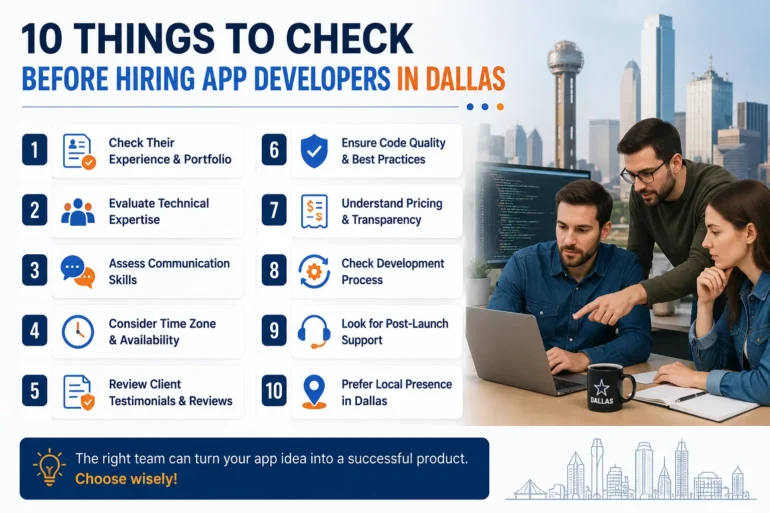
Hiring the wrong development team rarely fails loudly at the start. It fails quietly over time. Timelines stretch, costs shift, and the final product feels disconnected from what was originally intended.
In a competitive market like Dallas, where options are everywhere, the risk isn’t finding developers.
It’s choosing a team that can actually carry your idea through uncertainty. Before committing to a mobile app development company in Dallas, the real question is not who can build your app, but who can build it right.
1. Start With Business Outcomes, Not Features
Most projects begin with a feature list. Login systems, dashboards, integrations. It feels like progress, but it usually isn’t.
The issue is simple. Features don’t define success. Outcomes do.
Teams that understand this will slow the conversation down early. They will ask what the app is expected to change. Is it supposed to increase revenue, reduce manual work, or improve customer retention?
This matters because every failed app has one thing in common. It delivered features, but not results.
If a team moves straight into execution without anchoring the discussion in outcomes, you are already on a risky path.
2. Evaluate What Happened After Launch
Portfolios are easy to curate. Impact is not. Most companies show what they built. Few show what happened after. That is where the real signal is.
Ask direct questions:
- Are those apps still active?
- Did they grow?
- Did the client continue working with the same team?
In many cases, products that look polished at launch quietly fade because they were never aligned with real user needs.
A team that can point to products that evolved, scaled, or improved over time is showing something more valuable than design quality. They are showing continuity.
3. Pay Attention to How They Challenge You
One of the clearest signs of a weak team is early agreement.
They accept every idea, approve every feature, and move forward without resistance. It feels smooth, but it usually leads to bloated products and unclear priorities.
Stronger teams behave differently. They question decisions. They ask why something exists. They suggest removing features that don’t add value. This is where many hiring decisions go wrong. Businesses mistake agreement for alignment.
In reality, alignment often requires friction. If no one challenges your thinking early, the product will likely suffer later.
4. How They Approach the First Version
There is a pattern that shows up in failed projects. Too much is built before anything is tested.
The assumption is that a complete product is needed before launch. In practice, this leads to longer timelines and higher costs, with no guarantee of success.
Teams with experience take a different approach. They focus on getting a smaller version into users’ hands quickly. That version is not perfect, but it is usable and focused.
This approach reduces risk. It allows decisions to be based on real feedback instead of assumptions. If a team presents a large, feature-heavy roadmap before discussing validation, they are optimizing for completion, not learning.
5. Clarity in Pricing Is Rare, and That’s the Problem
Cost overruns rarely come from unexpected complexity. They come from unclear scope.
It usually starts with a broad estimate. As the project progresses, new requirements appear, priorities shift, and the original number becomes irrelevant.
By the time this becomes visible, the project is already in motion.
A disciplined team approaches pricing differently. They break the work into stages. They explain what is included and what is not. More importantly, they explain what happens when things change.
This does not eliminate cost changes, but it makes them predictable. If pricing feels unclear at the beginning, it will not become clearer later.
6. Communication Is Where Most Projects Break
Many teams fail to recognize this early. They focus on technical skill and overlook how decisions will be communicated.
Most delays are not caused by development. They are caused by slow feedback, unclear priorities, or misaligned expectations.
You can often detect this in early interactions. Are responses thoughtful or surface-level? Do they clarify decisions or move past them quickly?
Over time, weak communication compounds. Small misunderstandings turn into larger issues. Strong teams reduce this risk by maintaining consistent, clear communication. They surface problems early and keep decisions visible.
7. Technology Decisions Should Have Context
It is easy to list technologies. It is harder to justify them.
A strong team will explain why a particular approach fits your product. They will talk about performance, scalability, and long-term maintenance.
More importantly, they will explain trade-offs. Every decision has one. Speed versus flexibility. Cost versus scalability. If a team cannot explain these trade-offs clearly, they are likely applying a default approach rather than thinking through your specific case.
8. Testing Is Often Undervalued Until It Fails
Most teams talk about building. Fewer talk about what happens when things break.
Users rarely give second chances to unstable apps. A few crashes or delays are enough for them to leave. Testing is what prevents this, but it is often compressed into the final stages of development.
That approach creates risk.
Teams that integrate testing throughout the process tend to release more stable products. They identify issues earlier, when they are easier to fix. This is not a technical detail. It directly affects user retention.
9. Post-Launch Reality Is Different From Pre-Launch Plans
Many businesses assume that once the app is launched, the heavy work is done.
In reality, that is when real feedback begins. Users behave differently than expected. Features need adjustment. New priorities emerge.
If the team is not structured to support this phase, progress slows down quickly.
Understanding how updates, fixes, and improvements are handled after launch is critical. This is where many products either gain traction or stall.
10. Local Experience Can Shorten the Learning Curve
Dallas has its own dynamics. Certain industries dominate. User expectations vary.
Working with mobile app developers in Dallas who have seen similar use cases can reduce early-stage uncertainty. They may recognize patterns faster. They may anticipate issues that are not obvious at first.
This does not replace strategy, but it reduces avoidable mistakes.
What Most Businesses Realize Too Late
The biggest risk is not choosing the wrong technology. It is choosing the wrong way of working.
Projects rarely fail in a single moment. They drift. Priorities become unclear. Costs expand. Timelines extend. The product loses focus. By the time this becomes visible, the cost of correction is high. The hiring decision is where most of this risk can be reduced.
A More Practical Way to Evaluate Teams
Instead of focusing only on past work, shift the evaluation toward how the team thinks. Ask questions that reveal their approach:
- What would you remove from our idea and why?
- Where do you expect this project to face challenges?
- How would you reduce scope without reducing value?
The answers to these questions often reveal more than any portfolio. They show whether the team is thinking critically or simply executing.
Conclusion
Hiring app developers in Dallas is not a decision about capability alone. It is a decision about judgment, process, and long-term thinking. The right team does more than build. They guide, challenge, and adapt as the product evolves.
That difference is not always visible at the start, but it defines the outcome. Taking the time to evaluate these signals early is what separates projects that gain traction from those that quietly fade.