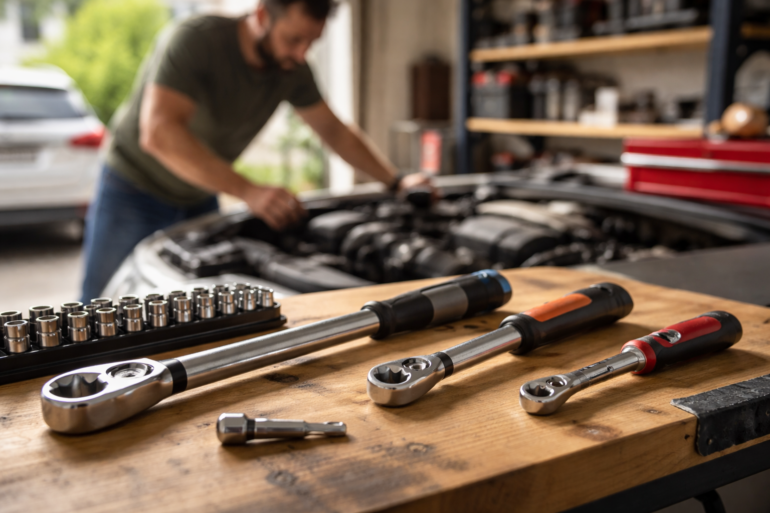
A torque wrench is one of those tools people often buy after they have already made a mistake. A stripped thread, a warped brake component, a leaking gasket, or a loose wheel usually teaches the lesson fast. Once you start working on cars, motorcycles, bicycles, lawn equipment, or even home fixtures with threaded fasteners, you realize that “tight enough” is not a real specification.
That is where a torque wrench becomes essential. It helps you tighten bolts and nuts to a measured value instead of relying on feel alone. Standards from ASME cover the performance and safety requirements for hand torque tools, and manufacturers commonly design their tools around those standards and ISO calibration practices.
For home and garage projects, choosing the right torque wrench is not only about price. Size, range, accuracy, ease of use, and the kind of work you actually do matter much more. A small wrench that handles inch pounds will feel perfect for delicate work, while a larger model is better for lug nuts, suspension hardware, and other higher-torque jobs. Product ranges from major tool brands show a clear pattern: 1/4 inch drive tools usually cover lower torque values, 3/8 inch tools handle mid-range jobs, and 1/2 inch tools are built for heavier fasteners.
If you want one clear takeaway before getting into the details, it is this: buy the torque wrench that matches the jobs you do most often, not the one that merely looks the most professional.
What a Torque Wrench Actually Does
A torque wrench applies a specific amount of rotational force to a fastener. That matters because bolts are designed to clamp parts together within a certain load range. Too little torque can let parts loosen or leak. Too much can stretch bolts, damage threads, distort components, or crack housings.
In practical terms, the tool gives repeatability. Instead of guessing, you set a target and tighten until the wrench indicates you have reached it. That indication depends on the wrench type. Some bend and show a reading on a scale. Some click. Some beep, vibrate, or flash on a screen. The purpose is the same in every case: controlled tightening.
This matters far beyond professional shops. Home users run into torque-sensitive jobs all the time. Spark plugs, oil drain plugs, brake caliper brackets, bicycle stems, valve covers, wheel lugs, and even some plumbing and furniture assemblies can benefit from correct torque.
Why the Right Size Matters More Than Most People Think
When people talk about torque wrench size, they often mean the square drive size: 1/4 inch, 3/8 inch, or 1/2 inch. That drive size usually lines up with the tool’s torque range and the kind of sockets it uses.
A smaller drive is better for light-duty, lower-torque fasteners. A larger drive is built for more force and larger hardware. The mistake many beginners make is buying one large wrench and trying to use it for everything. That sounds economical, but it often leaves them working at the very bottom of the wrench’s range, where many tools are not at their best operating zone.
Many manufacturer listings still describe common click-type tools as calibrated to their stated tolerance in the upper 80 percent of their range. That is why matching the wrench range to the job is so important.
1/4 Inch Drive Torque Wrench
A 1/4 inch drive torque wrench is usually the smallest common option for home users. These tools often measure in inch-pounds rather than foot-pounds. Typical ranges from major brands fall around 20 to 200 inch-pounds or 40 to 200 inch-pounds, depending on the model.
This size is ideal for:
- Small engine work
- Bicycle components
- Interior fasteners
- Hose clamps with torque specs
- Valve cover bolts on some engines
- Light assembly work where over-tightening is a real risk
A 1/4 inch drive tool shines when precision matters more than brute force. It is the wrench you reach for when a delicate aluminum thread is involved and you know one heavy pull could turn a quick project into a repair job.
3/8 Inch Drive Torque Wrench
For many DIY users, the 3/8 inch drive torque wrench is the sweet spot. It is versatile, manageable in size, and well suited to the middle range of garage work. Typical product ranges are around 10 to 80 foot-pounds or 10 to 100 foot-pounds.
This size works well for:
- Spark plugs
- Brake components
- Engine accessories
- Oil pan and drain plug work
- Motorcycle maintenance
- Medium-duty fasteners around the house and garage
If someone only buys one torque wrench for mixed car and home projects, this is usually the most practical starting point. It handles a wide variety of jobs without feeling oversized or awkward.
1/2 Inch Drive Torque Wrench
A 1/2 inch drive torque wrench is built for higher torque applications. Common ranges include 25 to 250 foot-pounds, 30 to 300 foot-pounds, and similar heavy-duty spans.
This size is best for:
- Wheel lug nuts
- Suspension hardware
- trailer work
- heavy equipment maintenance
- large structural fasteners
- bigger automotive jobs where leverage and higher torque are required
A larger torque wrench gives you the strength for demanding jobs, but it is not the best choice for smaller hardware. Using a 1/2 inch tool on tiny fasteners is like using a sledgehammer to hang a picture. You can do it, but it is not the smart way to work.
The Main Types of Torque Wrench for Home and Garage Use
Choosing a torque wrench also means choosing how you want the tool to signal that the target has been reached. Each type has its own feel, advantages, and tradeoffs.
Beam Torque Wrench
The beam-style torque wrench is simple and old-school in the best possible way. It uses a pointer and scale. As force is applied, the beam deflects and the pointer shows the torque reading.
The biggest strengths are simplicity and value. There is very little inside to wear out, no battery to die, and no click mechanism to drift from rough handling. It can also show live torque as you pull, which some people prefer.
The downside is usability. You need to watch the scale carefully, and that can be awkward in tight spaces or poor lighting. For beginners, it is not always the easiest option because it demands attention and good positioning. Still, it remains a solid choice for careful, budget-conscious users.
Click Torque Wrench
The click-style torque wrench is the most popular option for home garages. You set the desired torque on the handle scale, tighten the fastener, and stop when the tool clicks.
That audible and tactile feedback is the reason so many people prefer it. It is fast, familiar, and easy to use. For automotive maintenance, it is usually the best balance of price, speed, and convenience.
The weakness is that it requires proper handling. Once the click happens, you stop immediately. Pulling past the click can over-torque the fastener. It also needs sensible storage and periodic recalibration. Snap-on’s maintenance guidance advises storing click-type wrenches at the lowest scale setting and having them inspected or recalibrated after about 5,000 cycles or up to one year of use, whichever comes first.
Split Beam Torque Wrench
A split-beam torque wrench is a variation designed for durability and convenience. Many users like it because it does not need to be dialed back after each use the way a traditional micrometer click wrench usually does.
That makes it practical for frequent users who want quicker setup and less worry about spring storage. It is often a favorite among mechanics who repeatedly torque wheel lugs or other recurring fasteners.
The main drawback is cost. Split-beam models usually cost more than entry-level click tools. For someone working on cars every month, though, the extra convenience can be worth it.
Digital Torque Wrench
A digital torque wrench gives the most feedback. It typically uses a display and alerts such as lights, sound, or vibration when you approach and hit the target torque. Many electronic models also store readings or provide angle measurement.
This type is excellent for users who want precision, visibility, and convenience. Product pages from major brands show digital models commonly available in 3/8 inch and 1/2 inch drive sizes with features like calibration certificates, record storage, and target alerts.
The tradeoff is price and complexity. A digital torque wrench is more expensive, depends on battery power, and may be unnecessary if your projects are occasional and straightforward.
Preset Torque Wrench
A preset torque wrench is set to one specific value, often for repetitive work. These are common in production environments but can still be useful in a home setting if you perform the same task repeatedly, such as servicing a specific bike component or doing batch assembly work.
For general home and garage use, most people will get more value from an adjustable model.
Which Torque Wrench Type Is Best for Most People
For most homeowners and DIY mechanics, the best torque wrench is a 3/8 inch click model for general work and a 1/2 inch click model if wheel, suspension, or trailer jobs are common.
If your projects include bicycles, small engines, or light-duty assemblies, add a 1/4 inch model later. If you work often and want more feedback, a digital torque wrench becomes attractive. If you want simplicity and low cost above all else, a beam wrench still makes sense.
A smart, realistic setup looks like this:
- One 3/8 inch click wrench for daily versatility
- One 1/2 inch click wrench for higher-torque jobs
- One 1/4 inch inch-pound wrench for delicate fasteners when needed
That three-wrench approach covers almost everything a serious home garage will encounter.
How to Pick the Right Torque Range
The best torque wrench is not simply the one with the highest maximum number. It is the one whose working range includes your target torque comfortably.
If most of your jobs are around 15 to 25 foot-pounds, a 1/2 inch wrench topping out at 250 foot-pounds is a poor match. You are better off with a 3/8 inch model in the 10 to 100 foot-pound range. If most of your work is around 90 to 110 foot-pounds, a 1/2 inch wrench makes more sense.
This is where shopping carefully matters. Real product listings show how ranges are split across sizes. For example, major consumer and pro brands commonly place 1/4 inch tools around low inch-pound work, 3/8 inch tools around mid-range foot-pound work, and 1/2 inch tools around heavier automotive torque values.
Common Home and Garage Projects by Torque Wrench Size
Here is the easiest way to think about it in real life.
A 1/4 inch torque wrench belongs in the drawer for careful, lower-force work. Think of it as the precision option.
A 3/8 inch torque wrench is the generalist. It handles a broad range of maintenance tasks and feels right for most mid-size bolts.
A 1/2 inch torque wrench is the heavy hitter. It comes out when safety-critical or high-load fasteners need proper tightening.
That division keeps you from forcing one tool to do jobs it was never meant to do.
Mistakes That Ruin Results
The biggest mistake with any torque wrench is using it like a breaker bar. It is a measuring tool, not a tool for loosening stuck fasteners. Rough treatment can knock it out of calibration or damage the mechanism.
Another common mistake is ignoring extensions and adapters. Straight socket extensions usually do not change the setting, but crowfoot-style attachments can change the effective leverage and may require adjustment depending on how they are positioned.
People also make the mistake of continuing to pull after the click. Once the wrench signals target torque, stop. That is especially important on aluminum parts, wheel studs, and smaller engine hardware.
Storage matters too. Manufacturer guidance for click-type tools recommends storing them at the lowest scale setting, keeping them in a case, and protecting them from moisture, dirt, and harsh conditions.
Calibration and Accuracy in the Real World
Accuracy is one reason a torque wrench is worth buying in the first place, but accuracy is never permanent. Standards and manufacturers treat torque tools as precision instruments, which means calibration matters. ASME publishes dedicated standards for hand torque tools and testers, while NIST calibration resources emphasize traceable measurement quality for precision instruments more broadly.
Many consumer and prosumer listings advertise around ±3 percent clockwise accuracy for click-type wrenches, while some professional tools advertise tighter figures or full-range certification depending on design and standard.
In the real world, that means two things. First, buy from a brand that actually publishes its specifications. Second, do not assume a cheap or abused wrench is still accurate just because it still clicks.
If you use your torque wrench regularly, periodic recalibration is sensible. If you only use it a few times a year, careful storage and occasional verification are still important.
The Best Buying Strategy for Beginners
If you are just starting out, do not overcomplicate it. Buy a quality 3/8 inch click torque wrench first if your projects are mixed and moderate. Add a 1/2 inch tool if you work on wheels and suspension. Add a 1/4 inch tool if you do precision work.
Pay attention to:
- Clear scale markings
- A range that fits your actual jobs
- Published accuracy specs
- A sturdy case
- Calibration support or documentation
- Comfortable grip and locking adjustment
A torque wrench should make work calmer, not more confusing. The right one feels easy to trust.
Final Thoughts
The best torque wrench for home and garage projects is not about owning the most expensive tool. It is about matching the tool to the work. Small fasteners need finesse. Mid-range maintenance needs versatility. Heavy hardware needs reach and strength.
Once you understand sizes and types, buying becomes much easier. A 1/4 inch model covers delicate low-torque jobs. A 3/8 inch model handles the broad middle. A 1/2 inch model takes care of high-torque work like wheel and suspension fasteners. Click wrenches suit most people, beam wrenches offer simplicity, split-beam models add convenience, and digital tools provide more feedback.
Use the correct torque wrench, store it properly, and respect the manufacturer’s torque specs for the job in front of you. That single habit improves safety, protects threads, and helps your repairs last. If you want a quick background read on the history and general design of the torque wrench, it is a useful starting point before comparing brands and ranges.