Choosing a mattress sounds simple until you actually start shopping. Suddenly, every product page promises better comfort, better cooling, deeper sleep, stronger support, and less tossing at night. That is why many shoppers search for a clear way to Make a Table Comparing Memory Foam vs Hybrid Mattresses before spending money on a new bed.
Memory foam and hybrid mattresses are two of the most popular choices today, but they do not feel the same. One gives more of a soft, body-hugging feel. The other usually feels more lifted, breathable, and responsive.
The right choice depends on how you sleep, whether you get hot at night, how much support your body needs, and whether you share the bed with a partner. A mattress is not just a bedroom item. It affects comfort, sleep quality, pressure relief, and how refreshed you feel in the morning.
Health organizations commonly recommend that adults get at least 7 hours of sleep per night, which makes your mattress choice more important than many people realize.
Why Compare Memory Foam and Hybrid Mattresses?
A side-by-side comparison helps because both mattress types can sound similar in ads. Many hybrids contain memory foam layers. Many memory foam mattresses now include cooling gels or firmer support bases. So, the labels alone do not tell the full story.
When you compare them properly, you start to see the real differences:
- How each mattress supports your spine
- How well it relieves pressure
- Whether it traps or releases heat
- How much movement you feel from a partner
- How easy it is to move around
- How long it may last
- Which sleepers it suits best
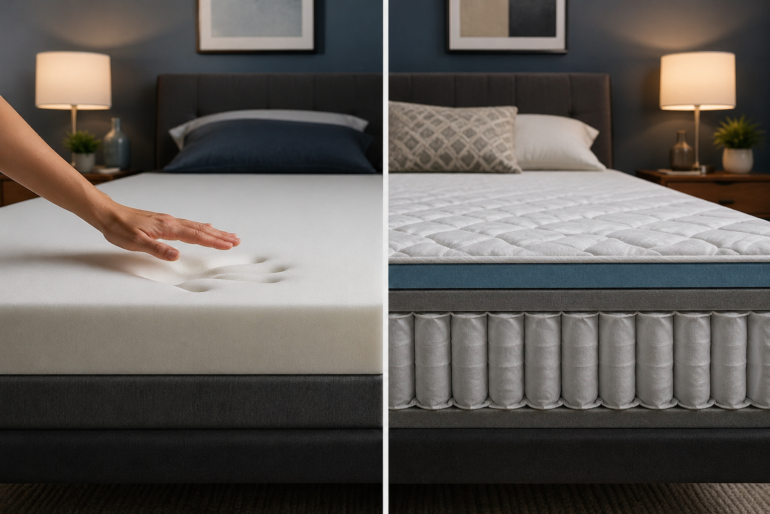
A memory foam mattress is usually built with layers of foam. The top layer is designed to contour around the body, while the base foam provides support.
A hybrid mattress combines foam comfort layers with a coil support system. That coil layer gives the mattress bounce, airflow, and stronger edge support compared with many all-foam beds.
Sleep Foundation notes that memory foam is often strong for motion isolation, while hybrid mattresses tend to sleep cooler because air can move through the coil support system.
Make a Table Comparing Memory Foam vs Hybrid Mattresses
We hereby Make a Table Comparing Memory Foam vs Hybrid Mattresses in the areas shoppers care about most.
| Feature | Memory Foam Mattress | Hybrid Mattress |
|---|---|---|
| Overall feel | Soft, contouring, body-hugging | Balanced, supportive, slightly bouncy |
| Support system | Foam support core | Coil system with foam layers |
| Pressure relief | Very good for shoulders, hips, and joints | Good to very good, depending on foam thickness |
| Cooling | Can retain more heat | Usually cooler due to airflow through coils |
| Motion isolation | Excellent for couples | Good, but may transfer slightly more movement |
| Edge support | Average to good | Usually stronger |
| Ease of movement | Can feel slow or sinking | Easier to move and change positions |
| Best for | Side sleepers, couples, pressure relief seekers | Hot sleepers, combination sleepers, heavier sleepers |
| Durability | Good if high-density foam is used | Often strong if coils and foams are high quality |
| Price range | Often more budget-friendly | Often more expensive |
| Sink-in feeling | Higher | Lower to moderate |
| Responsiveness | Slower response | Faster response |
| Noise potential | Very quiet | Usually quiet, but coils may add slight noise over time |
| Weight | Usually lighter than hybrids | Often heavier due to coils |
| Mattress height | Often lower to medium profile | Often medium to tall profile |
This table gives a clear starting point, but the best mattress still depends on your personal sleep style.
What Is a Memory Foam Mattress?
A memory foam mattress is made mainly from foam layers. The top layer responds to body heat and pressure, allowing the mattress to mold around your shape.
This is the classic “hugging” feeling people talk about. When you lie down, memory foam slowly compresses under your body. It can feel cozy, cushioned, and stable.
For people with sore shoulders, hips, or pressure points, this close contouring can be helpful. Sleep Foundation explains that pressure relief comes from a mattress evenly distributing body weight and reducing force around areas such as the shoulders and hips.
Memory foam is also popular with couples because it absorbs movement well. If one person rolls over, the other person is less likely to feel it.
That said, not everyone loves the feel. Some people feel stuck in memory foam, especially if the mattress is very soft. Others may find that older or cheaper memory foam sleeps warm.
Best Things About Memory Foam
Memory foam is usually a strong choice if you want close body contouring and quiet comfort.
Its main benefits include:
- Excellent motion isolation
- Strong pressure relief
- Quiet surface
- Cozy, cushioned feel
- Good option for many side sleepers
- Often available at lower prices than hybrids
It can also be useful for lighter sleepers who do not need the extra lift of coils. If you like a mattress that feels like it gently wraps around your body, memory foam may feel more natural.
Possible Downsides of Memory Foam
Memory foam has improved a lot, but it still has a few common drawbacks.
Some people notice:
- More heat retention
- Less bounce
- Weaker edge support
- A “stuck” feeling when changing positions
- Slower response time
- Off-gassing smell when new
Cooling gel, open-cell foam, and breathable covers can help with heat, but the basic construction still has less airflow than a coil-based mattress.
What Is a Hybrid Mattress?
A hybrid mattress combines foam layers with an innerspring-style coil system. Most modern hybrids use pocketed coils, which means each coil is wrapped separately. This helps reduce motion transfer while still giving the mattress lift and bounce.
The foam layers on top may include memory foam, latex foam, polyfoam, or cooling foam. The coil base supports the body and helps air move through the mattress.
This makes hybrids a popular middle-ground choice. They are not as sink-in as memory foam, but they are usually softer and more pressure-relieving than traditional innerspring mattresses.
Hybrid mattresses tend to feel more responsive. If you move from your side to your back during the night, a hybrid usually makes that movement easier.
Best Things About Hybrid Mattresses
Hybrid mattresses are often chosen by people who want comfort without losing support.
Their main benefits include:
- Better airflow than most all-foam beds
- Stronger edge support
- More bounce and responsiveness
- Good spinal support
- Easier movement
- Balanced comfort for different sleeping positions
Hybrids are especially useful for hot sleepers, combination sleepers, and people who prefer sleeping “on” the mattress instead of sinking deeply “into” it.
Possible Downsides of Hybrid Mattresses
Hybrid mattresses are not perfect for everyone.
Some common drawbacks include:
- Higher price
- Heavier design
- More difficult to move
- Slightly more motion transfer than memory foam
- Quality varies widely by brand and coil system
A cheap hybrid may not feel better than a good memory foam mattress. The coil quality, foam density, comfort layer thickness, and mattress cover all matter.
Memory Foam vs Hybrid Mattress for Side Sleepers
Side sleepers usually need extra pressure relief around the shoulders and hips. A mattress that is too firm can create soreness in these areas. A mattress that is too soft can allow the body to sink too deeply, causing poor spinal alignment.
Memory foam often works well for side sleepers because it contours closely. It cushions the shoulder and hip while supporting the waist.
A hybrid can also work well, especially if it has a thick comfort layer. Side sleepers should look for a medium-soft to medium-firm hybrid, depending on body weight.
Sleep Foundation notes that firmness preference is connected to body weight and sleep position, with softer beds often suiting lighter side sleepers while heavier sleepers may need more support.
For example, a 125-pound side sleeper may feel great on a softer memory foam mattress. A 220-pound side sleeper may prefer a hybrid with strong coils and a plush top layer because it offers both cushioning and deeper support.
Memory Foam vs Hybrid Mattress for Back Sleepers
Back sleepers need a balance of comfort and support. The mattress should support the lower back while allowing the hips to rest naturally.
Memory foam can work well if it is medium-firm and not too soft. If the foam allows the hips to sink too much, the lower back may feel strained.
Hybrid mattresses are often a safe choice for back sleepers because coils provide stronger lift. The foam comfort layers still add cushioning, but the support core helps keep the spine aligned.
A medium-firm hybrid is often a good starting point for many back sleepers. It provides enough comfort without creating a deep sink.
Memory Foam vs Hybrid Mattress for Stomach Sleepers
Stomach sleepers usually need a firmer mattress. If the midsection sinks too deeply, the spine can curve into an uncomfortable position.
For this reason, very soft memory foam may not be the best match for stomach sleepers. A firmer memory foam mattress can work, but it must have enough support to keep the hips lifted.
Hybrid mattresses often perform better for stomach sleepers because the coil system gives stronger pushback. A firm or medium-firm hybrid can help keep the body flatter and more supported.
Stomach sleepers should avoid overly plush pillow tops unless they are paired with a strong support system.
Which Mattress Is Better for Hot Sleepers?
Hot sleepers often prefer hybrid mattresses. The reason is simple: coils create space inside the mattress, allowing air to move more freely.
Memory foam can trap heat because it hugs the body closely. This can reduce airflow around the sleeper. Newer memory foam beds may include cooling gel, copper infusions, breathable covers, or open-cell foam, but some still sleep warmer than hybrids.
If you often wake up sweaty, a hybrid mattress with breathable foam and a cooling cover may be a better fit.
However, room temperature, bedding, pajamas, and mattress protector also matter. Even the coolest mattress can feel warm if it is covered with heavy blankets or non-breathable sheets.
Which Mattress Is Better for Couples?
For couples, the choice depends on what matters more: motion isolation or edge support.
Memory foam is usually better at absorbing motion. If your partner tosses and turns, gets out of bed early, or changes positions often, memory foam can reduce disturbance.
Hybrid mattresses still perform well if they use pocketed coils and thick foam layers, but they may not isolate motion quite as strongly as all-foam beds.
On the other hand, hybrids usually offer better edge support. This matters if two people share a smaller bed or if one person tends to sleep near the edge.
A couple may prefer memory foam if one partner is a light sleeper. A couple may prefer hybrid if they want more space, stronger edges, and easier movement.
Which Mattress Is Better for Back Pain?
No mattress type automatically fixes back pain. Comfort depends on firmness, support, body weight, sleep position, and personal preference.
A memory foam mattress may help if your pain comes from pressure points or poor cushioning. It can cradle the body and reduce stress around sensitive areas.
A hybrid mattress may help if your pain comes from lack of support. The coil base can keep the hips and lower back from sinking too deeply.
A 2025 study published through PubMed Central found that mattress firmness can influence sleep quality, with medium firmness showing favorable outcomes for many people.
For many sleepers, medium-firm is a practical starting point. But the best mattress for back pain is the one that keeps your spine neutral while still feeling comfortable enough to sleep through the night.
Real-World Buying Scenario
Imagine two people shopping for a mattress.
Sarah sleeps on her side, weighs 135 pounds, and wakes up with shoulder soreness. She shares a bed with a partner who moves a lot at night. She does not usually sleep hot.
For Sarah, memory foam may be the better choice. It gives her pressure relief and reduces partner movement.
Now consider Marcus. He sleeps hot, changes positions often, and weighs 210 pounds. He dislikes feeling trapped in the bed and wants stronger support around the edges.
For Marcus, a hybrid mattress may make more sense. It offers airflow, bounce, edge support, and a more lifted feel.
This is why a mattress comparison should not stop at price. The best option depends on your body and your habits.
How to Choose Between Memory Foam and Hybrid Mattresses
Before buying, ask yourself a few practical questions.
Do You Like a Hugging Feel?
Choose memory foam if you enjoy a mattress that contours closely around your body.
Choose hybrid if you prefer a more lifted, responsive surface.
Do You Sleep Hot?
Choose hybrid if cooling is a top concern.
Choose memory foam only if it has strong cooling features and breathable materials.
Do You Share the Bed?
Choose memory foam if motion isolation matters most.
Choose hybrid if edge support and easier movement matter more.
Do You Change Positions Often?
Choose hybrid if you roll from side to back or stomach during the night.
Memory foam may feel slower when you try to move.
Do You Need Stronger Support?
Choose hybrid if you are heavier, sleep on your stomach, or need more lift.
Choose memory foam if you are lighter or want deeper pressure relief.
Memory Foam vs Hybrid Mattress by Budget
Memory foam mattresses are often more affordable because they do not include coil systems. Many bed-in-a-box brands offer budget-friendly memory foam options.
Hybrid mattresses usually cost more because they combine foam, coils, and often more complex construction. The higher price can be worth it if you need cooling, edge support, and durability.
Still, price should not be the only factor. A cheap mattress that causes poor sleep is not a good value. A slightly more expensive mattress that improves comfort for years may be the smarter choice.
Look for:
- A sleep trial
- Clear return policy
- Warranty details
- Foam density information
- Coil type and count
- Cooling materials
- Verified customer reviews
A mattress is a long-term purchase. Take time to compare what is inside, not just what the product name says.
Durability: Which One Lasts Longer?
Both memory foam and hybrid mattresses can last for years if made with quality materials.
Memory foam durability depends heavily on foam density. Lower-density foam may sag faster, while higher-density foam usually holds up better.
Hybrid durability depends on coil quality, foam quality, and overall construction. A strong pocketed coil system can help the mattress keep its shape.
In general, hybrids may have an advantage for sleepers who need stronger support, while high-density memory foam can still perform very well for many users.
To make either mattress last longer:
- Rotate it every few months if the brand allows it
- Use a proper bed frame
- Keep it dry and clean
- Use a breathable mattress protector
- Avoid jumping or placing heavy pressure in one spot
Common Mistakes to Avoid When Buying
Many shoppers make the same mistake: they choose based on what sounds popular, not what fits their body.
Avoid these mistakes:
- Buying the softest mattress just because it feels cozy at first
- Ignoring your sleeping position
- Choosing memory foam even though you sleep hot
- Choosing hybrid only because it sounds more premium
- Forgetting to check the return policy
- Ignoring mattress height and sheet fit
- Assuming all memory foam feels the same
- Assuming all hybrids are automatically better
A mattress should feel comfortable after several full nights, not just during a quick test.
Quick Buying Checklist
Before you decide, use this simple checklist:
- Side sleeper: consider memory foam or a plush hybrid
- Back sleeper: consider medium-firm memory foam or hybrid
- Stomach sleeper: consider firm hybrid or firm foam
- Hot sleeper: consider hybrid
- Light sleeper with partner: consider memory foam
- Combination sleeper: consider hybrid
- Tight budget: compare memory foam first
- Need edge support: compare hybrids first
- Want deep pressure relief: compare memory foam first
- Want bounce and easy movement: compare hybrid first
This checklist does not replace testing a mattress, but it helps narrow your options quickly.
FAQs About Memory Foam vs Hybrid Mattresses
Is memory foam better than hybrid?
Memory foam is better for sleepers who want deep contouring, strong motion isolation, and pressure relief. Hybrid is better for sleepers who want cooling, bounce, edge support, and easier movement.
Is a hybrid mattress good for side sleepers?
Yes, a hybrid mattress can be good for side sleepers if it has a soft enough comfort layer. Side sleepers should avoid hybrids that feel too firm around the shoulder and hip.
Do memory foam mattresses sleep hot?
Some memory foam mattresses can sleep hot because they hug the body closely. Cooling foam, gel layers, and breathable covers can help, but hybrids usually allow more airflow.
Are hybrid mattresses worth the money?
Hybrid mattresses can be worth the money for hot sleepers, heavier sleepers, couples who need edge support, and people who change positions often. The value depends on material quality and comfort.
Which mattress is better for couples?
Memory foam is often better for motion isolation. Hybrid mattresses are often better for edge support and movement. Couples should choose based on their biggest sleep problem.
Can memory foam help with pressure points?
Yes, memory foam can help reduce pressure around the shoulders, hips, and joints because it contours closely to the body.
Can a hybrid mattress help with back support?
Yes, many hybrid mattresses provide strong back support because the coil system helps keep the body lifted and aligned.
Final Verdict: Which Mattress Should You Choose?
There is no single winner for every sleeper. Memory foam and hybrid mattresses solve different problems.
Choose memory foam if you want a quiet, cushioned mattress with excellent motion isolation and close pressure relief. It is especially helpful for many side sleepers, couples, and people who enjoy a soft body-hugging feel.
Choose hybrid if you want stronger support, better airflow, more bounce, and easier movement. It is often a better match for hot sleepers, combination sleepers, stomach sleepers, and people who want a more lifted surface.
The smartest approach is to Make a Table Comparing Memory Foam vs Hybrid Mattresses and match the features to your own sleep style. Once you compare cooling, support, pressure relief, motion isolation, and price, the right choice becomes much clearer.
A good mattress should support your body, suit your habits, and help you wake up feeling rested. Sleep comfort is personal, but comparison makes the decision easier. Even small details like firmness, airflow, and sleep quality can shape how well a mattress works for you over time.