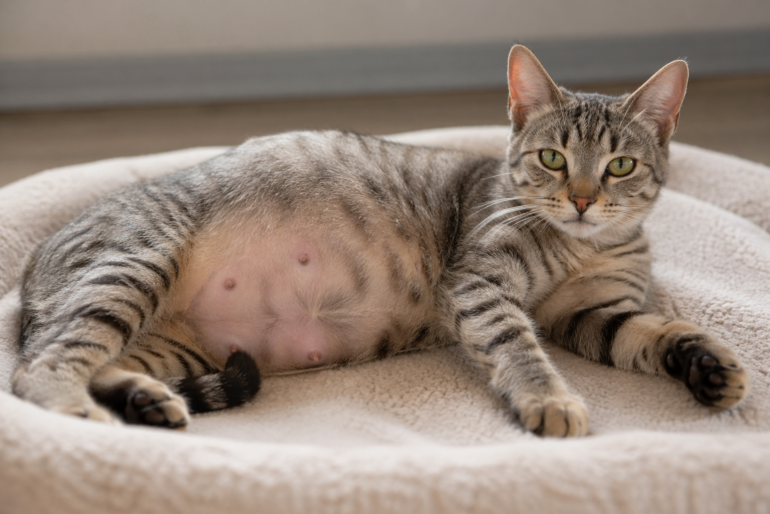
If you have recently noticed your cat acting extra affectionate, eating more than usual, sleeping in hidden corners, or looking a little rounder around the belly, one big question may come to mind: How Long Are Cats Pregnant? The short answer is that most cats are pregnant for about 63 to 65 days, which is roughly nine weeks. VCA Hospitals notes that feline pregnancy, also called gestation, commonly ranges from 60 to 67 days, with an average of 63 to 65 days.
That may sound quick, especially compared with human pregnancy, but a lot happens in those two months. A queen, which is the proper term for an unspayed female cat, goes through fast physical, hormonal, and behavioral changes before giving birth to kittens.
This article walks you through the full cat pregnancy timeline in a simple, week-by-week way, so you know what is normal, what to prepare, and when it is time to call a veterinarian.
How Long Are Cats Pregnant on Average?
Most cats are pregnant for around nine weeks. In days, that usually means 63 to 65 days, although some healthy pregnancies may be slightly shorter or longer. PetMD also gives the average cat gestation period as 63 to 65 days, dividing the pregnancy into three rough trimesters of about 20 days each.
So, when someone asks, How Long Are Cats Pregnant, the most practical answer is:
Cats are usually pregnant for about two months, or eight to ten weeks, with most kittens arriving close to day 63, 64, or 65.
The exact timing can vary depending on the cat’s health, age, litter size, breed, and when mating actually resulted in pregnancy. If you do not know the mating date, it can be hard to predict the birth date without veterinary help.
A veterinarian may use palpation, ultrasound, or other methods to estimate pregnancy stage. Merck Veterinary Manual states that ultrasound is most useful for confirming pregnancy and checking fetal viability around 25 to 35 days of gestation.
Cat Pregnancy Timeline at a Glance
Here is a simple overview before we go deeper into each week.
| Pregnancy Stage | Approximate Time | What Usually Happens |
|---|---|---|
| Week 1 | Days 1 to 7 | Mating and fertilization may occur |
| Week 2 | Days 8 to 14 | Embryos begin early development |
| Week 3 | Days 15 to 21 | Implantation and early nipple changes |
| Week 4 | Days 22 to 28 | Pregnancy may become easier to confirm |
| Week 5 | Days 29 to 35 | Belly may start rounding |
| Week 6 | Days 36 to 42 | Appetite often increases |
| Week 7 | Days 43 to 49 | Kittens grow quickly |
| Week 8 | Days 50 to 56 | Nesting behavior may begin |
| Week 9 | Days 57 to 65 | Labor signs may appear |
| Possible late window | Days 66 to 67 or slightly beyond | Vet check is wise if labor does not begin |
This table is helpful, but every cat is a little different. Some cats show obvious signs early. Others hide pregnancy surprisingly well until the final weeks.
Week 1: Mating and the Very Beginning
During the first week, your cat may not look or act pregnant at all. This is completely normal. Pregnancy begins after successful mating and fertilization, but there are no clear outside signs yet.
Female cats are induced ovulators, which means ovulation is triggered by mating rather than happening on a fixed cycle. VCA Hospitals explains that after mating, the queen may groom herself, wait, and then mate again. This can happen several times during a heat cycle.
At this stage, you cannot confirm pregnancy just by looking at her. Her appetite, behavior, and body shape may seem the same.
If you are wondering How Long Are Cats Pregnant from this point, count roughly nine weeks from the likely mating date. Still, keep in mind that if she mated more than once over several days, the exact due date may be hard to pin down.
Week 2: Quiet Changes Inside the Body
In week two, the pregnancy is still mostly invisible. The embryos are developing, but your cat may continue playing, eating, grooming, and sleeping like usual.
Some owners notice subtle mood changes. A cat may become clingier, calmer, or more private. But these signs are not reliable on their own. Cats can change behavior for many reasons, including stress, heat cycles, illness, or changes at home.
This is why early pregnancy can be easy to miss. You may search How Long Are Cats Pregnant only after your cat’s belly becomes noticeable later on.
The best thing you can do during this early stage is keep her routine peaceful. Give her clean water, good food, a clean litter box, and a calm environment.
Week 3: Early Signs May Start Appearing
By week three, some cats begin showing one of the classic early signs of pregnancy: nipple changes. The nipples may look larger, pinker, or more noticeable. This is sometimes called “pinking up.”
This does not happen in every cat at exactly the same time, but it is one of the first visible clues owners may notice.
Inside the body, important development is taking place. MSD Veterinary Manual notes that implantation in queens occurs at around 14 days, and small swellings in the uterus may be palpable by about 21 days, depending on the cat and whether she cooperates during examination.
Do not press your cat’s belly at home to check for kittens. This can cause discomfort and may be risky if done incorrectly. Let a veterinarian examine her if you need confirmation.
Week 4: Pregnancy Becomes Easier to Confirm
Week four is when many owners begin to feel more certain something is happening. Your cat may eat more, sleep more, or look slightly fuller around the abdomen.
A vet may be able to confirm pregnancy around this period. As mentioned earlier, ultrasound is generally useful from about 25 to 35 days of gestation for confirming pregnancy and checking fetal viability.
This is also the time to start thinking seriously about nutrition. Pregnant cats need more calories as pregnancy progresses, especially in the later weeks. Many veterinarians recommend a high-quality kitten food because it is more calorie-dense and supports the queen’s higher energy needs.
Do not start supplements without veterinary advice. More is not always better, and unnecessary supplements can sometimes do harm.
Week 5: The Belly May Start Showing
By week five, your cat’s belly may begin to look rounder. This is often when owners become confident enough to ask, How Long Are Cats Pregnant, because the physical signs are now harder to ignore.
Her appetite may increase, but some cats eat in smaller, more frequent meals because the growing uterus takes up space. Fresh water should always be available.
You may also notice:
- A rounder abdomen
- More sleeping
- Less interest in rough play
- A calmer or more affectionate mood
- More frequent trips to the food bowl
At this stage, avoid picking her up in a way that puts pressure on her belly. If you need to lift her, support her chest and back end gently.
Week 6: Appetite and Weight Gain Become More Noticeable
Week six is an active growth period for the kittens. Your cat may look visibly pregnant now, especially if she is carrying a larger litter.
The average litter size can vary. A peer-reviewed clinical review published through the National Institutes of Health reported an average domestic cat gestation length of 65.6 days and an average litter size of 4.0 kittens per litter, though individual pregnancies can differ.
You may notice your cat wants food more often. Instead of giving one huge meal, smaller meals throughout the day may be easier for her.
A real-world example: imagine a three-year-old indoor cat named Luna. She usually eats twice a day, but around week six she starts asking for food in the afternoon too. Her owner worries she is being greedy, but in pregnancy, this appetite change can be normal. The better response is to check with a vet and adjust her diet safely rather than restricting her food too much.
Week 7: Kittens Grow Fast
By week seven, the kittens are growing rapidly. Your cat’s belly may be clearly enlarged, and she may move more carefully.
Some owners say they can see or feel kitten movement around this stage. While that can happen, avoid poking or pressing the abdomen. Gentle observation is fine. Prodding is not.
This is also a good time to prepare a nesting area. Choose a quiet, warm, low-traffic space where your cat can feel safe. A clean cardboard box or soft bed with washable towels can work well.
Keep the nesting area:
- Away from loud appliances
- Away from curious dogs or children
- Easy for the mother cat to enter
- Warm but not overheated
- Clean and dry
Even if you make the perfect nest, your cat may choose a closet, laundry basket, or hidden corner instead. Cats like privacy when they feel vulnerable.
Week 8: Nesting and Pre-Birth Behavior
By week eight, birth is getting close. Your cat may begin nesting, which means she looks for a safe place to deliver her kittens.
She may also become more affectionate or more withdrawn. Some cats follow their owners around. Others hide and want quiet. Both patterns can be normal.
If you have been asking How Long Are Cats Pregnant, this is the week when the answer becomes very practical. You are probably within one to two weeks of labor.
Watch for these pre-labor signs:
- Searching for quiet places
- Restlessness
- More grooming, especially near the belly or rear
- Reduced appetite close to labor
- Milk appearing in the nipples
- More vocalizing than usual
Do not force her into the nesting box. Show it to her, keep it clean, and let her decide.
Week 9: Labor May Begin Soon
Week nine is the final stretch for most cat pregnancies. Since the average gestation is about 63 to 65 days, many cats give birth during this week. VCA Hospitals gives the normal range as 60 to 67 days, averaging 63 to 65 days.
Signs labor may be near include:
- Refusing food
- Pacing or restlessness
- Repeated visits to the nesting area
- Licking the genital area
- Panting or heavier breathing
- Visible contractions
- Clear or slightly blood-tinged discharge
Once active labor begins, kittens are usually born one at a time, with breaks between them. Some cats deliver quickly. Others take longer between kittens.
Call a vet immediately if your cat seems in extreme pain, has strong contractions for a long time without producing a kitten, has foul-smelling discharge, appears weak or collapsed, or goes beyond the expected due window without signs of labor.
How Long Are Cats Pregnant If You Do Not Know the Mating Date?
This is one of the most common problems cat owners face. Maybe your cat escaped outside. Maybe you adopted a stray. Maybe you did not realize she was in heat.
If you do not know the mating date, you can estimate based on signs, but a vet visit is the most reliable option.
Here is a rough way to think about it:
| Sign You Notice | Possible Pregnancy Stage |
|---|---|
| Pinker nipples, little belly change | Around 3 weeks |
| Slight belly rounding, more appetite | Around 4 to 5 weeks |
| Clearly rounded belly | Around 6 to 7 weeks |
| Nesting, milk, restlessness | Around 8 to 9 weeks |
This is only a general estimate. Some cats carry small litters and barely show. Others show earlier because they are smaller, thinner, or carrying more kittens.
How to Care for a Pregnant Cat at Home
Good care makes a big difference. A pregnant cat does not need panic, constant handling, or a dramatic routine change. She needs steady support.
Feed the Right Food
As pregnancy progresses, your cat needs more energy. Ask your vet whether kitten food is appropriate. Kitten formulas are often recommended because they contain higher calories and nutrients for growth and nursing.
Avoid sudden diet changes. Mix new food gradually over several days if your vet approves it.
Keep Stress Low
Stress can affect appetite and behavior. Keep her space calm. Avoid moving furniture, introducing new pets, or changing her sleeping area unless necessary.
Do Not Give Human Medicine
Never give painkillers, antibiotics, supplements, or dewormers without veterinary direction. Some products that are safe for humans or dogs can be dangerous for cats.
Keep Her Indoors
If your cat may be pregnant, keep her indoors. Outdoor cats face risks from traffic, fights, parasites, infections, and giving birth in unsafe places.
Schedule a Vet Check
A vet can confirm pregnancy, estimate timing, check overall health, and discuss nutrition, parasites, vaccines, and birth preparation. This is especially important for very young cats, older cats, underweight cats, or cats with previous health problems.
When Should You Worry During Cat Pregnancy?
Most cat pregnancies go smoothly, but some signs need quick attention.
Call a veterinarian if you notice:
- Heavy bleeding
- Green or foul-smelling discharge before kittens are born
- Severe weakness
- Refusal to eat for more than 24 hours
- Fever or extreme lethargy
- Signs of pain
- Straining without delivering a kitten
- Pregnancy lasting past the expected date
- A kitten stuck in the birth canal
- Long gaps with distress between kittens
A cat may seem calm even when something is wrong, so trust your instincts. If her behavior feels seriously different, it is safer to ask a vet.
Can a Cat Get Pregnant Again After Giving Birth?
Yes, a cat can go back into heat after giving birth, sometimes while still nursing. This surprises many owners. If you do not want another litter, talk to your veterinarian about the safest timing for spaying.
Spaying also helps prevent future unwanted litters and can reduce the risk of certain reproductive health problems. Your vet can recommend the right timing based on your cat’s condition and whether she is nursing.
How Many Kittens Do Cats Usually Have?
Many cats have around two to five kittens, but litter size can vary. The NIH-hosted clinical review mentioned earlier reported an average litter size of about four kittens per litter.
First-time mothers may have smaller litters. Breed, age, health, and genetics can all play a role.
Do not assume belly size tells you the exact number of kittens. A large belly does not always mean a large litter, and a small belly does not always mean only one or two kittens.
FAQs About How Long Are Cats Pregnant
How Long Are Cats Pregnant in Weeks?
Cats are pregnant for about nine weeks on average. Most pregnancies last around 63 to 65 days, though some may fall within a slightly wider range.
How Long Are Cats Pregnant in Months?
Cats are pregnant for about two months. Since the timeline is shorter than human pregnancy, changes can appear quickly once the pregnancy reaches the middle stage.
How Long Are Cats Pregnant Before They Show?
Many cats start showing visible belly changes around weeks four to six. Nipple changes may appear earlier, often around week three.
How Long Are Cats Pregnant Before Labor Starts?
Labor usually starts near the end of week nine. Many cats give birth around days 63 to 65, but timing can vary by a few days.
Can I Touch My Pregnant Cat’s Belly?
Gentle petting is usually fine if your cat enjoys it, but do not press, squeeze, or try to feel kittens yourself. A vet should handle pregnancy checks.
What Should I Do When My Cat Starts Labor?
Keep the area calm and quiet. Do not interfere unless there is a problem. Have your veterinarian’s number ready in case labor becomes difficult or your cat seems distressed.
Common Mistakes Cat Owners Make During Pregnancy
One mistake is waiting too long to confirm pregnancy. If you suspect your cat is pregnant, a vet visit can help you plan safely.
Another mistake is overfeeding too early. Pregnant cats need more calories later in pregnancy and during nursing, but feeding too much too soon can lead to unnecessary weight gain. Your vet can help you adjust portions.
Some owners also create a nest in a busy area. A pregnant cat needs privacy. If she feels exposed, she may give birth somewhere unsafe or hard to access.
The last common mistake is assuming birth will happen exactly on one date. When asking How Long Are Cats Pregnant, remember that the answer is an average, not a stopwatch. A few days of variation can be normal, but long delays or distress should be checked.
Final Thoughts on How Long Are Cats Pregnant
So, How Long Are Cats Pregnant? Most cats are pregnant for around 63 to 65 days, or about nine weeks. Some may deliver a little earlier or later, but the safest approach is to watch the timeline, notice behavior changes, and stay connected with your veterinarian.
A healthy cat pregnancy is usually quiet at first, more obvious in the middle, and very active near the end. From pinker nipples to nesting behavior, each stage gives you clues about what is happening.
If you are caring for a pregnant cat, keep her indoors, feed her well, reduce stress, prepare a calm nesting space, and avoid unnecessary handling. The more prepared you are, the safer and calmer the experience can be for both the mother and her kittens.
Pregnancy in domestic cats is short, delicate, and full of fast changes. Knowing the timeline helps you respond with patience instead of panic, especially when the birth date gets close.