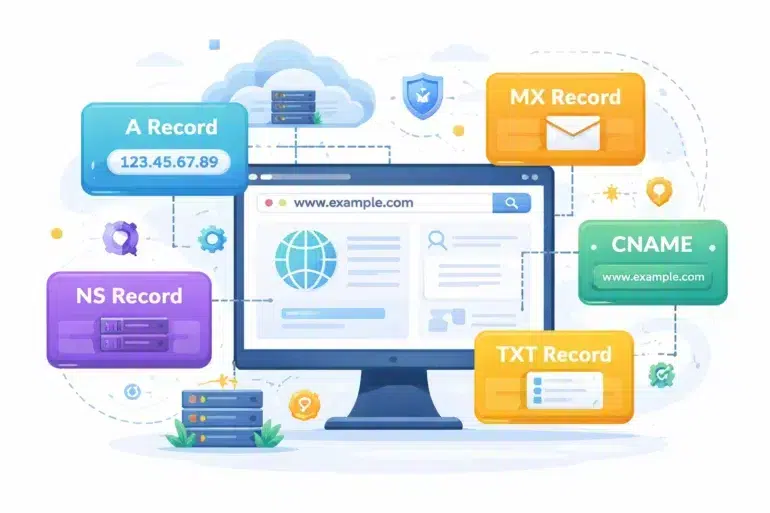
Each time a user opens a website, a process runs behind the scenes to link the domain name to the right server. This process is reliant on DNS records. If not for those records, it would be impossible to access websites using easy-to-remember domain names.
DNS records are essential to the way users can access websites quickly and reliably. Knowing a lot about them also allows for better performance, security, and even the overall website access.
What Are DNS Records?
DNS, an acronym for Domain Name System, is a means to identify sites on the internet just like a directory. Normally, you wouldn’t have to memorize long IP addresses as you would only need to type the domain names, and DNS will then translate it to the location of the server.
DNS records are basically the set of instructions that the internet is following at a given time. They define the location of a website or service on the internet.
Common Types of DNS Records
There are quite a few DNS records that have different uses, with the major ones being:
- A Record – Links a domain to an IPv4 address
- AAAA Record – Links a domain to an IPv6 address
- CNAME Record – Points one domain to another domain
- MX Record – Handles email routing
- TXT Record – Stores verification and security data
How DNS Influences the Ability to Access a Website
DNS records have a direct impact on whether a website can be accessed. In case the records are incorrect or missing, the site becomes inaccessible to users.
Proper DNS setup is a key factor in the following:
- Quick domain name resolution
- Right server identification
- User satisfaction
Even minuscule mistakes can result in outages or slow loading.
The Role of DNS Propagation
After DNS records are changed, the new information will not be supposedly reflected everywhere at once. This delay is called DNS propagation.
Some users may still view the old version of the website, while others have the new version only.
Knowing propagation can assist in scheduling updates and averting confusion during migrations.
Impact of DNS on Website Performance
The speed of DNS determines how fast a website is able to load. A slow DNS resolution will naturally lead to a longer wait for the page to load. Performance can be significantly enhanced by switching to fast and reliable DNS servers as it not only cuts down on the delays but also provides a better experience for the users.
This way, the WEBSITE OPTIMIZATION will also be supported by improved performance.
DNS And Security
DNS plays a crucial role in security as well. A well-configured DNS is a major step towards keeping the system free from misuse and attacks.
A few DNS security, related records being:
- SPF to verify the source of the emails
- DKIM to maintain the integrity of the emails
- DMARC to make the email policies binding
These records act as a barrier against those trying to use the domain name for spoofing and phishing.
Efficient Management of DNS
It is crucial to manage DNS properly. Any blunder in it may cause the website to be down or the services to fail.
A web hosting control panel can simplify DNS management. Through it, users can change the records, track the changes and manage the domain names, all from a simple and easy, facing environment. This leads to fewer manual mistakes and higher efficiency.
Frequently Occurring DNS Issues
Certain problems are common in the DNS setups:
- Mixup of IP address in the records
- Entries that are missing or wrongly set up
- Outdated DNS configurations
- Propagation delay
Continuous monitoring makes it possible to spot and rectify these issues immediately.
Follow these guidelines to ensure efficient DNS management:
- Never rely on a single source for record information
- Maintain the record of DNS settings you are using
- Select reliable providers for DNS services
- Keep a habit of checking the changes
- Make sure to change the records as per the need
Being consistent and having a keen eye for details will work wonders.
Future of DNS in Modern Web Infrastructure
DNS is going through a transformation influenced by present-day advancements. The latest features mainly emphasize speed, privacy, and security.
More and more people are using technologies such as DNS over HTTPS (DoH) and DNS over TLS (DoT), which not only prevent user data from being leaked but also increase the level of trust.
In the future, DNS is still going to play a prominent role in web infrastructure as websites are becoming feature-rich.
Final Thoughts
Simply put, without DNS records your website would be inaccessible. They serve as the bridge connecting web domain names to servers and thereby making sure users can get to the websites effortlessly.
Implementing DNS correctly can lead to better performance, security features, and less downtime. Even minor mistakes can have serious consequences, so it is crucial to handle the situation with great care. It’s only going to become more important as the internet expands exponentially. DNS is not just a matter of technicalities. Rather it is the base of a secure and dependable web presence.