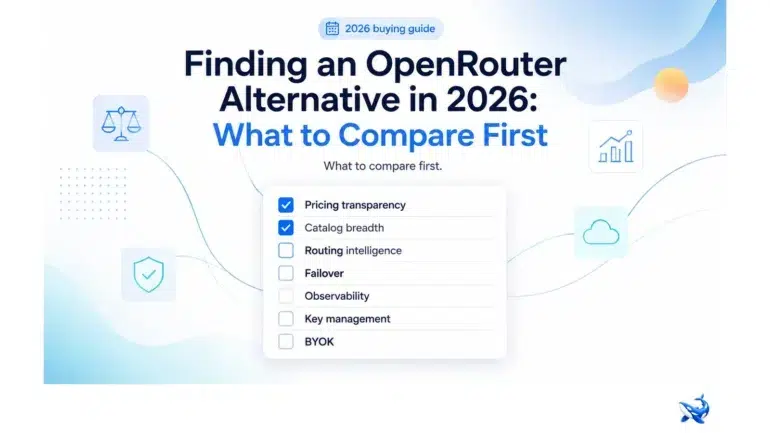
Teams searching for an OpenRouter alternative in 2026 are rarely leaving a broken product; they’re outgrowing a single choice. The gap isn’t catalog size or key count — it’s what happens after you route: whether prices stay honest, whether routing decisions are actually intelligent, and whether you can see and control what ran. OrcaRouter is built for exactly that gap, and the openrouter alternative write-up is where the 2026 criteria are laid out in depth — but before you click anything, run the checklist below. It’s the same list we’d hand any team, and it’s the fastest way to tell a routing layer from a reseller with a key.
The reason 2026 is the year teams start comparison-shopping is that the category grew up. A single API key that reaches a hundred-plus models stopped being exotic and became table stakes, so the differentiators moved from “how many models?” to “what happens after I send a request?” Pricing, routing, failover, logs, and key control now decide the buy — and those are exactly the things a homepage hides. The checklist below is what we’d run first, in order, because the first four items are cheap to check and they disqualify most of the field before you ever sign up.
The checklist: seven things to compare first
| Compare this first | Why it decides your outcome | What to look for |
| Pricing transparency | A markup makes every routing decision a guess | Provider list price passed through; no hidden percentage |
| Catalog breadth | You can only route to the cheapest model if it’s there | Models across many providers, not one vendor’s price sheet |
| Routing intelligence | The cost savings live here, request by request | Prompt graded fast, then routed to the cheapest qualifying model |
| Failover | Downtime becomes a routing problem, not an incident | Automatic re-route on errors, rate limits, and timeouts |
| Observability | Budget questions should be queries, not archaeology | Per-request log: model, tokens, and cost |
| Key management | Keys scattered through code is a security hole | One key in one place, with roles and budgets |
| BYOK | Keeps enterprise contracts and governance intact | Bring your own keys and keep your negotiated rates |
Scan the table and notice the pattern: every row is about what happens after the request leaves your code. That’s the honest definition of a routing layer in 2026 — the plumbing is everywhere, the decisions are not.
Pricing transparency: the difference between routing and guessing
A routing service only helps if the prices it routes by are real. If the layer adds a markup on top of provider list prices, every “cheapest qualifying model” decision is off by the markup, your internal cost comparisons drift, and the budget report stops matching the invoice. That’s why pricing transparency is the first box to tick: does the provider list price pass through untouched? OrcaRouter does — a documented 0% markup, with provider list prices passed through and receipts per request [OrcaRouter]. “Provider price, no $0.00 added” isn’t marketing copy; it’s the difference between routing to the cheapest model and routing to whatever makes the vendor the most money. The rule of thumb: if you can’t see the provider’s list price on the same screen as your routed cost, you aren’t comparing services, you’re comparing markups.
Catalog breadth: the cheapest model only counts if it’s there
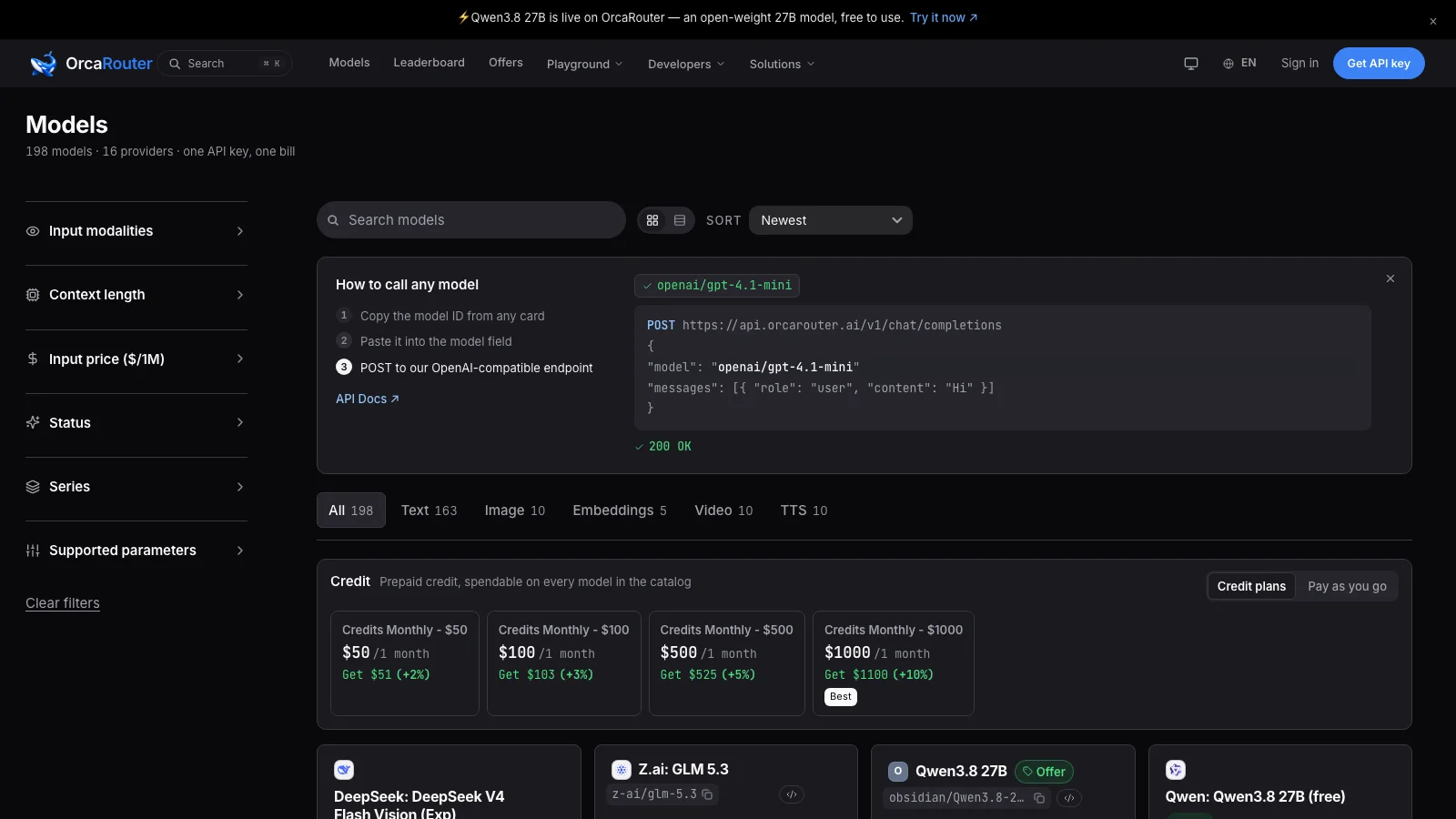
Routing only saves money if the cheaper model is actually in the catalog. A hub that fronts one vendor’s models routes within a single price sheet; a hub that fronts many vendors’ models can genuinely drop a prompt from a frontier model to a fast, inexpensive one. Count breadth across providers, not just models: a single key that reaches 200+ models — OpenAI, Anthropic, Google, Meta, Mistral, xAI, DeepSeek, Qwen, GLM, MiniMax and more — is a catalog with real headroom [OrcaRouter]. Then check the endpoint: breadth is only useful if your existing code can talk to it through an OpenAI-compatible API without a rewrite [OrcaRouter].
Routing intelligence: where the savings actually come from
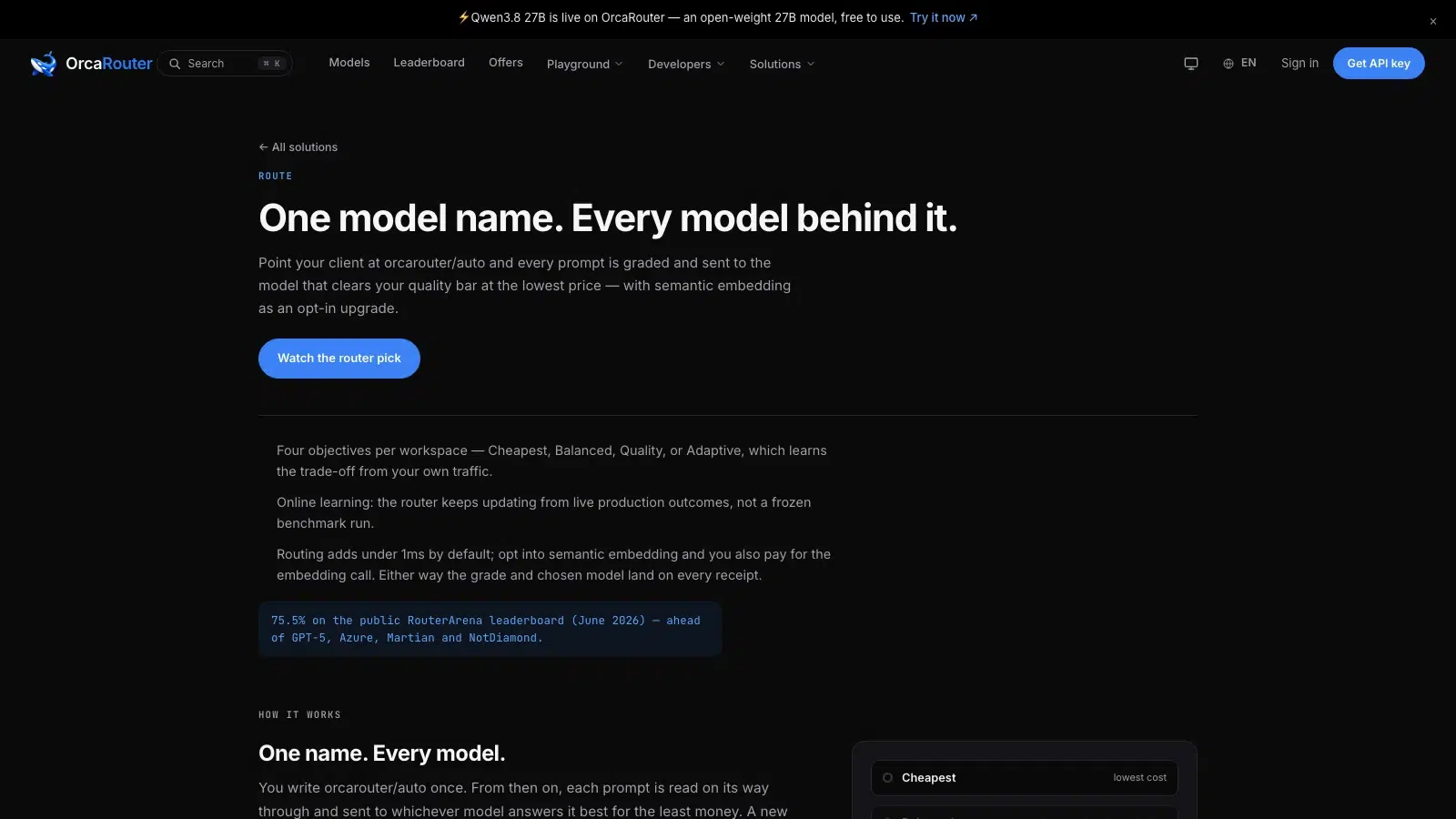
Catalog breadth is inert without routing intelligence; the savings come from the decision, not the menu. The meaningful test is whether the router grades the prompt or just follows a tag. A grade-then-route router scores each prompt against your quality bar — in under a millisecond — and sends it to the cheapest model that clears the bar [OrcaRouter]. Easy questions hit a fast, inexpensive model; hard ones escalate to a frontier model. That is the difference between cost optimization and a fixed config that you update by hand. Ask two follow-ups. First, can the router also think across a session? Prefix-aware, session-aware routing keeps a multi-turn conversation on the same model so context isn’t lost between turns [OrcaRouter]. Second, can it orchestrate a panel of models — say, with a routing DSL or model fusion — instead of picking exactly one [OrcaRouter]? The more decision logic lives in the routing layer, the less of it lives in your code.
Failover and observability: what happens after the request
Two boxes that get skipped in demos and punished in production. Failover first: when a provider errors, rate-limits, or times out, does the layer re-route automatically? Automatic failover keeps the user facing a working response instead of your retry loop, and load balancing spreads traffic across instances of the same model so one endpoint doesn’t bottleneck [OrcaRouter]. Then observability: can you see, per request, which model answered, how many tokens it used, and what it cost? Request logs that are auditable per request turn “where did the budget go?” into a query instead of a spreadsheet mystery [OrcaRouter]. If the only numbers you receive are a monthly invoice, you haven’t bought observability; you’ve bought a bill.
Key management and BYOK: who holds your keys
Key management is the security half of the comparison. A service that lets your keys scatter through your code is a liability; one key held in one place, with budgets and roles per team, is a policy you can actually enforce [OrcaRouter]. BYOK — bringing your own provider keys — matters for teams with existing enterprise contracts or data-governance obligations: you keep your negotiated rates and your audit trail, and the routing layer never holds a credential it doesn’t need [OrcaRouter]. Guardrails and an agent firewall round out the story, filtering prompt injection and gating what your autonomous agents can call [OrcaRouter]. If the service can’t explain where your keys live and who can spend them, every other feature on the list is worth less.
How OrcaRouter scores on the checklist
Run the list against OrcaRouter and every row clears: 0% markup with glass-box receipts [OrcaRouter]; a single key for 200+ models across major providers [OrcaRouter]; grade-then-route adaptive routing that sends each prompt to the cheapest qualifying model in under a millisecond [OrcaRouter]; automatic failover and load balancing [OrcaRouter]; per-request logs with budgets and roles [OrcaRouter]; BYOK for teams that bring existing keys [OrcaRouter]; and guardrails with an agent firewall on top [OrcaRouter]. The point isn’t that it wins every row on paper — it’s that the rows it wins are the ones that change the monthly bill and the incident count. That’s the comparison that actually matters in 2026.
The takeaway
Switch to an OpenRouter alternative when the difference is operational, not cosmetic. If your current setup routes honestly, fails over automatically, logs every request, and holds your keys the way you want, you don’t need to move. If it marks up prices, routes by fixed config, or shows you cost only at the end of the month, that’s the gap — and it’s worth running the checklist above against a service that passes list prices through at 0% markup and grades each prompt before it routes. The cheapest, most observable, most boring-in-a-good-way option is the one that clears the first four boxes. Make the move once, on the full checklist, and you won’t be comparison-shopping again next year.
Sourcing note: All product facts — one API key for 200+ models, prompts graded in under 1ms and routed to the cheapest qualifying model, 0% markup pass-through of provider list prices, automatic failover, load balancing, per-request logs, budgets and roles, BYOK, and the agent firewall — are OrcaRouter’s own published claims, checked on its homepage and product pages August 22, 2026. No competitor pricing, benchmark, or performance data is used in this article.