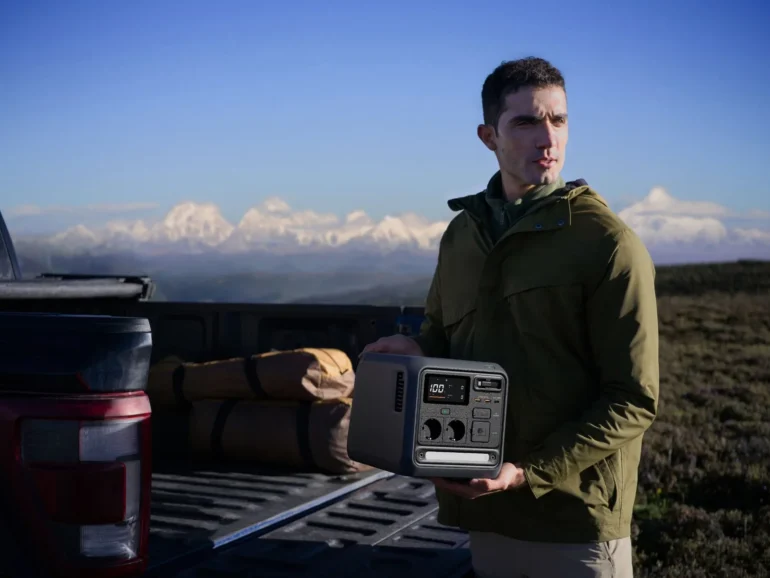
A weekend away from mains electricity changes the way you think about battery capacity. At home, a portable power station can simply be plugged into the wall. At a campsite, cabin or remote filming location, the important question becomes whether your solar panels can replace the energy you use before the next evening.
That is why choosing a solar generator should involve more than comparing battery capacity and the wattage printed on a solar panel. Real recharge time depends on panel size, weather, positioning, the power station’s solar-input limit and how much of the battery you actually used.
For a two- or three-day trip, getting these numbers roughly right can be the difference between having reliable power all weekend and watching the battery percentage fall each day.
Start with watt-hours, not panel wattage
Portable power-station batteries are normally rated in watt-hours, or Wh. A 1,000Wh battery stores roughly twice as much energy as a 500Wh battery, so it also takes roughly twice as much solar energy to refill.
The simplest theoretical calculation is:
Battery capacity ÷ solar input = recharge time
A 1,000Wh battery receiving a constant 200W would therefore take about five hours in a perfect world. At 400W, the theoretical figure drops to around 2.5 hours.
But those numbers should never be treated as guaranteed solar charging times.
Why solar charging takes longer in the real world
A 200W panel only reaches its rated output under favourable conditions. Clouds, shade, panel angle, temperature and the changing position of the sun can all reduce output.
There are also conversion losses between the panels and the battery. Charging may slow as the battery approaches full capacity, and some power can be consumed by devices that remain connected while the station is charging.
This is why a useful off-grid calculation should leave a margin.
If a manufacturer quotes five hours under controlled solar conditions, planning your entire weekend around exactly five hours of sunshine is risky. If your trip depends heavily on solar charging, extra panel capacity provides flexibility when conditions are less than ideal.
200W panels: portable, but not especially fast
A 200W panel is a sensible starting point for users who care about portability.
For phones, cameras, laptops and occasional lighting, you may only use a fraction of a 1kWh battery each day. In that case, there is no need to fully recharge from zero every afternoon. A 200W panel can simply replace the energy consumed during the previous evening.
The limitation appears when daily consumption becomes heavier.
If you run a portable fridge, charge multiple camera batteries and laptops or use cooking appliances, you may remove several hundred watt-hours from the battery every day. A single 200W panel can struggle to restore that energy during short or cloudy days.
Jackery’s Explorer 1000 v2 provides a useful reference. It has a 1,070Wh battery, and Jackery quotes approximately 7.5 hours to recharge it with one SolarSaga 200W panel under its specified conditions. With two 200W panels, the figure falls to approximately 3.8 hours.
That illustrates why doubling panel capacity can matter more than buying a larger battery for some weekend trips.
400W is a practical middle ground
For a power station around 1kWh, roughly 400W of solar capacity is often easier to live with off-grid.
It still requires a reasonable amount of space when unfolded, but it gives you a much better chance of replacing a significant amount of energy during the useful part of the day.
This setup makes sense for campers who use a fridge, charge several devices, work from a laptop or regularly recharge drone and camera batteries.
It also creates some margin. Even when the panels are not producing their full rated 400W, the incoming power may still be high enough to make useful progress.
The important check is the power station’s solar-input specification. Connecting 600W or 800W of panels to a station that only accepts 400W does not automatically make it charge faster.
Larger batteries need proportionally more solar
A 2kWh power station gives you much more stored energy, but it also takes approximately twice as much energy to refill as a 1kWh model.
This is easy to overlook when shopping.
A larger station may comfortably power a fridge, induction cooker, lighting and electronics through the evening, but pairing that battery with one small solar panel can create a bottleneck the following day.
DJI provides a useful example with its 240W solar charging kit. Using two 120W panels through an MPPT adapter, DJI quotes approximately four to eight hours to recharge the Power 1000 or Power 1000 V2, while the 2,048Wh Power 2000 takes approximately eight to sixteen hours with the same 240W setup. DJI notes that actual time varies with sunlight angle and intensity.
The lesson is broader than those particular products: if you double battery capacity but keep the same panel array, expect solar recovery to take considerably longer.
Where DJI Power 1000 V2 fits
For a typical off-grid weekend, DJI Power 1000 V2 is an interesting size because its 1,024Wh capacity is large enough for substantial campsite or creator use without moving into the bulk of a 2kWh system.
It also offers a continuous output of up to 2,600W, so the limitation in many weekend scenarios is more likely to be stored energy than the ability to run a short high-power load.
For solar charging, DJI offers configurations that can scale beyond a single small panel. The UK DJI Power range currently includes an 800W Power 1000 V2 solar bundle using four 200W folding panels and two MPPT adapter modules.
That does not mean everyone needs 800W. If you use only 300Wh overnight, carrying four large panels would be unnecessary. But for creators, campers or drone users who consume most of a 1,024Wh battery each day, the ability to increase solar input gives the system more room to adapt.
When Power 2000 makes more sense
DJI Power 2000 doubles capacity to 2,048Wh and provides up to 3,000W of continuous output. It is better suited to heavier loads, longer stays or situations where several people are sharing one power station.
For example, a weekend involving a fridge, cooking appliances, multiple laptops and camera equipment can justify the larger battery.
But a 2kWh station should ideally be paired with a correspondingly stronger charging strategy. Using only 200-240W of solar means a full recharge can occupy most or all of the daylight available.
DJI also supports higher-power solar configurations through additional accessories, including its 1.8kW Solar/Car Super Fast Charger, which is compatible with Power 2000 and Power 1000 V2. It can accept high solar input in appropriate installations, making it more relevant to camper vans and more permanent off-grid setups than to a minimalist weekend tent.
How much solar do you really need for a weekend?
Start with your expected daily consumption rather than battery size alone.
If you only charge phones, cameras and a laptop, 200W may be enough because you probably will not empty a 1kWh station every day.
If you use a fridge, work for several hours or recharge multiple high-capacity batteries, 400W gives considerably more breathing room.
If you regularly consume most of a 1kWh battery each day, moving towards 600-800W can make off-grid charging much less dependent on perfect weather.
And if you choose a 2kWh power station, remember that the larger battery does not generate more energy — it only stores more. Without enough solar input, you may simply begin the weekend with a bigger reserve that gradually runs down.
For most off-grid weekends, the best setup is therefore not the largest battery or the largest panel array. It is the combination that can realistically replace roughly the amount of energy you expect to use each day. DJI Power 1000 V2 is particularly well balanced for this type of use because it starts at a practical 1,024Wh capacity while leaving room to scale the solar setup if your weekends become more energy-intensive.