
First impressions happen quickly — and in professional settings, what you wear is one of the first signals people use to read credibility, preparation, and attention to detail. A poorly chosen outfit does not need to be dramatic to work against you; a bad fit, wrong fabric, or misunderstood dress code can quietly weaken the impression you meant to make.
The problem isn’t that men don’t care about how they dress. It’s that the rules around business attire have shifted, splintered, and become genuinely confusing. ‘Business casual’ means something different in a corporate law office than it does in a fast-growing tech startup. The result: avoidable mistakes that quietly cost people opportunities they’ve worked hard for.
Here are seven of the most common business dress code mistakes — and the straightforward fixes that make them non-issues.
1. Misreading the Dress Code Before You Even Walk In
Most dress code miscalculations happen before a single item of clothing is chosen. The confusion usually starts with terminology. “Business formal,” “business professional,” and “business casual” are not interchangeable, and treating them as if they are is the fastest way to walk into a room visually out of place.
Business formal usually means a matched suit, dress shirt, and tie. A business professional may allow a little more flexibility, but it still expects a polished jacket-and-trouser combination. Business casual is looser, but it is not weekend casual; it simply gives you more room to use smart separates without looking underdressed. The moment you treat a business casual environment as an excuse to wear what you’d wear on a weekend, you’ve already lost ground.
The safest rule: when the dress code is ambiguous, dress one level above what you think is required. You can always remove a jacket. You can’t add formality you didn’t bring.
2. Letting Poor Fit Do All the Damage
Fit is the single variable that separates an entry-level suit that looks sharp from an expensive suit that looks sloppy. Most men know this intellectually — and then buy off-the-rack without budgeting for even basic tailoring.
The shoulder seam is the easiest diagnostic. If it sits off your shoulder — even by half an inch — no amount of tailoring elsewhere will fix the silhouette. That’s a structural issue that belongs to the fit of the jacket itself. After the shoulder, check the jacket’s length (it should cover your seat), the sleeve (roughly half an inch of shirt cuff should show), and whether the trousers break cleanly at the shoe.
If bespoke tailoring isn’t in the budget, quality fabric with basic alterations is a smarter investment than a more expensive off-the-rack piece that doesn’t fit. For those who make or source their own garments, Global Fabric Wholesale can be a useful reference point for comparing suiting-weight materials before committing to a final garment.
3. Ignoring What Your Suit Fabric Actually Says About You
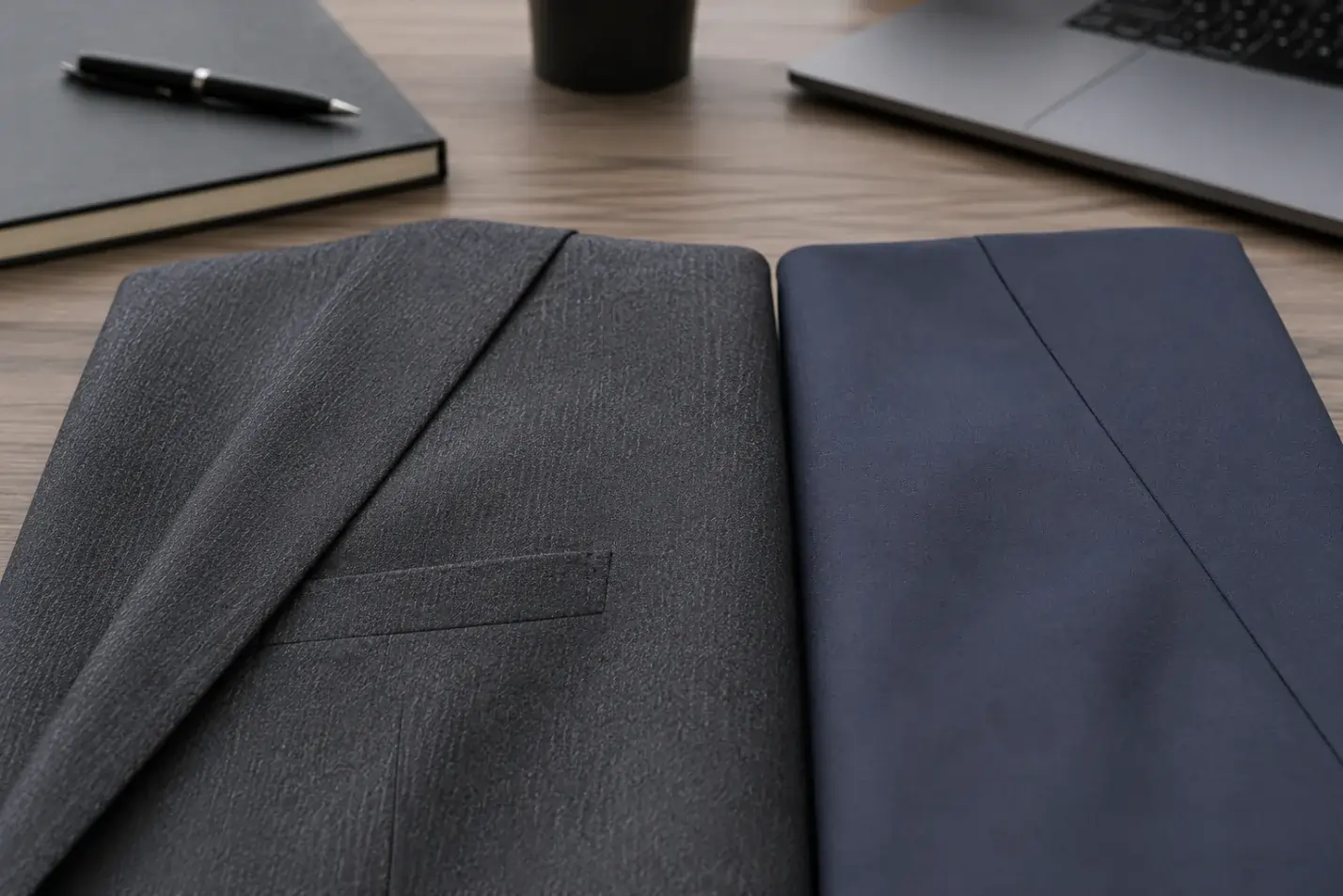
Fabric choice matters more than most men realize, and it’s one of the easiest signals that experienced professionals read instantly. A suit made from a high-sheen synthetic blend reads differently than one in a quality wool — even to someone who couldn’t identify the fibre if asked. If you’re serious about suiting, understanding the best fabric for suits — including how fibre content, weight, and weave affect drape, breathability, and longevity — is worth the research time.
Wool and wool blends are usually safer choices for professional suiting: they drape well, hold their shape through a long meeting, breathe better than many synthetic-heavy blends, and tend to recover from light creasing more cleanly. A lightweight wool works year-round in most office climates. Heavier weights — tweed and flannel — are better suited to winter and colder settings.
The practical rule: if the suit looks slightly shiny under office lighting and you haven’t paid a premium for it, it’s almost certainly polyester-heavy. That’s not necessarily a dealbreaker in casual environments, but it’s noticeable in formal ones.
4. Getting Accessories Wrong in Both Directions
Accessories are where men most commonly swing between two opposite errors: over-accessorizing in an attempt to look polished, or ignoring accessories entirely and leaving an outfit visually unfinished.
Over-accessorizing — stacking a tie bar, pocket square, cufflinks, a bold watch, and patterned socks all at once — signals effort in the wrong direction. It looks like someone is trying too hard to demonstrate that they understand style, which paradoxically suggests they don’t. One or two intentional accessories are more effective than five competing ones.
The more common mistake, though, is neglecting shoe and belt coordination. These are the details that experienced eyes catch immediately. Mismatched leather tones between shoes and belt, scuffed soles on otherwise sharp footwear, or a canvas belt with dress trousers — each of these quietly undermines the overall impression a suit is trying to create.
5. Dressing for a Generic “Professional” Rather Than Your Actual Industry
There is no single universal professional wardrobe. What reads as sharp and credible in finance — a dark navy suit, white shirt, conservative tie — can read as oddly formal in a creative agency or a tech company where the culture skews deliberately casual. Wearing the wrong register of dress for your industry doesn’t just look out of place; it signals that you haven’t done your homework on the culture.
Before any high-stakes professional appearance, spend ten minutes on a company’s LinkedIn page or website. Look at how people in senior roles present themselves. That’s your target range — not a generic idea of what “professional” looks like.
6. Wearing Something You’ve Never Worn Before
This one is straightforward but consistently overlooked: do not wear an untested outfit to an important occasion. New shoes that haven’t been broken in, a suit that hasn’t been tried with the specific shirt and belt combination you’re planning, a collar that chafes — any of these details will occupy a corner of your attention throughout the day, and that distraction costs you presence.
The fix is simple: do a full dress rehearsal at least a few days beforehand. Wear the complete outfit, including footwear, for a few hours. You’ll identify any problems with time to solve them. On the day itself, comfort and confidence should be the only things on your mind.
7. Treating Business Casual as “Almost Casual”
Business casual has become the default dress code in many workplaces — and it’s arguably the most misunderstood one. The word “casual” in the phrase is doing a lot of damage. Too many men interpret it as an invitation to wear whatever they’d wear on the weekend, slightly tidied up.
The word to pay attention to is “business.” Business casual means you can skip the tie and the matched suit, but the standard for grooming, fit, and overall presentation remains professional. Dark, well-fitted chinos with a button-down shirt and clean leather shoes are business casual done correctly. A graphic T-shirt, cargo shorts, and sneakers — regardless of how clean or expensive they are — is not.
As workplaces continue to evolve, the men who navigate dress codes most successfully are the ones who understand that how you dress is a form of professional communication — one you control entirely, and one your audience is reading whether they mention it or not.