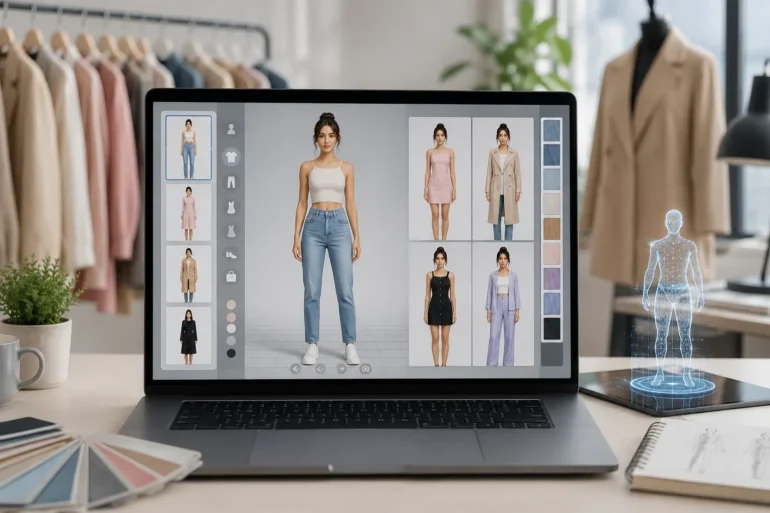
The fashion industry is undergoing a quiet revolution. Where brands once spent thousands on professional photoshoots — booking studios, hiring models, coordinating stylists — many are now turning to AI character models to showcase their collections. These digital models can be customized to any body type, skin tone, age, or style, and they can wear any garment in seconds.
For e-commerce brands, this shift is not just about cutting costs. It is about speed, scale, and consistency. A single AI character model can be deployed across hundreds of product listings in the time it would take to schedule one traditional shoot. And with virtual try-on technology advancing rapidly, the results are increasingly photorealistic.
This guide walks you through what AI character models are, how they work, and how to create one that delivers real results for your fashion brand or online store. Whether you are a solo designer or a growing retail operation, understanding this technology is becoming essential to staying competitive in modern fashion e-commerce.
What Is an AI Character Model and Why Does It Matter?
The term “AI character model” refers to a digitally generated human figure created using artificial intelligence. Unlike stock photos or CGI renders from a decade ago, today’s AI character models are built with deep learning systems trained on vast datasets of real human images. The result is a figure that looks, moves, and wears clothing in a way that is nearly indistinguishable from a real photograph.
For fashion brands, this matters because the model is the product context. Shoppers do not just want to see a garment on a hanger — they want to see how it fits, how it drapes, and how it looks on a body similar to their own. AI character models make it possible to show a single item on dozens of different body types without a single additional photoshoot. This capability is reshaping how brands think about product presentation at every stage of the customer journey.
The Shift from Traditional to Digital Fashion Models
Traditional fashion photography is expensive, time-consuming, and difficult to scale. A mid-sized brand might spend $5,000 to $20,000 per shoot, and even then, the resulting images represent only a narrow slice of their customer base. AI character models change this equation entirely. Brands can now generate diverse, realistic model images on demand, adjusting everything from height and build to skin tone and facial features. This democratizes high-quality fashion imagery for brands of all sizes, removing the financial barrier that once kept smaller labels from competing with larger players on visual quality.

How AI Character Models Work in Virtual Try-On
At the core of AI character model technology is a combination of generative AI, computer vision, and physics-based simulation. When you upload a garment image, the system analyzes its shape, texture, and fabric properties. It then maps that garment onto the AI character model using neural networks that understand how fabric behaves — how it stretches, folds, and drapes across different body shapes.
The process happens in seconds. What once required a 3D rendering pipeline and specialized software can now be done through a browser-based interface. The AI handles the complex calculations: lighting consistency, shadow placement, fabric weight simulation, and edge blending. The output is a photorealistic image of your garment on a digital model that looks like it was taken in a professional studio. For brands managing large catalogs, this speed is transformative — hundreds of product images can be generated in the time a single traditional shoot would take to set up.
Key Technologies Behind the Magic
Several technologies work together to make AI character models possible. Generative adversarial networks and diffusion models are used to create and refine the human figure with high visual fidelity. Garment fitting algorithms handle the physics of how clothing sits on a body, accounting for fabric weight, stretch, and layering. Lighting models ensure that the garment and the character share the same visual environment, creating a coherent and believable image. Together, these systems produce outputs that are increasingly difficult to distinguish from real photography — and the technology continues to improve with each new model generation.
Step-by-Step: Creating Your AI Character Model
Creating an AI character model for virtual try-on does not require technical expertise. Modern platforms have simplified the process into a few clear steps. Here is how to approach it from start to finish, whether you are creating your first digital model or refining an existing workflow.
Preparing Your Inputs for Best Results
The quality of your output depends heavily on the quality of your inputs. For garment images, use flat-lay photography on a clean, neutral background. Ensure the garment is fully visible, wrinkle-free, and well-lit from a consistent direction. Avoid images where the garment is partially obscured or folded in ways that hide its shape or structure. For the model itself, decide in advance what characteristics you want: body type, height, skin tone, age range, and pose. Having a clear brief before you start will save time during the customization phase and produce more consistent results across your product catalog. If you are working with multiple garment categories — tops, bottoms, outerwear — consider whether a single model configuration will serve all of them or whether you need different setups for different product types.
Customizing Your Digital Model
Once you have your inputs ready, the customization process is straightforward. Most AI character model platforms allow you to adjust physical characteristics through a combination of sliders and text prompts. You can specify a body type, an age range, and a background setting — from a clean studio white to a lifestyle scene or outdoor environment. Some platforms also allow you to upload a reference photo to guide the model’s appearance, which is useful when you want to maintain visual consistency with existing brand imagery.
After setting your parameters, the system generates the model and applies your garment. Review the output carefully — check that the garment fits naturally, that edges are clean, and that the overall image matches your brand aesthetic. Pay particular attention to areas where garments typically render less accurately, such as collars, cuffs, and layered pieces. Most platforms allow you to regenerate or fine-tune the result if the first output does not meet your standards. Build this review step into your workflow from the start to maintain consistent quality across your catalog.
Benefits for Fashion Brands and E-Commerce Stores
The business case for AI character models is straightforward. Brands that adopt this technology report significant reductions in content production costs, faster time-to-market for new collections, and measurable improvements in conversion rates. When shoppers can see a garment on a model that resembles them, they are more likely to buy — and less likely to return. Return rates are one of the most significant cost drivers in fashion e-commerce, and better product visualization is one of the most effective ways to reduce them.
Reducing Costs Without Sacrificing Quality
A traditional photoshoot for a collection of 50 items might take two days and cost upward of $15,000 when you factor in studio rental, model fees, photographer rates, and post-production editing. With AI character models, the same 50 items can be visualized in a matter of hours at a fraction of the cost. The quality is not a compromise — for many use cases, AI-generated model images are indistinguishable from professional photography. This cost efficiency is particularly valuable for small and mid-sized brands that need to compete with larger players on a limited budget. It also enables faster iteration: when a product is updated or a new colorway is added, the model image can be regenerated immediately rather than waiting for the next scheduled shoot.
Best Practices for AI Character Model Try-On Campaigns
Getting the most out of AI character model technology requires more than just generating images. Consistency matters across your catalog. Use the same model characteristics for related product lines to create a cohesive brand look. Shoppers who browse multiple products should see a consistent visual identity, not a random mix of different AI-generated figures with varying styles and backgrounds.
Diversity drives engagement. Offer multiple model options for key products — different body types, skin tones, and age ranges. Research consistently shows that shoppers engage more with products shown on models that reflect their own appearance, and this representation directly influences purchase decisions. Prioritize diversity not as a checkbox but as a genuine strategy for connecting with a broader customer base.
Test before you scale. Before rolling out AI character model images across your entire catalog, test a subset of products and measure the impact on conversion rates and return rates. Use the data to refine your approach before committing to a full deployment. Platforms like Kling AI offer intuitive tools for creating and customizing AI character models, making it accessible for brands at any stage of their digital transformation journey without requiring specialized technical knowledge.
Bringing Your Fashion Brand Into the AI Era
AI character models are not a future technology — they are available today, and the brands adopting them are already seeing measurable results. From reducing photoshoot costs to enabling diverse representation across product catalogs, the benefits are concrete and scalable for businesses of every size.
The key is to start with a clear understanding of what you want to achieve. Define your model characteristics, prepare high-quality garment images, and choose a platform that gives you the control and output quality your brand requires. Kling AI’s virtual try-on tools provide a powerful starting point for brands looking to explore AI character model creation without a steep learning curve, combining ease of use with professional-grade output.
As AI technology continues to advance, the gap between AI-generated and traditionally photographed fashion imagery will continue to narrow. The brands that build this capability now will be better positioned to move faster, spend less, and connect more authentically with their customers — turning product visualization from a cost center into a genuine competitive advantage.