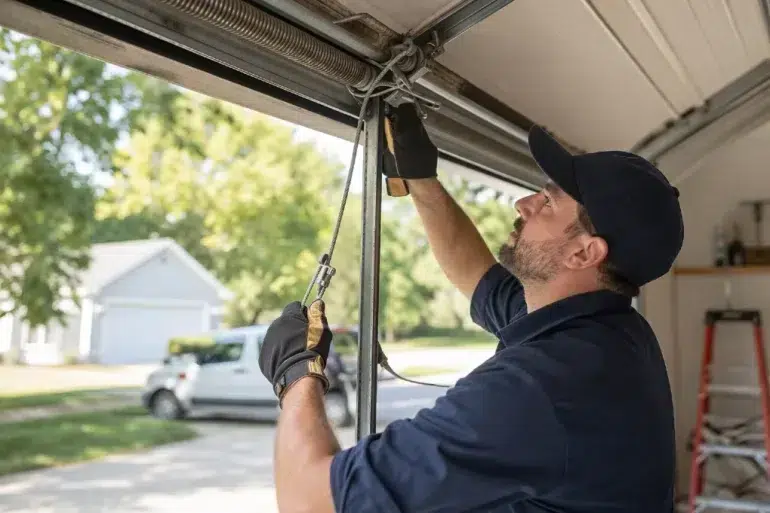
When you search for Garage Door Cable Replacement Near Me, you are usually not browsing out of curiosity. You are dealing with a door that will not open, a cable that has snapped, or a garage door hanging unevenly and creating a real safety problem. In those moments, speed matters, but so does making the right decision.
A damaged garage door cable is not a small inconvenience. It is part of the counterbalance system that helps the door lift and lower safely. Industry safety guidance warns that garage door systems contain components under tension, and extension spring systems should include safety cables because a broken spring can cause injury. UL notes that residential garage door operators in the U.S. are tied to safety requirements under UL 325 through federal law, which is one reason emergency repairs should be handled with care and by qualified professionals.
If your garage door cable has come off the drum, looks frayed, or has already broken, this article will walk you through what is happening, what emergency service usually includes, what it may cost, and how to choose the right local repair company without wasting time.
Why a broken garage door cable becomes an emergency fast
A garage door cable works with the spring system to control the weight of the door. When one cable fails, the door can become crooked, jammed, noisy, or completely stuck. In some cases, one side drops lower than the other. In more serious situations, the door may slam shut or refuse to close properly.
That is why homeowners often treat cable failure as an emergency, especially when:
- The garage door is stuck open at night
- The door is hanging at an angle
- One cable is visibly loose or wrapped incorrectly
- The opener is straining but the door will not move
- You hear a loud snap and the door suddenly stops working
- Your car is trapped inside the garage
- The garage is the main entry point to your home
The biggest mistake people make is continuing to run the opener after the cable fails. That can put more stress on the springs, drums, rollers, and opener itself. A repair that started with a cable issue can turn into a much bigger and more expensive job.
Garage Door Cable Replacement Near Me: what local emergency service usually includes
When people search Garage Door Cable Replacement Near Me, they are usually looking for a company that can arrive quickly, make the door safe, and restore normal operation in one visit if possible.
A proper emergency service call often includes:
- Inspection of both lift cables
- Check of torsion or extension springs
- Drum and pulley inspection
- Roller and track check
- Door balance test
- Opener stress check
- Replacement of worn or broken cables
- Tension adjustment and safety testing
In many cases, technicians replace both cables, not just the damaged one. That is because the second cable is often close to the same wear point. Replacing only one side can leave the system uneven and may lead to another failure soon after.
If your garage door uses extension springs, safety guidance from DASMA says safety cables are important because they help contain a broken spring. That is the kind of detail a good emergency technician should notice during the visit.
Signs you need garage door cable replacement right now
Some cable problems build gradually. Others show up all at once. Here are the most common warning signs.
The cable looks frayed or rusty
Frayed strands are a major red flag. Once the cable begins to unravel, failure can happen without much warning. Rust is another sign that the cable is weakening, especially in humid climates or coastal areas.
The door is crooked when opening
If one side of the garage door lifts higher than the other, the cable may be slipping, stretched, or broken. This is one of the clearest signs that you should stop using the door immediately.
The garage door slams shut
A cable issue can disrupt the balance of the entire system. If the door feels unusually heavy or drops too quickly, do not try to force it.
You hear grinding or snapping sounds
These sounds may mean the cable is slipping off the drum or that another component in the lift system is failing at the same time.
The opener works, but the door does not move correctly
Sometimes the motor still runs, but the door barely moves or jerks upward unevenly. That usually means the opener is trying to do work the spring and cable system should be handling.
Why this is not a smart DIY repair
A lot of homeowners are comfortable with basic home maintenance. Replacing air filters, painting a room, or changing weatherstripping is one thing. Garage door cable repair is different.
Garage door systems use tightly wound springs and tensioned components. The industry repeatedly emphasizes that manufacturer instructions and professional guidance matter because these systems can be dangerous if handled incorrectly. DASMA specifically notes that its technical data sheets are not substitutes for manufacturer instructions and that users should consult manufacturers and local regulations.
Here is the practical reality. A cable rarely fails by itself. It often fails because something else is off:
- Spring tension may be incorrect
- The drum may be worn
- The shaft may be misaligned
- The pulley may be damaged
- The track may be bent
- The door may already be out of balance
A professional does not just swap the cable. They diagnose why it failed and make sure the whole system is safe again.
How much emergency garage door cable replacement usually costs
Cost is one of the first questions homeowners ask, and for good reason. Emergency service pricing varies by location, door size, cable type, labor rates, and whether other parts are damaged.
Recent pricing references show that standard garage door cable replacement often lands in the low hundreds, while emergency or after hours service can push the total higher. Angi notes emergency garage door repair service may add up to $300, while HomeGuide lists standard cable replacement at roughly $150 to $250 in common scenarios. Homewyse’s location-based estimator starts around $169 to $317 for cable repair, depending on project details and market conditions.
Here is a simple cost overview:
| Service Type | Typical Range |
|---|---|
| Basic cable adjustment | $100 to $200 |
| Standard cable replacement | $150 to $250 |
| Cable replacement with added parts or alignment work | $200 to $350+ |
| After-hours or emergency surcharge | Up to $300 extra |
These are not universal flat rates, but they are useful for setting expectations.
A repair estimate can increase when:
- Both cables need replacement
- Springs are worn or broken
- The drum or pulley is damaged
- The door came off track
- The technician is responding late at night, on a weekend, or during a holiday
- You have a custom, oversized, or heavy insulated door
If a company gives you a suspiciously low quote over the phone without asking any questions, be careful. Real emergency repairs depend on the condition of the full system, not just one part.
What to ask when hiring a local emergency garage door company
Typing Garage Door Cable Replacement Near Me into Google will bring up a long list of local results. Some are excellent. Some are just lead generation pages that sell your information.
To find a real local pro, ask these questions before you book:
Do you handle emergency garage door repairs today?
You want a direct answer on availability, not a vague promise.
Will you inspect the springs and drums too?
A technician who only talks about the cable may be missing the bigger issue.
Do you replace both cables?
That is often the best practice when one cable fails from wear.
Are you insured and experienced with my door type?
This matters even more for heavier doors and nonstandard setups.
Is there a service call fee or after-hours fee?
Get clear pricing terms before the truck arrives.
Do you test door balance and safety before leaving?
This should be part of the repair, not an optional extra.
A trustworthy company should be able to explain the issue in plain English. If the conversation feels rushed, pushy, or unclear, keep looking.
What happens during an emergency repair visit
If you have never hired garage door repair before, the process usually looks like this.
First, the technician secures the area and inspects the door. If the cable has failed while the door is open or crooked, they may need to stabilize the door before doing anything else.
Next, they inspect the related hardware. That includes springs, drums, bearings, pulleys, tracks, rollers, and the opener. This step matters because a new cable installed into a damaged system will not last.
Then the damaged cable or cables are removed and replaced. Tension is reset, the door is rebalanced, and the technician runs the door through several test cycles.
Finally, they should confirm that the door opens smoothly, closes fully, and does not place unusual strain on the opener.
That last part matters more than many homeowners realize. UL’s garage door safety framework is centered on safe operation and protection features, and a door that is still out of balance after repair is not truly fixed.
Real-world scenario: when a “small cable issue” becomes a bigger repair
Imagine a homeowner leaves for work early, hits the opener, and hears a loud pop. The left side of the garage door lifts a few inches, then hangs crooked. They try again. The opener strains, the right side rises more, and the door jams.
What actually happened?
One cable likely snapped after long-term wear. The second press of the opener increased the imbalance. That may have caused the remaining cable to twist, the drum to misfeed, or the rollers to bind in the track.
In a case like this, fast professional service saves money. The sooner the door is stabilized, the better the chance the repair stays limited to cables and adjustment instead of expanding into tracks, rollers, drums, or opener damage.
That is why emergency response is not just about convenience. It is often the cheaper option in the long run.
How to reduce the risk of another cable failure
No garage door cable lasts forever, but a few habits can help you avoid another emergency.
- Schedule a professional inspection once a year
- Watch for fraying, rust, or loose cable wraps
- Stop using the opener if the door starts lifting unevenly
- Lubricate moving parts that your manufacturer recommends
- Keep tracks clear of debris
- Never force a stuck door open with the motor
- Replace worn springs and cables before they fail completely
The garage door industry promotes routine inspection and maintenance for a reason. Garage door systems are heavy, frequently used, and easy to ignore until something goes wrong. DASMA and IDA both emphasize safety education and professional service standards across the industry.
Should you repair the cable or replace the entire garage door?
In most cases, a cable issue does not mean you need a whole new garage door.
Cable replacement is usually the right call when:
- The panels are still in good shape
- The opener works normally
- The tracks are not badly bent
- The spring system is repairable
- The door is not extremely old or structurally damaged
Full replacement may make more sense when:
- The door has repeated mechanical failures
- Panels are cracked, rotted, or badly dented
- The opener and spring system are both near the end of life
- The door lacks modern safety features
- Repair costs are stacking up across multiple components
Angi notes that replacing the entire garage door is much more expensive than a cable repair, with full replacement commonly running far above the cost of a simple service call.
How local search intent affects your choice
There is a reason people search Garage Door Cable Replacement Near Me instead of just “garage door cable repair.” The search intent is highly local and highly urgent.
People want:
- Same-day availability
- Fast arrival times
- Real local technicians
- Transparent pricing
- Emergency scheduling
- Trust signals like reviews and insurance
- A repair that solves the problem in one visit
So if you run a home services business, your page should not sound generic. It should clearly speak to the emergency. Homeowners are not looking for theory. They are looking for help that is close, available, and reliable.
Final thoughts
A broken garage door cable can turn an ordinary day into a stressful one fast. The door may become unsafe, your vehicle may be trapped, and the longer you wait, the more likely other parts will be damaged. That is why searching for Garage Door Cable Replacement Near Me usually means you need a prompt, local solution rather than a slow comparison process.
The smartest move is to stop using the door, avoid DIY tension work, and call a qualified local technician who can inspect the entire lift system. Good emergency service is not just about replacing a cable. It is about restoring safe, balanced operation and preventing the next breakdown.
If you are comparing providers, focus on same-day response, clear pricing, insurance, experience, and a full-system inspection. That approach protects your home, your time, and your budget. In the broader world of home maintenance, garage door care is one of those jobs where quick action and the right expertise make all the difference.
A garage door may look simple from the outside, but it depends on a carefully balanced system working together every time you press the opener. When that balance fails, emergency repair is the right answer.
FAQs
How do I know if my garage door cable is broken?
A broken cable usually causes the door to lift unevenly, hang crooked, make snapping sounds, or stop moving properly. You may also see a loose cable hanging near the side of the door.
Can I open my garage door if the cable snapped?
You should avoid using the opener. Running the door with a failed cable can worsen the damage and create a safety risk.
How long does garage door cable replacement take?
Many standard repairs can be completed in one visit, often within one to two hours, depending on whether other components are damaged.
Is garage door cable replacement covered by homeowners insurance?
Usually not for normal wear and tear. Coverage may apply if the damage was caused by a covered event, but homeowners need to check their specific policy.
Should both garage door cables be replaced at the same time?
In many cases, yes. If one cable failed from age or wear, the other may be close behind.
Is emergency garage door repair more expensive?
Yes. After-hours, weekend, and holiday service often adds an extra fee to the total bill.