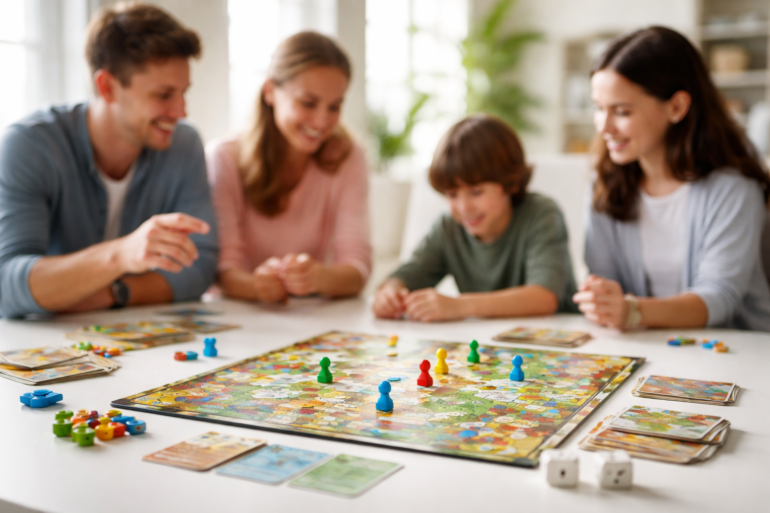
Finding the best board games for families is not really about buying the most expensive box or chasing the trendiest release. It is about choosing games that fit real life: different ages, short attention spans, loud opinions, busy evenings, and the need for something that feels genuinely fun for both kids and adults. The best family games do more than fill an hour. They create shared routines, spark laughter, build communication, and turn ordinary nights into something people remember. Play itself matters for child development and family connection, which is one reason pediatric and child-development experts consistently treat play as more than simple entertainment.
That is why family board games still matter, even in homes full of streaming apps, tablets, and nonstop schedules. The toy industry remains huge, with U.S. retail toy sales reaching $30.3 billion in 2025, and The Toy Association has also pointed to strong cross-generational demand for toys and games, including adults buying games for themselves. In other words, playing together is not old-fashioned. It is still very much part of modern family life.
The challenge, of course, is that not every family game is truly family-friendly in practice. Some are too complicated for younger players. Others are so simplistic that adults mentally check out after one round. The sweet spot sits somewhere in the middle: easy to learn, fun to replay, fast enough to keep the table moving, and flexible enough for different personalities.
What makes the best board games for families actually work?
A great family board game usually shares a few traits. First, the rules need to be clear. Nobody wants a 20-minute rules lecture before the fun begins. Second, turns should move quickly. Long waits are where younger players lose focus and adults start glancing at their phones. Third, the game should give everyone a real chance to participate, even if skill levels vary.
This does not mean every family game has to be ultra-light. Plenty of families enjoy strategy games. But the best ones usually keep the experience approachable. You want enough decision-making to make the game interesting, without making it feel like homework.
Good family games also create interaction. Some games do this through teamwork. Others do it through trading, guessing, racing, wordplay, or light competition. The common thread is that people stay engaged with one another, not just with the board in front of them.
That interactive piece matters more than people sometimes realize. Play supports social, emotional, and cognitive development, and shared play can strengthen parent-child relationships. It is one of the reasons family game night often feels more valuable than its simple setup suggests.
How to choose the right family board game for your household
Before picking from any “best of” list, think about your family’s real habits. A game that is brilliant for one household can flop in another.
If you have younger kids, look for games with visual cues, simple turns, and playtimes under 30 minutes. Children do better when they can quickly understand what they are trying to do and when they do not have to sit quietly for too long between actions. Research and expert guidance on play consistently point to the value of playful, engaging experiences for attention, learning, and social development.
If your family includes teens and adults, you can go a little deeper. In that case, games with strategy, hidden roles, route-building, team play, or bluffing often work well. The key is making sure younger or less experienced players still feel included.
It also helps to think in terms of energy level. Some board games are calm and thoughtful. Others are noisy, fast, and chaotic. Neither is automatically better. A quiet Sunday afternoon may call for something strategic. A Friday night after dinner may need something silly and high-energy.
One underrated factor is replay value. The best family games reveal something new each time. Maybe the board changes. Maybe players use different tactics. Maybe the rounds are short enough that losing once just makes everyone want to go again. That replayability is often what separates a one-time novelty from a shelf favorite.
The main types of family board games worth considering
When people search for the best board games for families, they are often searching for different things without realizing it. Breaking games into categories makes the choice much easier.
Classic family board games
These are the titles most people already recognize. They tend to be easy to teach and familiar across generations. Their strength is accessibility. Grandparents, parents, and kids can usually sit down and start without much friction.
The downside is that some classics can feel repetitive or overly dependent on luck. Still, when the goal is low-pressure togetherness, familiar games can be exactly right.
Strategy games for families
These are ideal for households that enjoy planning ahead, making choices, and thinking through consequences. Strategy games can be excellent for older kids because they create opportunities to practice patience, flexible thinking, and decision-making in a fun setting. Research on games and playful learning has linked game-based experiences with executive function skills such as working memory, attention, and self-control, though results vary depending on the game and the setting.
You do not need to jump straight into heavy hobby games. Many family-weight strategy titles are accessible enough for beginners while still giving adults something interesting to chew on.
Cooperative board games
These are a lifesaver for families who do not enjoy direct conflict. Instead of competing against one another, players work together against the game itself. This format is especially helpful when younger children get discouraged by losing or when siblings tend to take competition personally.
Co-op games also create a different kind of table talk. Instead of “I’m winning,” the mood becomes “What should we do next?” That can make game night feel less stressful and more inclusive.
Party-style family board games
These are often the easiest path to laughter. They usually involve drawing, guessing, acting, word association, or fast reactions. They are perfect for larger groups and gatherings because the rules are lighter and the pace is faster.
The trade-off is that they may not satisfy people who want deep strategy. But for birthdays, holidays, and mixed-age groups, they are often the safest pick.
Best board games for families by age group
Age labels on the box help, but they are not the whole story. Some kids can handle more complexity than expected, while some adults would honestly prefer something simpler.
Families with kids ages 4 to 7
At this stage, the best games focus on matching, memory, color recognition, simple counting, and turn-taking. Kids in this range need games that teach through doing, not through long explanations. A good early family game feels active and visual.
The ideal playtime is short. Think 10 to 20 minutes. If a game goes much longer, it needs enough excitement built in to justify it.
Families with kids ages 8 to 12
This is often the golden range for family board games. Kids are old enough to understand more rules, think ahead, and appreciate a little strategy, but they still enjoy playful themes and energetic interaction.
This is where many of the best board games for families shine. You can introduce set collection, tile placement, deduction, teamwork, and light engine-building without making the experience too dense.
Families with teens and adults
Now the door opens wider. You can play games with bluffing, negotiation, long-term planning, and more layered tactics. At this point, it often makes sense to choose games based on personality rather than age.
Does your family enjoy teasing and banter? Bluffing games may work. Prefer calm focus? Strategy games might land better. Want more warmth than competition? Cooperative games are often the answer.
What families usually get wrong when buying board games
One of the biggest mistakes is choosing a game based on popularity alone. A viral hit can still be a poor fit for your table. A great family game is not the one everybody else loves. It is the one your people ask to play again.
Another mistake is overestimating patience. Many families buy games that look smart and impressive but require too much setup, too many exceptions, or too much reading. The box gets opened once, then quietly disappears onto a high shelf.
Some families also focus too much on winning. The best board games for families are often the ones that make losing tolerable because the experience itself is enjoyable. If every round ends in tears, arguments, or boredom, the game is not a good fit, no matter how highly rated it is.
How to build a family game night that people actually stick with
The game itself matters, but the routine matters too. A family game night works best when it feels easy. Pick a regular time, keep snacks simple, and avoid turning the night into a production.
Start with shorter games, especially if the habit is new. A 20-minute game that ends with everyone smiling is better than a 90-minute marathon that feels like an obligation. Momentum matters. When people leave the table wanting one more round, you are doing it right.
It also helps to rotate who chooses the game. This keeps everyone invested and prevents one dominant player from shaping the entire experience. If you have a broad age range, alternate between skill-based games, luck-based games, and cooperative titles so everybody gets a turn with something that suits them.
You can even create small house rules to fit your family better. Some families remove harsher penalties. Others shorten the number of rounds. Purists may object, but game night is for your household, not for internet approval.
Why board games still matter in a screen-heavy world
One reason board games continue to resonate is that they create a shared physical space. Everyone is in the same room, responding in real time, reading faces, taking turns, and reacting together. That kind of presence is harder to replicate through passive entertainment.
Experts on child development and play have long emphasized that play helps children build relationships, resilience, and a range of social and emotional skills. While a board game is only one form of play, it fits beautifully into that larger picture because it combines rules, imagination, communication, and connection.
There is also a reason adults enjoy them. Games give structure to togetherness. Sometimes families want to spend time together but do not know what to do with that time. A board game solves the awkwardness. It gives everyone a shared goal and a shared language for the next hour.
A practical checklist for picking the best board games for families
If you want a quick way to narrow your options, ask these questions before buying:
- Can the rules be explained in under five minutes?
- Will all players stay involved between turns?
- Is the average playtime realistic for your household?
- Does the game suit your youngest regular player?
- Is it fun even if the same person does not win every time?
- Would your family ask to play it again next week?
If the answer is yes to most of those, you are probably looking at a strong contender.
Frequently asked questions about family board games
What are the best board games for families with mixed ages?
The best choice is usually a game with simple core rules and a little room for strategy. Mixed-age families benefit from games where younger players can participate without adults feeling under-stimulated. Cooperative games and light strategy games often work especially well.
Are board games actually good for kids?
They can be. Play supports learning, social development, and emotional growth, and games can reinforce skills like turn-taking, planning, memory, and communication when matched appropriately to a child’s age and temperament.
How many board games does a family really need?
Usually fewer than people think. A small, well-chosen collection is better than a closet full of boxes nobody opens. Many families do well with a balanced mix: one quick game, one cooperative game, one strategy game, and one louder party-style option.
What if my family says they do not like board games?
Often that means they do not like the games they have tried. The problem may be long rules, too much downtime, or the wrong energy for the group. The right game can completely change that response.
Conclusion
The best board games for families are the ones that make real life feel a little warmer, a little funnier, and a little more connected. They do not have to be complicated, expensive, or trendy. They just need to work at your table, with your people, in the time you actually have.
If you focus on clear rules, strong interaction, replay value, and the ages and personalities in your home, you will make better choices and get more value from every box you buy. Family game night is not about perfection. It is about showing up, laughing a little, competing or cooperating a little, and creating small rituals people remember.
Even the long history of board games points to the same idea: people keep coming back to them because shared play has lasting appeal. In a busy world, that simple kind of togetherness still matters.