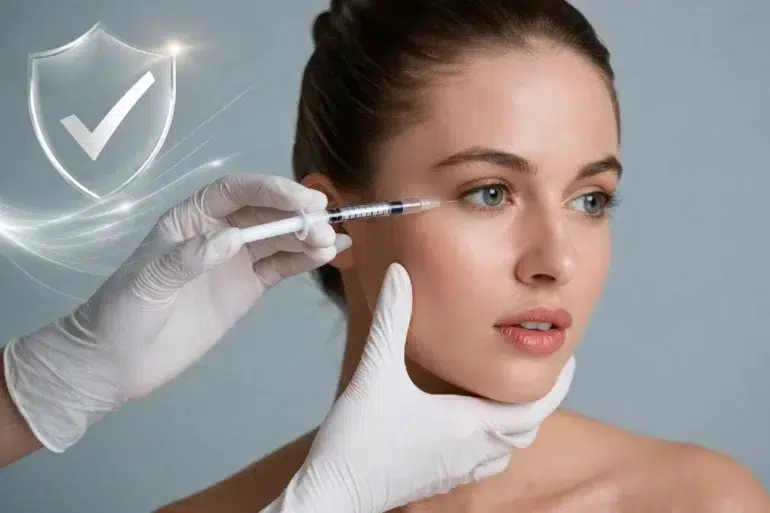
If you’re thinking about Botox Around Eyes, you’re probably asking a very reasonable question before anything else: is it actually safe?
The short answer is yes, Botox Around Eyes is generally considered safe when it is used in the right patient, at the right dose, and by a qualified medical professional who understands facial anatomy. The FDA-approved use of Botox Cosmetic includes treatment of lateral canthal lines, better known as crow’s feet, and the official prescribing information stresses both proper technique and proper patient selection.
That said, safe does not mean risk-free. The eye area is delicate. Small changes in muscle movement can affect more than just wrinkles. A treatment that softens crow’s feet beautifully in one person can trigger temporary eyelid heaviness, brow imbalance, dry eye symptoms, or an unnatural look in someone else if placement is off or the injector is inexperienced. The American Society of Plastic Surgeons notes that temporary facial weakness or drooping can happen, and the American Academy of Dermatology warns that injections done outside a medical setting can lead to serious complications.
This is where a lot of online confusion comes from. People hear that Botox Around Eyes is “simple,” “lunchtime,” or “totally harmless,” and they assume every injector offers the same level of safety. That is not true. The product matters, but the person holding the needle matters more.
So let’s talk honestly about how Botox Around Eyes works, what the real risks are, which myths need to go, and what experts want patients to know before they book.
What Botox Around Eyes actually does
Botox Around Eyes usually refers to injections placed near the outer corners of the eyes to soften crow’s feet. Botox Cosmetic is a purified form of onabotulinumtoxinA, a neuromodulator that temporarily reduces muscle activity. When the targeted muscles contract less, the overlying lines look softer, especially expression lines that appear when you smile or squint. The effect is temporary, and the American Academy of Dermatology says results typically last about three to four months, sometimes longer.
That sounds straightforward, but the anatomy is not. Around the eyes, the orbicularis oculi muscle helps with blinking and facial expression. Nearby muscles influence eyebrow position, eyelid movement, and overall eye symmetry. That means Botox Around Eyes is not just about erasing wrinkles. It is about balancing movement.
A skilled injector looks at more than static lines. They watch how you smile, whether one brow already sits higher than the other, whether you compensate with your forehead muscles, and whether you have a history of dry eyes, contact lens discomfort, eyelid surgery, or eyebrow heaviness. Those details can change both the treatment plan and the risk profile.
Is Botox Around Eyes safe?
In general, yes. Botox Around Eyes has a strong safety record when performed appropriately. The FDA-approved label specifically includes lateral canthal lines, and professional organizations such as the AAD and ASPS describe botulinum toxin injections as generally safe cosmetic treatments when performed by properly trained clinicians.
But safety depends on several variables:
- The injector’s training and experience
- The exact injection points
- The dose used
- Your anatomy
- Your medical history
- The authenticity and storage of the product
- Whether the treatment happens in a legitimate medical setting
The AAD is especially blunt on one point: buying botulinum toxin online or getting injected at a party, salon, home, or non-medical setting can be dangerous. It warns of serious complications, including long-term muscle paralysis, Bell’s palsy, and permanent eye damage in unsafe scenarios.
That distinction matters. When people say they had a “bad Botox experience,” the product often gets blamed. In reality, the problem may have been counterfeit product, poor technique, incorrect dose, bad candidacy screening, or unsafe settings.
Common risks of Botox Around Eyes
Most side effects from Botox Around Eyes are temporary and mild, but some are more bothersome than people expect. Here are the ones that come up most often.
1. Bruising, redness, and tenderness
These are the most routine short-term effects. A tiny needle still breaks the skin, so minor bruising, swelling, or soreness can happen. ASPS lists bruising, redness, pain at the injection site, headache, nausea, and flu-like symptoms among possible side effects.
For many people, these issues settle quickly. Still, the eye area bruises easily, especially if you take blood thinners, fish oil, certain supplements, or drink alcohol close to your appointment.
2. Eyelid droop or brow heaviness
This is one of the biggest worries with Botox Around Eyes, and for good reason. If the injected product affects nearby muscles in an unintended way, you can end up with a temporary droopy eyelid or a heavy, flattened brow. The FDA label includes ptosis and diplopia among symptoms associated with toxin effects, and ASPS notes temporary facial weakness or drooping as a known complication.
This does not mean every treatment near the eyes causes drooping. It means precision matters. Too much product, the wrong placement, or rubbing the area too soon can increase the chance of migration. ASPS specifically advises patients not to rub or massage treated areas because it can cause toxin migration and temporary weakness or drooping.
3. Dry eye symptoms and irritation
This risk gets less attention than drooping, but it matters. Because the eye area is so dependent on healthy blinking and tear film balance, Botox Around Eyes can sometimes worsen ocular surface symptoms in susceptible patients. The FDA label includes a warning section for dry eye in patients treated with Botox Cosmetic, and ophthalmology reporting on newer research has highlighted reduced tear production or worsened dry eye metrics after lateral canthal injections in some patients.
This does not mean Botox causes dry eye in everyone. It means people who already have dry eye, contact lens intolerance, meibomian gland dysfunction, or previous eye surgery should mention that before treatment. It is an important screening question, not a trivial detail.
4. Double vision or visual discomfort
Rarely, diffusion into nearby muscles can contribute to double vision or visual changes. The FDA prescribing information lists diplopia among possible toxin-related symptoms. That kind of side effect is uncommon in cosmetic use at labeled doses, but it is one more reason the eye area is not a place for casual injecting.
5. Unnatural facial expression
Not every bad result is a medical complication. Some are aesthetic complications. You might not get a droopy lid, but you may feel that your smile looks odd, your eyes look smaller, or your expression seems stiff. The AAD notes that skilled dermatologists aim to preserve natural facial expressions by weakening only targeted muscles without affecting others.
When Botox Around Eyes is overdone, the area can look flat rather than refreshed. That is often a planning problem, not a Botox problem.
6. Rare but serious systemic effects
The FDA maintains a boxed warning about distant spread of toxin effect for botulinum toxin products. The label says symptoms can include generalized weakness, ptosis, double vision, trouble swallowing, and breathing difficulties, reported hours to weeks after injection. It also notes that no definitive serious adverse event reports of distant spread have been associated with dermatologic use at labeled cosmetic doses, but the warning remains important.
For a typical cosmetic patient treated around the eyes with approved dosing, this is not the most likely outcome. Still, patients deserve full informed consent, not sugarcoating.
Who should be extra cautious?
Botox Around Eyes is not automatically off-limits for these groups, but extra care is warranted:
| Situation | Why it matters |
|---|---|
| Dry eye history | Treatment may worsen symptoms in some patients |
| Heavy upper lids or low brows | Small muscle changes can make heaviness more noticeable |
| Previous eyelid or brow surgery | Altered anatomy can change where product should be placed |
| Neuromuscular disorders | The FDA notes higher risk in susceptible patients |
| Infection at injection site | This is a formal contraindication |
| Known hypersensitivity to botulinum toxin components | Also a formal contraindication |
The FDA lists infection at the injection site and known hypersensitivity to botulinum toxin preparations or formulation components as contraindications. It also warns that patients with underlying conditions that predispose them to toxin-related symptoms may be at greater risk.
Pregnancy and breastfeeding questions come up a lot too. The decision there is usually conservative. Many injectors defer elective cosmetic treatments during pregnancy and lactation because cosmetic timing is not urgent and safety data remain limited.
Myths about Botox Around Eyes that need to stop
Myth 1: Botox Around Eyes is completely harmless
No cosmetic procedure is completely harmless. Botox Around Eyes is lower risk than surgery, but “minimally invasive” does not mean risk-free. The eye area is anatomy-dependent, and side effects can affect both appearance and comfort.
Myth 2: Anyone can inject it safely
This is one of the most dangerous myths online. The AAD explicitly warns against non-medical settings and black-market product. Safety depends on training, anatomy knowledge, sterile technique, and the ability to manage complications.
Myth 3: If it’s FDA-approved, there’s nothing to worry about
FDA approval matters, but it does not erase technique-related mistakes. Approval means the product has an established evidence base for specific indications and dosing. It does not guarantee every injector will use it well.
Myth 4: More units mean better results
Often, they do not. Around the eyes, more is not automatically better. Over-treatment can lead to heaviness, stiffness, asymmetry, or a smile that does not feel like you. The best cosmetic work is usually the work nobody notices.
Myth 5: Botox Around Eyes always causes frozen expressions
Not when it is done well. The AAD explains that trained injectors use enough product to relax targeted muscles while preserving natural facial movement.
What expert advice looks like in the real world
Experts tend to repeat the same practical advice because it works.
Choose the right professional
Look for someone with strong medical training, experience with periocular anatomy, and a consistent record of treating the eye area. Board-certified dermatologists, plastic surgeons, facial plastic surgeons, and oculoplastic surgeons are common choices, depending on the case and the local practice model. The safest provider is not the one with the flashiest social media page. It is the one who can assess anatomy, explain risks clearly, and say no when you are not a good candidate.
Be honest during the consultation
Tell them if you have:
- Dry eyes
- Eyelid droop
- Brow heaviness
- Contact lens discomfort
- Prior facial surgery
- Neurologic conditions
- Allergies
- A recent infection near the area
- Previous bad Botox experiences
Those details help shape safer placement and dosing.
Start conservative
For many patients, a lighter first treatment is smart. You can always add more later. Fixing an overtreated eye area is not as easy as topping up an undertreated one.
Follow aftercare exactly
Basic aftercare matters more than people think. ASPS advises patients not to rub or massage treated areas because migration can lead to weakness or drooping.
A reasonable approach after Botox Around Eyes usually includes:
- Avoid rubbing the area
- Skip aggressive facials for the day
- Hold off on intense exercise until your injector says it is fine
- Watch for unusual symptoms such as worsening eyelid droop, visual changes, trouble swallowing, or breathing issues
Know when to call your injector
Do not panic over every tiny bruise. Do call if you develop:
- Marked eyelid drooping
- New double vision
- Significant dry eye pain
- Trouble speaking, swallowing, or breathing
- Hives, swelling, or signs of allergic reaction
A realistic example
Imagine two patients, both asking for Botox Around Eyes because they hate crow’s feet in photos.
The first has healthy tear film, balanced brows, and no history of eyelid heaviness. A conservative treatment softens her smile lines without changing her natural expression.
The second already has mild dry eye and compensates for heavy upper lids by lifting the brows slightly when speaking. If the injector ignores that and treats too aggressively, her crow’s feet may improve, but her eyes may feel drier and her upper lids may look heavier afterward.
That difference is exactly why expert assessment matters. The treatment is the same category, but the safe plan is not identical.
How to make Botox Around Eyes safer for yourself
If you want the benefits while minimizing the downside, keep this checklist in mind:
- Choose a legitimate medical setting.
- Ask who is doing the injections and what their training is.
- Confirm the product is authentic and FDA-approved.
- Mention any eye symptoms, especially dryness or prior drooping.
- Ask for a conservative approach if it is your first time.
- Follow aftercare instructions closely.
- Book a follow-up if symmetry or comfort feels off.
That last point matters. Good injectors do not disappear after the appointment. They want to reassess the result, especially in a highly expressive area like this one.
The bottom line on Botox Around Eyes safety
Botox Around Eyes can be a safe and effective way to soften crow’s feet and refresh the eye area, but it is not a casual beauty add-on. It is a medical procedure. In the right hands, risks are usually mild and temporary. In the wrong hands, even a common treatment can create avoidable problems.
The biggest safety wins usually come from boring decisions that are easy to overlook: choosing a properly trained injector, being honest about your eye history, resisting bargain offers, and keeping your goals realistic. That is what separates a thoughtful treatment from a risky one.
If you remember only one thing, make it this: the safest Botox Around Eyes does not start with the syringe. It starts with assessment. A provider who understands the muscles around your eyes, your baseline lid position, and your tear film health is far more likely to give you a result that looks natural and feels comfortable.
And if you want to understand the science behind botulinum toxin, it helps to see why such a tiny dose can create such visible changes around one of the most delicate parts of the face.