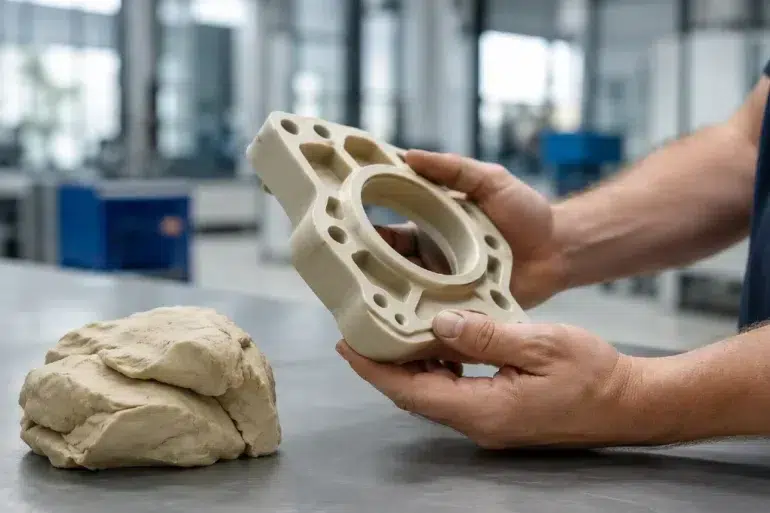
Dough Moulding Compound is one of those industrial materials that does not get much attention outside factories, yet it quietly supports many products people use every day. From electrical housings and automotive components to appliance parts and industrial enclosures, this composite material helps manufacturers create strong, heat-resistant, and dimensionally stable parts at scale.
In simple terms, Dough Moulding Compound is a ready-to-mold thermoset composite. It is commonly made with resin, short glass fibers, mineral fillers, catalysts, pigments, and additives. The material has a thick, dough-like consistency before molding, which is where the name comes from. Once molded and cured under heat and pressure, it becomes hard, durable, and resistant to many demanding working conditions.
For manufacturers, the real value is practical. Dough Moulding Compound can help reduce part weight, improve production consistency, support complex shapes, and deliver reliable performance in electrical, mechanical, and heat-exposed environments.
What Is Dough Moulding Compound?
Dough Moulding Compound is also known as DMC or, in many markets, Bulk Moulding Compound. It belongs to the wider family of fiber-reinforced thermoset composites. ScienceDirect describes BMC, also called DMC, as a mixture usually made from short glass fibers, resin, and additives, often supplied in bulk or rope-like form for handling during molding.
Unlike ordinary plastic pellets, this material is not melted and reshaped again and again. It is a thermoset material. That means once it is cured in the mold, it forms a permanent structure. Heat may soften many thermoplastics, but cured thermosets are designed to hold their shape under tougher conditions.
That is why manufacturers often choose it for parts that must stay stable under heat, pressure, vibration, chemicals, or electrical stress.
Why Modern Manufacturers Use Dough Moulding Compound
Manufacturing has changed a lot over the past few decades. Companies want parts that are lighter, stronger, cheaper to repeat, and easier to produce in large quantities. At the same time, buyers expect products to last longer and perform safely.
Dough Moulding Compound fits into this demand because it offers a good balance between strength, moldability, insulation, and cost control.
A metal part may be strong, but it can be heavy, conductive, and expensive to machine. A basic plastic part may be affordable, but it may not handle heat or stress well. DMC sits somewhere in between. It gives manufacturers a reinforced composite option that can be molded into practical shapes without losing the performance needed in demanding applications.
Common Ingredients Used in DMC
The exact formula varies by manufacturer and end use. A compound designed for electrical insulation will not always be the same as one designed for automotive lighting or appliance handles.
Still, most formulations include a few common ingredients:
| Component | Purpose in the Compound |
|---|---|
| Thermoset resin | Forms the main binding system |
| Short glass fibers | Add strength and stiffness |
| Mineral fillers | Improve stability, reduce shrinkage, and manage cost |
| Catalysts | Help the material cure during molding |
| Pigments | Add color or finish consistency |
| Release agents | Help molded parts separate from the tool |
| Additives | Improve flame resistance, surface quality, or flow |
The material is usually mixed into a thick mass before being processed. Depending on the production setup, it may be packed in bulk, logs, or pre-measured charges.
Dough Moulding Compound in Compression Molding
One of the most common uses of Dough Moulding Compound is compression molding. In this process, a measured amount of compound is placed into a heated mold. The mold closes, pressure spreads the material into the cavity, and heat cures it into the final shape.
This process works well for medium and high-volume production because the cycle can be consistent once the mold, temperature, pressure, and charge weight are properly set.
The Composites Knowledge Network notes that compression molding can use materials such as BMC, SMC, prepreg, and other resin-based compounds, with material prepared by designed volume and weight before molding.
For DMC parts, compression molding is useful when manufacturers need:
- Good dimensional stability
- Strong molded edges
- Low shrinkage
- Repeatable part quality
- Heat-resistant performance
- Smooth or semi-smooth surface finishes
- Complex shapes with ribs, bosses, and inserts
This is one reason the material appears in industrial and electrical components where shape accuracy matters.
Injection and Transfer Molding Uses
Although compression molding is common, Dough Moulding Compound can also be used in injection molding and transfer molding, depending on the grade and part design.
Injection molding with DMC is useful when smaller, more detailed parts are needed in larger volumes. The compound is pushed into a heated mold cavity, where it flows and cures. Transfer molding works somewhat differently, using pressure to transfer the material from a chamber into the mold.
These methods are often chosen when the part needs tighter details, insert molding, or improved production speed. However, the compound must be formulated properly so it flows without damaging fiber distribution or creating weak spots.
A poorly matched formulation can lead to filling issues, surface defects, or inconsistent strength. That is why material selection, tool design, and processing conditions matter just as much as the compound itself.
Electrical Applications of Dough Moulding Compound
Electrical manufacturing is one of the strongest areas for Dough Moulding Compound. Its insulating ability, heat resistance, and dimensional stability make it useful for parts that must protect people, circuits, and equipment.
Common electrical uses include:
- Switchgear parts
- Circuit breaker housings
- Fuse boxes
- Terminal blocks
- Electrical insulators
- Motor components
- Connector housings
- Control panel parts
- Distribution box components
Electrical parts need more than just strength. They must resist heat, prevent current leakage, and maintain shape under stress. In many cases, flame resistance is also important.
This is where DMC offers a practical advantage. It can be formulated with flame-retardant fillers and additives while still keeping good mechanical strength. For manufacturers making electrical parts in high volumes, that combination is valuable.
Automotive Uses in Modern Manufacturing
Automotive manufacturers are constantly looking for ways to reduce weight without giving up durability. While metals still dominate many structural areas, reinforced composites are widely used in selected parts where weight, heat resistance, corrosion resistance, and design flexibility matter.
Dough Moulding Compound can be found in parts such as:
- Headlamp reflectors
- Under-hood components
- Sensor housings
- Electrical covers
- Brackets
- Ignition system parts
- Interior technical parts
- Heat-resistant housings
Headlamp reflectors are a good example. These parts must handle heat, hold accurate shape, and support reflective surfaces. A material that shrinks too much or warps during use can create performance problems. DMC helps because it can offer low shrinkage and stable molded geometry.
It is not the answer for every automotive part, but for specific molded components, it gives engineers a strong design option.
Appliance and Consumer Product Applications
Many appliance parts face repeated use, heat exposure, moisture, and cleaning chemicals. Handles, housings, knobs, motor supports, and internal electrical parts may all need better durability than basic plastic can provide.
Dough Moulding Compound can be used in appliances such as:
- Washing machines
- Dryers
- Ovens
- Toasters
- Mixers
- Electrical kitchen devices
- Industrial cleaning machines
In these products, the material may help with heat resistance, insulation, surface durability, and part consistency. It also supports molded-in features, which can reduce secondary assembly steps.
For example, instead of machining or assembling several separate parts, manufacturers can design a molded part with ribs, mounting points, and inserts built into the shape. That can reduce production time and improve repeatability.
Industrial Equipment and Machinery Parts
Industrial environments are often harsh. Parts may face vibration, dust, chemicals, temperature changes, and continuous operation. In such conditions, material failure can become expensive quickly.
Dough Moulding Compound is used in industrial equipment where manufacturers need parts that are tough but still moldable. Examples include covers, guards, handles, bearing housings, motor insulation parts, and equipment panels.
Because the material can be compounded for chemical resistance and dimensional stability, it is often useful in factories, processing plants, and equipment systems where ordinary plastics may not last long enough.
The key advantage is not just strength. It is the combination of strength, heat resistance, corrosion resistance, and consistent molded production.
Why DMC Works Well for Complex Shapes
One of the biggest reasons manufacturers use Dough Moulding Compound is its ability to form complex parts. When heated and pressed correctly, the material flows into mold cavities and fills details that would be difficult or expensive to machine from metal.
Designers can include features like:
- Ribs for stiffness
- Bosses for screws
- Inserts for assembly
- Thin walls in selected areas
- Curved surfaces
- Electrical barriers
- Mounting points
- Textured surfaces
This design freedom can reduce part count. A single molded composite part may replace several metal or plastic components. That can simplify assembly and reduce errors on the production line.
Still, design must be realistic. Very thin sections, sharp corners, and long flow paths can create issues if the mold and compound are not properly matched. Good part design always considers material flow, fiber orientation, shrinkage, and curing behavior.
Strength, Heat Resistance, and Stability
Dough Moulding Compound is valued because it offers more than one type of performance. Short glass fibers improve stiffness and strength. Fillers can reduce shrinkage and improve dimensional stability. The thermoset resin system helps the part stay stable after curing.
According to Davies Molding, BMC is valued for strength, heat resistance, and chemical durability in compression and injection molding applications.
That does not mean every DMC grade performs the same way. A low-cost general-purpose grade will not match a high-performance electrical or heat-resistant formulation. Manufacturers need to select the right grade based on actual working conditions.
Important performance questions include:
- What temperature will the part face?
- Will it carry mechanical load?
- Does it need electrical insulation?
- Will it contact chemicals or moisture?
- Does the surface finish matter?
- Will the part need flame resistance?
- How tight are the dimensional tolerances?
Answering these questions early helps prevent material mismatch later.
DMC Compared With SMC and Thermoplastics
DMC is often compared with Sheet Moulding Compound, also known as SMC. Both are reinforced composite molding materials, but they are not the same.
SMC usually comes in sheet form and often uses longer fibers. That can make it better for larger structural panels. DMC has a dough-like bulk form and is often used for smaller or more detailed molded parts.
Compared with common thermoplastics, DMC usually offers better heat resistance and dimensional stability after curing. However, thermoplastics can be remelted and recycled more easily, while thermoset composites are more difficult to reprocess after curing.
Here is a simple comparison:
| Material Type | Best For | Key Limitation |
|---|---|---|
| DMC | Detailed, heat-resistant, electrical and industrial parts | Harder to recycle after curing |
| SMC | Larger panels and structural composite parts | Less suited for very small detailed parts |
| Thermoplastics | Fast production and recyclable plastic parts | May soften under higher heat |
| Metal | High strength and load-bearing uses | Heavier and may need machining |
For many manufacturers, the decision is not about which material is “best” in general. It is about which one fits the part, the process, and the performance target.
Real-World Scenario: Electrical Housing Production
Imagine a company producing electrical control housings for industrial equipment. The part must be strong enough to protect internal components, stable enough to hold terminals in place, and resistant enough to handle heat near operating machinery.
A basic plastic might reduce cost, but it may deform or fail under heat. Metal might be strong, but it adds weight and requires insulation planning. Dough Moulding Compound gives the manufacturer another route.
The company can mold the housing with internal ribs, screw bosses, cable paths, and insulation barriers. The final part can be strong, electrically insulating, and repeatable across thousands of units. That is exactly the kind of manufacturing problem where DMC can make sense.
Real-World Scenario: Automotive Lighting Parts
Automotive lighting parts need accuracy. If a reflector or housing changes shape during use, light performance can suffer. Heat from bulbs or nearby components can also create stress.
In this situation, a heat-resistant DMC grade may help maintain shape while allowing detailed molding. The part can be designed for mounting points, reflective surface preparation, and stable geometry.
This does not remove the need for testing. Automotive parts still require validation for heat aging, vibration, moisture, and dimensional performance. But the material gives engineers a proven path for certain demanding molded components.
Manufacturing Tips for Better DMC Parts
Good results with Dough Moulding Compound depend on more than buying the right material. Processing discipline matters.
Manufacturers should focus on:
- Accurate charge weight
- Consistent storage conditions
- Proper mold temperature
- Correct molding pressure
- Controlled cure time
- Clean tool surfaces
- Smart venting
- Balanced material flow
- Realistic wall thickness
- Proper insert placement
Moisture, poor storage, incorrect temperature, or uneven charge placement can cause defects. These may include voids, poor filling, surface marks, weak areas, or dimensional variation.
A good production team treats DMC as an engineered material, not just a molding paste. Small process changes can affect the final part.
Common Defects and How to Reduce Them
Like any manufacturing material, DMC can create defects when design or processing is not controlled.
Common issues include:
- Incomplete filling
- Surface blisters
- Flow marks
- Fiber exposure
- Cracking near inserts
- Warpage
- Poor surface finish
- Dimensional variation
Many of these problems can be reduced by improving mold design, adjusting temperature, controlling pressure, and choosing the correct compound grade. For example, if a part has long flow paths and thin ribs, the material may need better flow characteristics. If a part cracks around inserts, the insert design or local wall thickness may need adjustment.
The best results usually come when material suppliers, toolmakers, and production engineers work together before the mold is finalized.
Sustainability and Recycling Considerations
Sustainability is becoming more important in modern manufacturing. Thermoset composites like DMC have clear performance benefits, but recycling them is not as simple as recycling many thermoplastics.
Once cured, the material cannot be melted back into its original form. This creates challenges for end-of-life recovery. However, research is moving in a better direction.
A 2024 research paper from the University of Strathclyde found that bulk moulding compounds using recycled glass fibers could achieve mechanical properties acceptable for commercial implementation, although higher fiber content was needed in some cases.
This kind of development matters because manufacturers are under pressure to reduce waste, reuse materials, and lower environmental impact. Recycled fiber use may not solve every issue, but it shows that composite manufacturing is evolving.
When Should a Manufacturer Choose DMC?
Dough Moulding Compound is a strong choice when a part needs more performance than standard plastic but does not require the full strength or weight of metal.
It is especially useful when the part needs:
- Electrical insulation
- Heat resistance
- Corrosion resistance
- Dimensional stability
- Moderate to high production volume
- Detailed molded geometry
- Good strength-to-weight balance
- Consistent repeatability
It may not be the best choice for parts that need frequent recycling, extreme structural load-bearing performance, or very flexible behavior. Like all materials, it has a proper place.
Buying and Material Selection Factors
For industrial buyers, the biggest mistake is choosing only by price. A cheaper compound may work for a simple part, but it can fail in a demanding electrical, thermal, or mechanical environment.
Before selecting a DMC grade, buyers should ask suppliers for details such as:
- Resin system
- Glass fiber content
- Filler type
- Flame resistance rating
- Heat deflection performance
- Electrical insulation properties
- Shrinkage data
- Chemical resistance
- Recommended molding conditions
- Certifications or compliance documents
It is also smart to request test samples or trial production before committing to a large order. Real molding behavior often reveals things that a datasheet cannot show fully.
The Future of Dough Moulding Compound in Manufacturing
Modern manufacturing is moving toward lighter parts, better energy efficiency, and more reliable production. Dough Moulding Compound fits many of these goals because it supports durable molded parts without the weight and machining needs of metal.
The material will likely remain important in electrical components, industrial equipment, appliances, and selected automotive applications. Its future growth may also depend on better recycling methods, bio-based fillers, lower-emission resin systems, and improved process simulation.
Manufacturers are also becoming more careful about total cost. They are not just looking at material price. They are looking at tooling life, reject rates, cycle time, assembly savings, part performance, and long-term reliability.
That wider view is where DMC often proves its value.
Conclusion
Dough Moulding Compound plays a quiet but important role in modern manufacturing. It helps companies produce strong, heat-resistant, electrically insulating, and dimensionally stable parts for industries where ordinary materials may not perform well enough.
Its strength comes from balance. It is moldable but tough. It can form detailed shapes but still support demanding performance. It can reduce part weight while giving manufacturers consistency in production.
For electrical housings, automotive lighting parts, appliance components, and industrial equipment, Dough Moulding Compound remains a practical material choice. As manufacturing keeps moving toward lighter, smarter, and more reliable products, this thermoset composite will continue to matter in the world of composite materials.