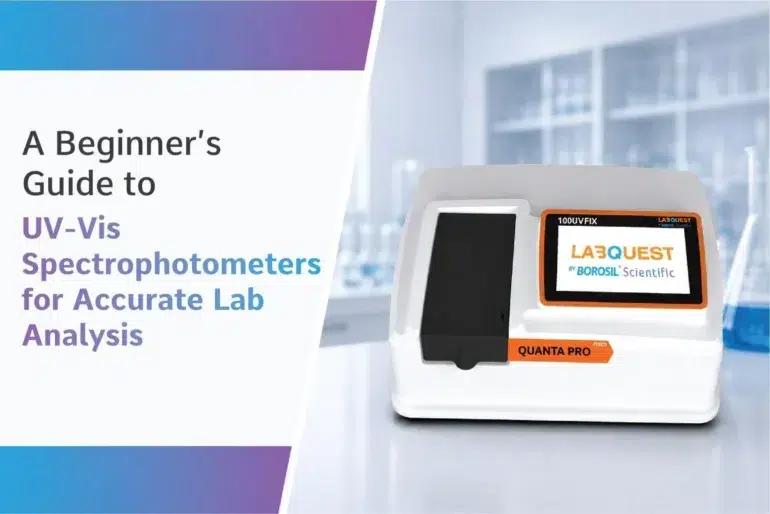
Ultraviolet-visible (UV-Vis) spectrophotometers have become a key technique in analytical laboratories. This technique is widely used in environmental science, chemistry, materials research and biology.
Let’s take a look at this guide to know about the fundamentals of UV visible spectrophotometers, their instrumentation and the best practices for precise and reliable results.
What is UV-Vis Spectrophotometry?
UV-Vis spectrophotometry measures the amount of ultraviolet (190 – 390 nm) and visible light (390 – 780 nm) a substance can absorb. When light passes through any sample, some of the wavelengths are transmitted, while some of them are absorbed. The absorption spectrum that comes as a result acts as a molecular fingerprint. This technique is used to determine concentrations and identify compounds.
What Are the Core Components of UV-Vis Spectrophotometers?
UV-visible spectrophotometers are made of many core components. The most important ones are as follows:
- Monochromator – This component selects specific wavelengths of light to pass through the sample.
- Light source – This is the most important component, which is a combination of deuterium (for UV) and tungsten-halogen (for visible) lamps.
- Sample holder (cuvette) – It is evident from the name that this component holds the sample. This is usually made from optical glass or quartz for complete transparency in the UV-Vis range.
- Detector – The detector plays a very important role in measuring the intensity of the transmitted light. It then converts the light into an electrical signal for further analysis.
All the above-mentioned core components work together to provide accurate and precise absorbance readings.
The Concept of Absorbance and Transmittance
To understand UV-Vis spectrophotometry, you must have a thorough knowledge and understanding of the key concepts, namely, Absorbance and Transmittance. Let us discuss the concepts briefly:
- Absorbance (A) – Absorbance is a measure of the amount of light that is absorbed by the sample. Absorbance is calculated using the formula A= -log10(T), where T stands for transmittance.
- Transmittance (T) – Transmittance is the fraction of light that passes through the sample. Denoted by the letter T, transmittance is expressed as T= I/I0, where I stands for the transmitted light intensity and I0 stands for the incident light intensity.
The obtained values help to determine the concentration of analytes in a sample.
Following the Best Practices for Accurate Measurements
To get accurate results from UV-visible spectrophotometers, it is essential to follow some best practices. Some of them are as follows:
- Sample preparation – The first thing to consider to get accurate measurements is the sample preparation. Ensure the sample is free from bubbles and particulates, as these can scatter light and result in inaccurate readings.
- Proper calibration – This is one of the most important things that you must never ignore for UV-Vis spectrophotometry. You must pay attention that the instrument is calibrated regularly using standard solutions. This helps to maintain accuracy.
- Baseline correction – It is best to use a blank solution to zero the instrument. This accounts closely for solvent absorbance.
- Cuvette handling – Handling the cuvette properly is important for getting accurate measurements. It is best to use scratch-free and clean cuvettes. To prevent fingerprints on the sample holder, handle it by the frosted sides.
Adhering to these simple practices reduces errors and enhances data quality significantly.
Interpretation of the UV-Vis Spectra
The UV-Vis spectrum displays wavelength vs. absorbance. The prominent features include:
- Peak Shape – Sharp or broad peaks indicate different molecular environments.
- λmax – This is the wavelength at which maximum absorbance takes place. This is specific to the molecule’s structure and characteristic of the particular compounds.
- Baseline Stability – If you notice a stable baseline in the results, it suggests good sample quality and instrument performance.
Analysing these aspects will help in purity assessment and compound identification.
Application of UV-Vis Spectrophotometry in Various Industries
UV-Vis spectrophotometry is versatile with its applications in various industries. Let us take a look at the important ones:
- Pharmaceutical industry – Rigorous analysis is mandatory for verifying the identity, concentration and purity of various drugs. It is also important to monitor the consistency and stability of the medications to guarantee their effectiveness over time under varying environmental conditions.
- Chemical industry – UV-Vis spectrophotometry is extensively used in the chemical industry. The process helps to determine chemical properties, study polymer composition, assess final product quality, determine purity and dyeing efficiency, analyse photocatalytic degradation, and much more.
- Food and beverage industry – The technique of UV-Vis spectrophotometry helps to assess food quality and composition, taking into consideration factors such as flavour, colour, and aroma. It provides consumer safety by employing analytical techniques for contaminant and adulterant identification.
- Biotechnology – UV-Vis spectrophotometry monitors microbial cell cultures, analyses biological samples like serum and blood plasma, determines purity and concentration of proteins and nucleic acids, studies protein kinetics and denaturation, and much more.
Conclusion
UV-Vis spectrophotometry has become an essential tool for quantitative and qualitative analysis in different scientific fields. And for that, it has become important to use the best quality UV visible spectrophotometers from premium suppliers like Borosil Scientific to get the most accurate results. Beginners must begin by learning the principles of the technique, best practices they can follow, and instrumentation, among others. With this knowledge, you can harness this technique for reliable and accurate laboratory analysis results.