A working prototype can create a false sense of progress. The board powers on, the firmware runs, and everyone starts talking about production. Then the BOM gets quoted, a key component goes out of stock, the PCB needs changes for assembly, and the manufacturing timeline suddenly stretches by weeks.
This gap between “it works” and “we can build 10,000 of them” is where many OEMs lose time.
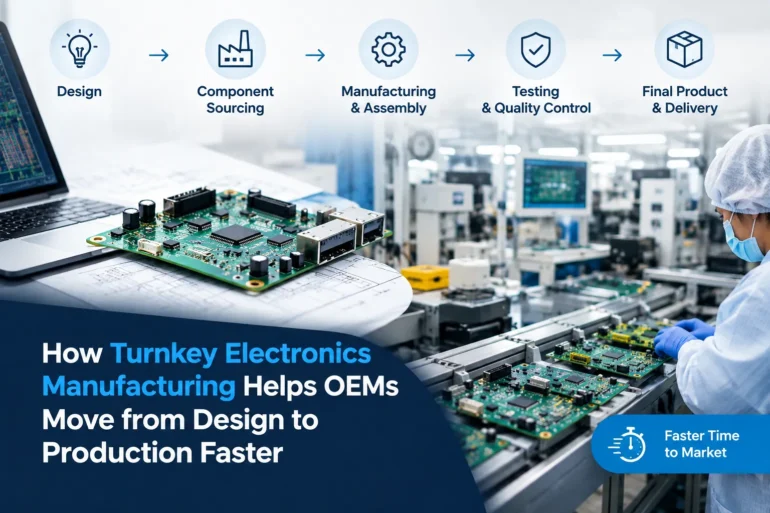
Turnkey electronics manufacturing helps close that gap by bringing design, sourcing, PCB manufacturing, assembly, testing, and production planning into a connected process. Instead of treating manufacturing as the final handoff, teams can account for production realities much earlier.
Why the jump from prototype to production gets complicated
Hardware development rarely moves in a straight line. A design decision made during engineering can affect procurement, assembly yield, cost, and launch dates.
Consider a simple example. An engineer selects a microcontroller based on performance and development convenience. Six months later, the part has a long lead time. Procurement suggests an alternative, but the replacement requires firmware changes and a PCB revision.
The original decision now has a much higher cost.
That is why new product development services that connect engineering with sourcing and manufacturing can be valuable. The goal is not simply to design a board faster. It is to make decisions that remain practical when the product enters volume production.
What changes when manufacturing starts early
A connected manufacturing workflow gives teams a chance to catch production problems before they become production delays.
A few areas matter most:
- BOM optimization: Recognize costly, old-fashioned, or hard-to-procure parts before the design is locked down.
- DFMA checks: DFMA principles may identify problems such as hard-to-place components, inadequate clearances, or superfluous assembly operations.
- Supply chain visibility: Early information on component availability, lead times, supplier options, and pricing makes production planning more realistic.
- PCB assembly readiness: Assembly process experts are able to evaluate the design based on the actual process instead of finding out the constraints during prototyping.
- Testing strategy: Functional testing, inspection, and test fixtures can be planned alongside the product rather than added at the end.
Individually, these details may seem minor. At production volumes, they can determine whether a product launches on schedule or spends another month in engineering.
Speed comes from avoiding rework
There is a common misconception that speed means moving quickly through each development stage. In hardware, speed often comes from reducing the number of times you have to go backwards.
For example, if a product team validates the BOM while the PCB is still being developed, it can discover that two components have poor availability. Replacing them at that stage is much easier than making changes after tooling, assembly programming, and production planning are underway.
The same principle applies to PCB assembly. A design may be electrically correct but still create unnecessary manufacturing complexity. A small change in component orientation, spacing, or package selection can sometimes improve assembly efficiency without affecting functionality.
This is where new product development services can support a more practical development process. Engineering decisions are made with cost, sourcing, manufacturing, and scale in view.
What to look for in a manufacturing partner
The right manufacturing partner can shorten the path to production. The wrong one can add another layer of coordination.
OEM teams should look for:
- Early manufacturing input: Reviews should happen before the design is locked, not only after the first production order.
- Component intelligence: BOM reviews should cover availability, lifecycle status, pricing, and viable alternatives.
- Integrated PCB capabilities: PCB fabrication and assembly should work from consistent design information and revision history.
- Defined testing processes: Functional testing and inspection requirements should be established before production.
- Production scalability: The prototype process should have a clear path toward pilot builds and larger volumes.
- Shared visibility: Engineering, procurement, and operations teams should not have to piece together project status from multiple vendors.
That last point is easy to underestimate. Every handoff creates opportunities for information to become outdated. A revised BOM may reach procurement but not the assembly partner. A sourcing issue may be known by purchasing while engineering continues developing around the original component.
A connected workflow reduces that friction.
When turnkey manufacturing makes the biggest difference
Turnkey electronics manufacturing is particularly useful when an OEM is moving from a validated prototype into pilot production or an initial market launch.
At this stage, the product is stable enough to build, but there are still unknowns. Component demand needs to be confirmed. Manufacturing yields need to be understood. Test procedures need validation. Suppliers need coordination.
Managing these activities through one connected workflow can reduce the load on a small hardware team. It also gives founders and product managers a clearer view of what is actually holding production back.
Elecbits connects engineering with the manufacturing journey
Elecbits is a full-stack electronics design and manufacturer, bringing product engineering and manufacturing activities together across component sourcing, PCB manufacturing, PCB assembly, testing, and production.
For an OEM moving from design to production, this connected approach helps teams address manufacturing constraints while the product is still being developed. BOM decisions can be reviewed with sourcing realities in mind, while manufacturing teams can work with engineering inputs earlier in the process.
Elecbits XOR, an AI-based BOM analysis solution, helps teams examine component availability, pricing, supplier information, and alternative parts. This gives engineering and procurement teams more information before a sourcing problem forces a redesign.
The broader value of new product development services lies in connecting these activities. When engineering, sourcing, and manufacturing operate with shared information, teams spend less time resolving preventable handoff issues and more time getting the product ready for market.
Summary
The true value in turnkey electronics manufacturing lies not only in having a single provider take on more roles. Rather, it is in the integration of engineering with procurement, manufacturing and assembly, and test realities at an earlier stage.
With electronics products becoming increasingly complicated, OEMs require manufacturing partners who can help even before there is a manufacturing order to be placed. When all these elements are combined, the teams are able to identify problems early, minimize rework, and get from validated design to volume production smoothly.