Picture a customer who texts your support line about a late order, gets no reply, calls the next morning, and has to explain the whole thing again to a person who has no idea the text ever happened. That gap is not a people problem. It is a plumbing problem. The channels do not communicate with each other, so the customer carries the memory the system should have retained.
The CPaaS platform market grew from about $23.5 billion in 2025 to a projected $31.37 billion in 2026, and analysts expect it to push past $97 billion by 2030 (The Business Research Company). A big chunk of that jump is being driven by one thing: businesses want AI baked into the way they message and support customers, not bolted on as an afterthought
This piece walks through what these platforms actually do, how AI changes the picture, where they earn their keep across industries, and how to size one up before you sign anything.
What a CPaaS Platform Actually Is
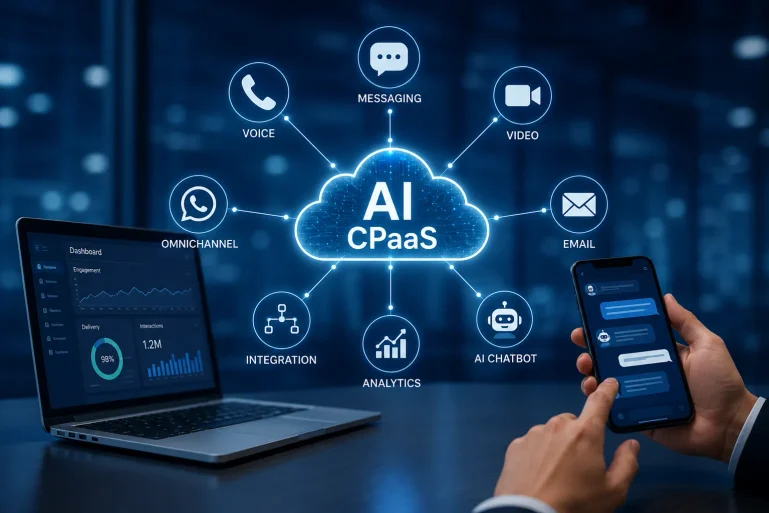
If you are wondering what is CPaaS, strip away the jargon, and a CPaaS platform is a cloud service that lets you drop communication features straight into your own apps, websites, and workflows. Instead of building SMS, voice, WhatsApp, or video from scratch, you pull them in through APIs and SDKs. If you have ever gotten a text when your integration delivered minutes out, or tapped a chat bubble on a website, you have used one without knowing it.
The value is simple. You skip the cost and headache of running your own telecom infrastructure. You scale up or down when you need to. And you reach people on the channel they already prefer instead of forcing them onto yours.
What separates modern CPaaS platforms from the early versions is intelligence. The first wave just moved messages from point A to point B. Today the smart ones read intent, route conversations, and act on what they learn. That shift, from pipes to brains, is the whole story.
How AI Changes the Role of Cloud Communication
AI is changing cloud communication from a system that simply connects businesses and customers into one that can understand interactions, make decisions, and support actions in real time.
- AI keeps customer conversations connected across WhatsApp, voice, chat, and other channels, so customers do not have to repeat the same information.
- Natural language processing helps AI understand customer intent, urgency, and sentiment, allowing businesses to respond in a more relevant way.
- AI can handle thousands of conversations simultaneously and around the clock, helping businesses manage higher volumes without increasing support staff at the same pace.
- AI can analyze communication and transaction patterns to identify unusual behavior and flag potential fraud or risks earlier.
- AI can automate repetitive communication tasks, allowing human teams to spend more time on complex customer issues and business decisions.
An AI-powered CPaaS platform can therefore do more than connect businesses with customers. It can understand interactions, maintain context, automate responses, and help teams deliver faster and more personalized experiences.
Where Communication Platforms Earn Their Keep Across Industries
The value of communication platforms becomes clearer when you see how different industries use them in day-to-day customer interactions. Each sector has different needs, but the goal remains the same: faster, more connected communication.
| Industry | Common Use Cases | Key Benefit |
| Banking & Financial Services | Balance alerts, loan updates, fraud warnings, KYC notifications | Faster customer communication and support |
| Healthcare | Appointment reminders, test-result notifications, remote check-ins | Better continuity of care and fewer missed appointments |
| Retail & E-commerce | Order tracking, returns, delivery updates, personalized offers | More convenient and engaging customer interactions |
| Logistics | Delivery updates, location sharing, delay alerts, rerouting notifications | Real-time visibility for senders and receivers |
| Telecom | Customer support, service updates, account notifications, white-label communication | Scalable communication across business customers |
Across these industries, the bigger advantage is connected communication. Instead of treating each channel as a separate system, businesses can bring conversations together and carry customer context across the journey.
How to Compare CPaaS Features for Omnichannel Customer Engagement
Choosing a CPaaS platform requires more than comparing feature lists. Follow these steps to check how well each platform handles channels, AI, workflows, pricing, scalability, and security in real-world use.
Step 1: Check If All Channels Share Customer Context
Check whether conversations continue smoothly when customers move between SMS, voice, WhatsApp, and chat without losing context.
Step 2: Check How AI Works Within the Platform
Find out if AI is built directly into the platform or depends on third-party tools for routing, automation, and customer interactions.
Step 3: Check If Teams Can Build Customer Journeys
Look for no-code or low-code tools that allow marketing and CX teams to create workflows without depending on developers.
Step 4: Compare Pricing and Additional Charges
Review the pricing model carefully, including conversation, usage, messaging, and channel-specific charges that could affect your overall costs.
Step 5: Check Security, Compliance, and Scalability
Review uptime, security certifications, compliance requirements, and platform capacity to ensure it can support your business as usage grows.
A CPaaS provider with multiple messaging channels is only the starting point. The right platform should bring those channels together while providing the AI, flexibility, and reliability needed for consistent customer engagement.
Choosing the Right Fit
There is no single Best CPaaS provider for enterprise business, and any vendor who claims to be that for everyone is selling. The right fit depends on your industry, your channel mix, your compliance needs, and how much you want your teams to build on their own.
If your customers live on WhatsApp, weigh messaging depth heavily. If you are in a regulated field, put security and compliance at the top. If speed matters, the no-code builder might be the feature that decides it. Start from your actual workflows and work backward to the platform, not the other way around.
Bottom Line
The move from simple messaging to intelligent, context-aware communication is not a trend that is coming. It is already here, and the market numbers make that plain. The businesses pulling ahead are the ones treating communication as one connected system rather than a pile of disconnected tools.
Platforms like Twixor sit in that shift, combining voice, WhatsApp, RCS, web chat, and SMS with agentic AI so a single conversation can move across channels without the customer ever repeating themselves. That is the practical version of the promise everyone else is still describing.
If you are weighing your options, the smartest first step is to map your own customer journeys and find the exact points where context gets dropped today. Fix those, and the rest of the decision gets a lot clearer.
FAQ
What is the difference between CPaaS and a regular messaging tool?
A regular messaging tool sends messages on one channel. A CPaaS platform lets you embed many channels, such as voice, SMS, and WhatsApp, directly into your own apps and connect them into one workflow, usually with AI handling routing and context.
Does adding AI to CPaaS require a technical team?
Not always. Many modern platforms include no-code journey builders, so your CX and marketing teams can design AI-driven conversations without writing code. Deeper custom work still benefits from developer involvement.
How do I know if a provider is truly omnichannel?
Test whether a conversation keeps its context when a customer switches from chat to voice or from WhatsApp to SMS. If the customer has to start over, it is multichannel, not omnichannel.
Which industries benefit most from AI-powered CPaaS?
Banking, healthcare, retail, logistics, and telecom see the clearest gains, mostly because they run high volumes of customer conversations that need to be fast, secure, and consistent across channels.
Is CPaaS cost-effective for mid-sized businesses?
Yes. Because it runs on the cloud and often uses usage-based pricing, you avoid heavy infrastructure costs and pay closer to what you actually use, which makes it workable well below enterprise scale.