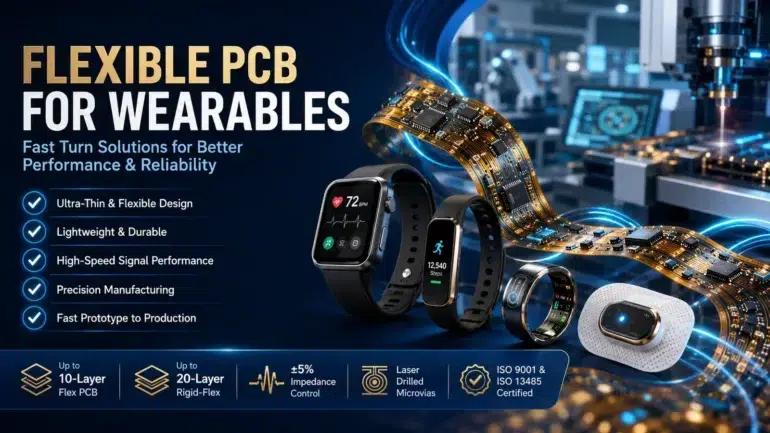
Wearable technology has changed the way people monitor their health, stay connected, and interact with smart devices. From fitness trackers and smartwatches to medical monitoring equipment and smart glasses, wearable electronics continue to become smaller, lighter, and more advanced. To achieve these compact designs, flexible PCB for wearables allows manufacturers to build bendable, space-efficient circuits without compromising performance or reliability.
Unlike traditional rigid circuit boards, flexible PCBs are designed to bend repeatedly while maintaining reliable electrical connections. This makes them ideal for wearable products that experience constant movement during everyday use. However, manufacturing flexible PCBs for wearable applications requires specialized materials, careful mechanical design, and strict quality control. Choosing an experienced manufacturing partner helps ensure wearable devices perform reliably throughout their service life.
Why Flexible PCBs Are Ideal for Wearables
Wearable devices are designed to be lightweight, comfortable, and durable. Traditional rigid circuit boards often cannot meet these requirements because they cannot adapt to the curved and moving surfaces found in wearable products.
Flexible PCBs solve these challenges by allowing designers to create products that are compact, lightweight, and mechanically reliable.
Some key advantages include:
- Thin and lightweight construction
- Ability to bend and flex
- Reduced need for connectors and cables
- Better resistance to vibration and repeated movement
- Greater design flexibility
These features make flexible PCB technology one of the most important foundations of modern wearable electronics.
Common Applications of Flexible PCBs
Flexible PCB technology is widely used in wearable and portable electronic products, including:
- Smartwatches
- Fitness trackers
- Health monitoring devices
- Smart glasses
- Wireless earbuds
- Wearable medical sensors
- GPS tracking devices
- Sports performance monitors
Many of these products are exposed to continuous movement, body heat, sweat, humidity, and changing environmental conditions, making long-term reliability a critical design requirement.
How Flexible PCBs Improve Performance
The design of a wearable device directly affects its comfort, durability, and overall performance.
Smaller Product Size
Because flexible circuits can bend around internal components, engineers can design thinner and more compact products without sacrificing functionality.
Better Reliability
Flexible PCBs reduce the number of connectors, cables, and solder joints inside a device. Fewer interconnections reduce potential failure points and improve long-term reliability.
Improved Durability Under Repeated Movement
Unlike rigid circuit boards, wearable electronics experience continuous bending and motion stress during normal use. Flexible PCBs are specifically designed to tolerate repeated bending cycles while maintaining stable electrical performance.
To improve durability, manufacturers often use rolled annealed (RA) copper, which offers greater flexibility and fatigue resistance than standard electrodeposited copper. RA copper helps copper traces withstand repeated flexing without cracking.
Flexible circuits also use coverlay instead of traditional solder mask to protect copper traces from moisture, abrasion, and mechanical damage while maintaining flexibility.
Where additional mechanical support is needed, stiffeners are added beneath connectors, components, or mounting areas. These reinforce selected portions of the circuit without affecting the flexibility of the bending sections.
Proper strain-relief design is equally important. Engineers carefully distribute mechanical stress around connector areas and transition zones to reduce fatigue and improve product lifespan.
Better Signal Performance
Shorter electrical connections help maintain stable signal transmission while reducing electrical interference, supporting reliable operation in compact wearable devices.
Why Fast Turnaround Matters
The wearable electronics market moves quickly. Companies must develop, test, and launch new products within increasingly shorter development cycles.
Choosing fast turn flex pcb services helps manufacturers accelerate product development while maintaining consistent manufacturing quality.
Some important benefits include:
Faster Prototype Development
Rapid production allows engineers to evaluate mechanical fit, bending performance, and electrical operation early in the development process.
Reduced Time to Market
Fast manufacturing shortens development schedules and helps companies introduce innovative wearable products more quickly.
Lower Development Costs
Early prototype evaluation helps identify design improvements before mass production, reducing expensive engineering changes later.
Greater Design Flexibility
Quick-turn manufacturing supports multiple prototype revisions, allowing engineers to optimize both mechanical durability and electrical performance before production begins.
Advanced Manufacturing Capabilities
Fast Turn PCB provides advanced flexible PCB manufacturing solutions for wearable electronics and other high-performance applications.
Its capabilities include:
- Flexible PCBs up to 10 layers
- Minimum line width and spacing of 2.5 mils
- Impedance control tolerance as tight as ±5%
- Minimum aspect ratio (board thickness to hole diameter) of 30:1
- ENIG, ENEPIG, and Hard Gold (50 µin) surface finishes
These capabilities help engineers develop compact wearable devices while maintaining reliable electrical performance.
Reliability Testing for Wearable Electronics
Because wearable devices experience constant movement and environmental exposure, comprehensive reliability testing is essential before production.
Manufacturers typically perform bend-cycle testing to verify that flexible circuits can withstand repeated bending without conductor fatigue or electrical failure.
Environmental reliability testing evaluates PCB performance under conditions such as elevated humidity, temperature changes, and sweat exposure, helping ensure dependable operation during everyday use.
For wearable medical products, manufacturing also requires strong traceability throughout the production process. Material batches, manufacturing records, inspection data, and test results should be documented to support quality management and regulatory requirements. While traceability is essential, product-specific claims such as biocompatibility should only be made when supported by certified materials and applicable standards.
Certified Quality Standards
Reliable wearable electronics require strict manufacturing standards.
Fast Turn PCB operates under internationally recognized quality systems, including:
- ISO9001 certification
- ISO13485 certification
- IPC Class 3 compliance
These certifications demonstrate the company’s commitment to consistent manufacturing quality for applications where reliability and precision are essential.
Why Engineers Choose Fast Turn PCB
Engineers developing wearable electronics need a manufacturing partner with expertise in flexible circuit design, material selection, and reliability control.
Fast Turn PCB supports projects from prototype development through production using precision fabrication processes, experienced engineering teams, and comprehensive quality management. By focusing on reliable flexible PCB manufacturing, controlled processes, and consistent inspection, the company helps customers develop wearable products that perform reliably in demanding real-world environments.
Conclusion
Wearable electronics continue to shape the future of personal technology, and flexible pcb for wearables plays a critical role in making these products smaller, lighter, and more reliable. Success depends not only on flexible circuit design but also on selecting suitable materials, protecting circuits against repeated bending, and verifying long-term environmental reliability.
With advanced flexible PCB manufacturing, RA copper construction, coverlay protection, precision fabrication, comprehensive reliability testing, and internationally recognized quality standards, Fast Turn PCB helps manufacturers develop wearable electronic products with greater confidence.
Visit fastturnpcbs.com today to explore professional flexible PCB manufacturing solutions and discover how its advanced capabilities can support your next wearable electronics project.